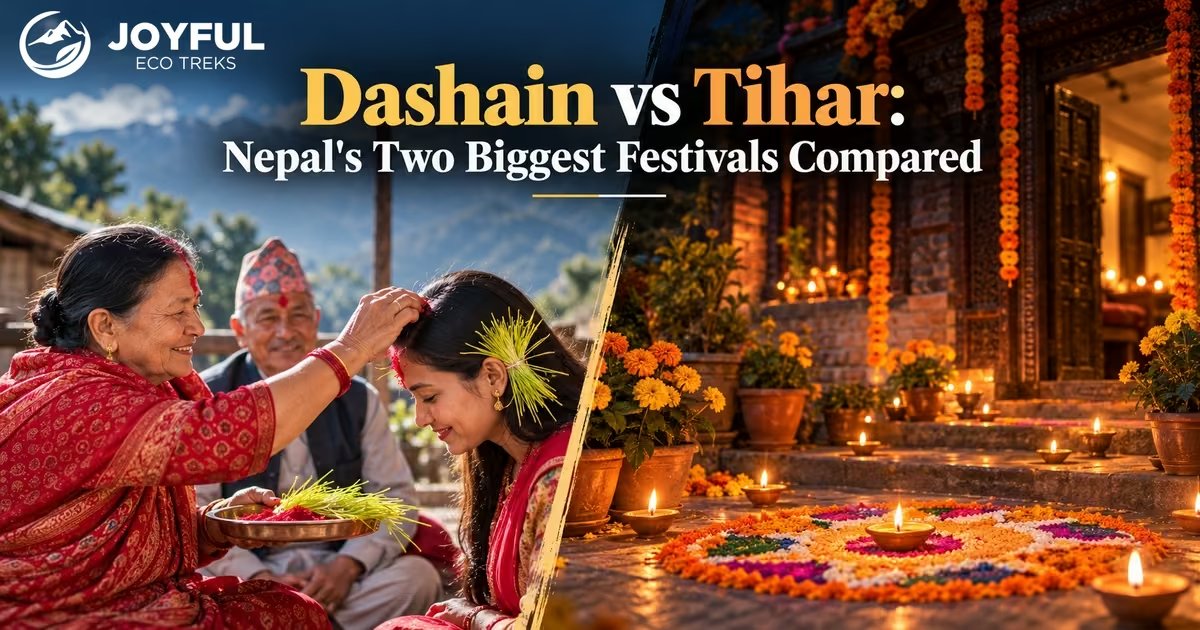
During Dashain, Kathmandu can feel half-abandoned. Shops shutter, the ring road goes quiet, and families board night buses toward ancestral villages some of them visit only once a year. Three weeks later, those same streets glow: oil lamps line every doorstep, teenagers move house to house singing Deusi Bhailo, and the city stays up past midnight. That swing from emptiness to illumination is the real story behind dashain vs tihar, Nepal's two largest festivals and the reason visitors so often plan around the wrong one.
Why Dashain and Tihar Feel Like Different Worlds
Both land in Nepal's autumn festival window only a few weeks apart, which is exactly why travelers assume they are variations on one theme. They are not. In 2026, Dashain peaks on Vijaya Dashami, October 21, while Tihar runs November 7 to 11. The short gap hides opposite social functions.
Dashain turns inward. Dashain is a family reunion built on blessings from elders and divine victory; its most important moments happen behind the walls of a home. Tihar turns outward. As a community celebration of wealth, light, and living relationships, much of it spills into the street where anyone can watch and, in places, take part.
Origins and Mythology: What Each Festival Celebrates
Dashain commemorates the goddess Durga's defeat of the buffalo demon Mahishasura, a victory of divine order over chaos retold across fifteen days, from Ghatasthapana on October 11 to Kojagrat Purnima on October 25. The whole arc builds toward day ten, Vijaya Dashami, when elders press a tika of rice, yogurt, and vermilion onto the foreheads of younger relatives and hand down jamara, the barley shoots sown on the first day. The day-by-day sequence is its own subject; our 15 Days of Dashain guide walks through each one.
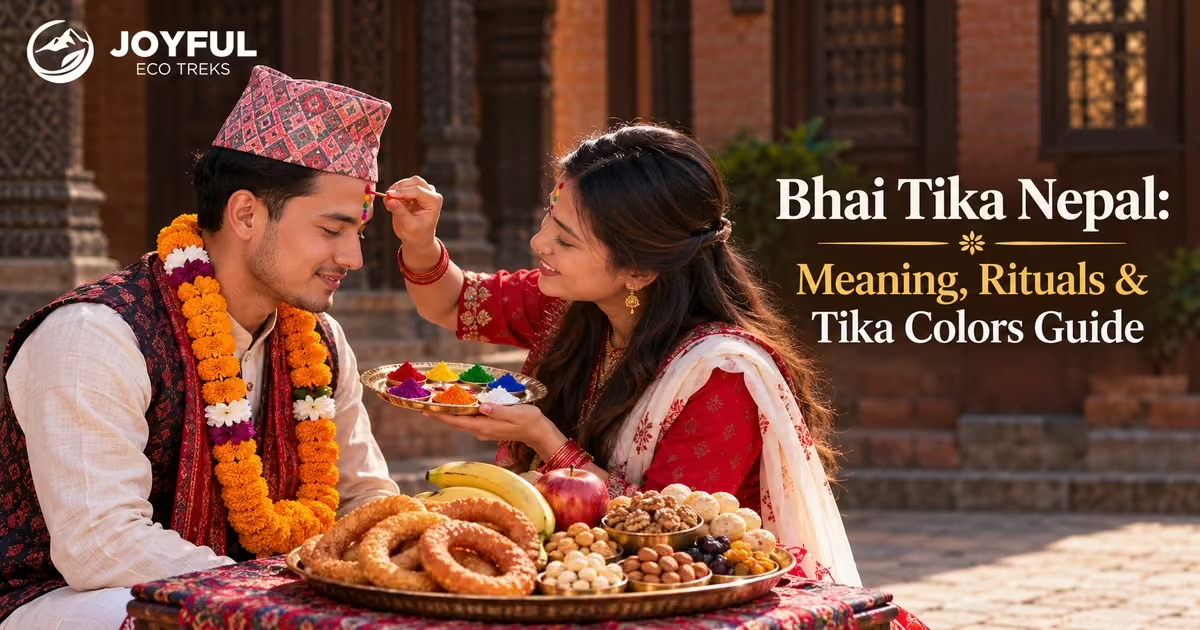
Tihar works differently. Also called Yamapanchak, the Five Days of Yama, it honors crows, dogs, cows, oxen, the self, and the bond between siblings, alongside worship of the goddess Laxmi. There is no single epic here. It is a sequence of relationships that ends not with a god but with Bhai Tika on day five, November 11, when living brothers and sisters sit across from each other while sisters apply a seven-color tika and exchange blessings. That closing ritual gives the festival a distinctive focus on the living sibling bond.
Scale, Duration, and National Weight
Dashain's grip on the calendar is structural, not only sentimental. Nepal's gazetted public holiday schedule grants seven consecutive days for Dashain in 2026, from Fulpati on October 17 through Dwadashi on October 23, making it the country's longest consecutive public holiday block. Tihar receives five consecutive gazetted days, from November 8 to 12.
That difference drives everything downstream. A week-long official shutdown converts a cultural homecoming into a nationwide migration, while Tihar's shorter, five-day block also brings closures even as public celebrations keep streets lively.
Atmosphere on the Ground: Exodus vs Festival of Lights
The seven-day block does something a shorter holiday cannot: it drains the capital. With offices and schools closed for a full week, Kathmandu's large population of internal migrants heads home to the hills and the Tarai all at once. A traveler expecting ordinary city life during Dashain's peak instead finds shuttered restaurants, dark offices, and intercity buses booked solid. For a precise read on what stays open, see our guide to traveling during Dashain.
Tihar inverts the picture, and the contrast is sharpest at night. Thresholds carry rangoli, rooftops and railings carry strings of lamps, and groups of singers work door to door. Laxmi Puja night, November 8 in 2026, is the single most visually spectacular evening of either festival, when households line every entrance with diyas to draw in the goddess of wealth.
Communities and Traditions: Who Celebrates and How
One Dashain tradition has no Tihar equivalent, and visitors should know about it in advance. During Navaratri, animals are offered to Durga; at the Hanuman Dhoka Taleju temple complex, reporting documents a Kalratri ritual involving 54 buffaloes and 54 goats on Maha Ashtami. Some sacrifices also occur outside major temple courtyards, so visitors who prefer not to witness them should ask local guides where ceremonies may take place.
Dashain is also not universally embraced. Since at least the early 1990s, some Adivasi Janajati activists have criticized the festival as an expression of Hindu cultural dominance, and documented boycott movements exist. Dashain is sometimes described as something all Nepalis celebrate; the honest picture is more layered.
Tihar's community traditions are distinctive, for two reasons. First, Kukur Tihar on day two, November 8, when dogs are honored with garlands and tika, is often visible to visitors, though joining a ceremony or interacting with a dog calls for permission. Second, Mha Puja on November 10 is observed by both Hindus and Buddhists; each family member sits before a personalized eight-petaled mandala of colored powders, rice, and lentils while the household's senior woman applies tilak and hands out sacred thread and fruit. That same day opens Nepal Sambat year 1147, the turn of the Newar lunar calendar, giving Tihar a distinct civic dimension. The Newar form of the festival, Swanti, falls within the wider Tihar period, with Laxmi Puja, Mha Puja, and Kija Puja forming its three central celebration days across Newar Hindu and Buddhist traditions.
Dashain vs Tihar: A Six-Criterion Comparison
This matrix places the two festivals side by side against the criteria a traveler actually decides on.
Criterion | Dashain | Tihar | Better suited to |
|---|---|---|---|
Religious meaning | Durga's victory over Mahishasura, plus an ancestral blessing | Worship of animals, Laxmi, the self, and sibling bonds | A single epic myth leans Dashain |
National holiday (2026) | 7 consecutive gazetted days, October 17 to 23 | 5 consecutive gazetted days, November 8 to 12 | Check travel bookings for both |
City atmosphere | The capital empties; many businesses close | Streets glow with lamps, rangoli, and singing | An urban experience leans Tihar |
Community breadth | Durga-centered; Mohani Nakha among Newars | Includes Swanti and Mha Puja among Newars | Both have diverse community traditions |
Peak single moment | Vijaya Dashami tika, October 21 | Laxmi Puja night of lamps, November 8 | Emotion leans Dashain, spectacle leans Tihar |
Logistics impact | High disruption, transport booked out | Public festivities; some services also close | Check transport and business hours for both |
Dashain: When Family Ritual and Blessing Are the Draw
Choose Dashain if the texture of family ritual and the weight of a blessing passed down a generation are what pull you to Nepal. Vijaya Dashami is the most emotionally charged single day in the Nepali year, and even observed from the edge, it carries weight.
Accept the trade-offs. The tika ceremony is an intimate family rite, not a public event, so you will mostly witness rather than join. Cities thin out, good food gets harder to find, and transport demands booking well ahead. If the animal sacrifices trouble you, ask local guides where ceremonies may occur before planning temple visits.
Tihar: When Lights, Music, and Open Streets Win
Choose Tihar if you want a festival you can see, hear, and step into. The streets stay busy, the lamps make even an ordinary alley worth photographing, and Kukur Tihar offers rituals you can witness, with opportunities to join when hosts welcome you.
Tihar also rewards an urban base. Where Dashain scatters people to villages, Tihar concentrates its energy in cities precisely when you are likely to be in one, and Nepal Sambat adds a layer that reaches beyond the Hindu calendar. Our Tihar 2026 guide maps the best places to see the lights and covers each of the five evenings.
Choosing Between Dashain and Tihar on One Trip
For most travelers, the dashain vs tihar question is not which festival is better but which one fits your window and your temperament. In 2026 the two peaks sit eighteen days apart, so an extended autumn trip spanning late October into mid-November can genuinely take in both.
If your Nepal window is fixed around Vijaya Dashami
Build the cultural half of your trip around October 21 and consider trekking during the surrounding week if logistics are arranged in advance. October is still a popular trekking month, so book guides, accommodation, permits, and transport ahead; our guide to trekking during Dashain and Tihar focuses on this window.
If your dates fall closer to Laxmi Puja night
Stay urban. Base yourself in Kathmandu or Patan for early-to-mid November, plan your evenings around November 8, and read up on local custom before you join anything; our Nepal festival etiquette guide covers what to do and what to avoid.
Once you know which festival matches your dates, go deeper: the full Dashain 2026 covers tika timing and visitor etiquette, and Tihar 2026 guide maps out each of the five nights with what to expect on the ground.
Dashain vs Tihar: Common Questions From Nepal Visitors
Is Dashain or Tihar more important to Nepalis?
Dashain is generally treated as Nepal's single most important festival, carrying the longest holiday and the deepest family obligation. That ranking is not universal: Newar communities also observe Dashain through Mohani Nakha and Tihar through Swanti and Mha Puja, and some Janajati communities deliberately hold Dashain at a distance.
Do Dashain and Tihar fall in the same week?
No. In 2026, Dashain peaks on October 21 and Tihar runs November 7 to 11, with Laxmi Puja falling eighteen days after Vijaya Dashami. Anyone planning around dashain and tihar 2026 should budget for two separate windows, not one.
Which festival is easier for visitors to join?
Tihar, clearly. Kukur Tihar and the door-to-door Deusi Bhailo singing happen in public and welcome onlookers, and the lamp-lit streets are open to everyone. Dashain's defining moment, the Vijaya Dashami tika blessing, happens inside the family and is harder for an outsider to do more than respectfully observe. Ask permission before joining private ceremonies or interacting with animals.
Do Newars and Buddhists celebrate them like Hindus?
Not identically. Tihar's Newar form is Swanti, marked by both Hindus and Buddhists, and its Mha Puja ritual runs across both traditions. Dashain is also observed through Mohani Nakha by Newar Hindus and Buddhists; some Adivasi Janajati activists have criticized its association with Hindu cultural dominance since at least the early 1990s, so participation varies across communities.
Can one Nepal trip include both Dashain and Tihar?
Yes, with time and planning. Because the peaks fall eighteen days apart in 2026, a single autumn trip spanning late October into mid-November can take in both Vijaya Dashami and Laxmi Puja night. Check the dedicated Dashain 2026 and Tihar 2026 date guides to lock your itinerary to the exact days.