Count the full arc and you get fifteen days of Dashain, yet nearly every travel guide describes only three: the seed-planting on Day 1, the procession on Day 7, and the forehead blessing on Day 10. The other twelve are not filler. Two stretches in particular, the quiet household days in the middle and the full-moon close on the fifteenth, carry the rituals that explain why the whole thing holds together as one ceremony rather than a run of separate events.
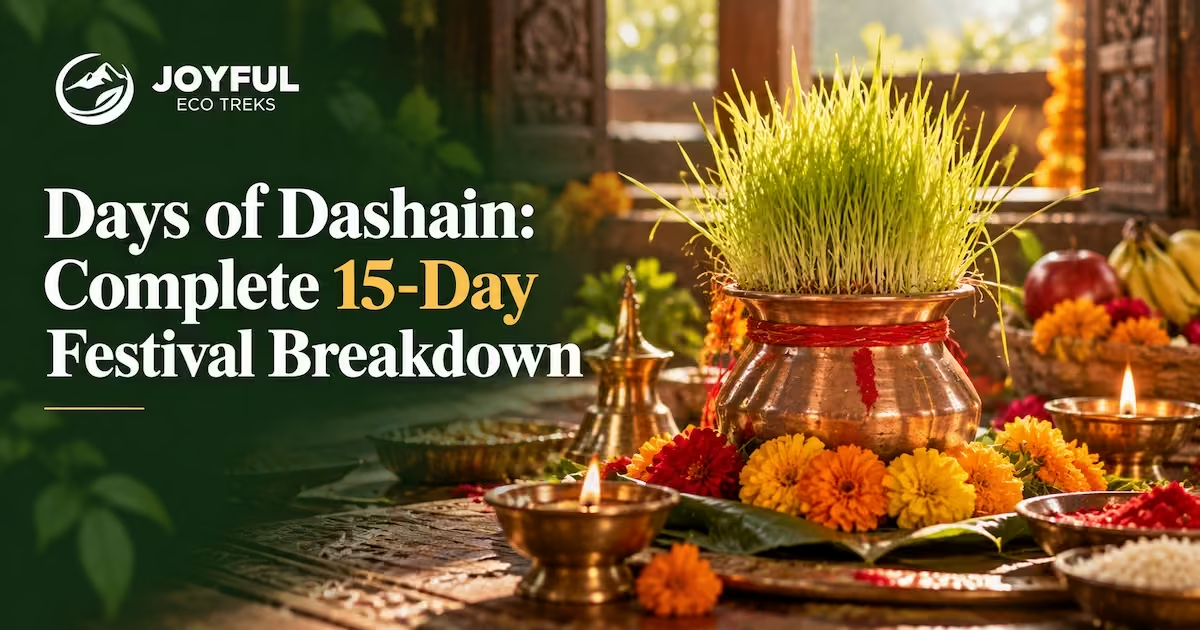
A single object ties all fifteen days of Dashain into one continuous rite: a tray of pale barley seedlings called jamara. Sown in a dark room on the first morning, worn on the foreheads of a whole family on the tenth, and carried to a river on the fifteenth, that tray turns the festival into something closer to a plant on a two-week schedule than a checklist of ceremonies. If you are already committed to being in Nepal for this window, knowing what each day does is the difference between catching a few photogenic moments and reading the logic underneath them.
Why Dashain Runs for 15 Days, Not 10
The fifteen days of Dashain divide into three movements: a nine-day build toward the goddess, the tika day itself, and a five-day close. Vijaya Dashami, the day outsiders think of as "Dashain," falls only on Day 10. The festival opens nine days before it and runs five days past it, a shape that comes straight from the lunar calendar.
The Shukla Paksha Lunar Fortnight That Sets the Calendar
Hindu lunar months split into two halves of roughly fifteen lunar days each. Shukla Paksha is the bright half, the waxing stretch from the new moon to the full moon. Dashain occupies that entire bright fortnight: beginning on the first lunar day (Pratipada) and ending on the full moon (Purnima). Fifteen lunar tithis traditionally frame the festival, though they do not always correspond one-to-one with calendar dates. The count follows the moon, which is why the festival extends beyond the ten days most guides describe.
How the Ashwin Month Anchors the Festival Window
The bright fortnight in question belongs to Ashwin, the lunar month falling across September and October. Because a lunar year runs about eleven days short of the solar one, the Gregorian date slides earlier each year until a leap month resets it, so Dashain lands anywhere from late September to late October. The authority resolving that drift is the Panchang, the lunar almanac, and it decides far more than the start date, as Day 10 will show.
Day 1, Ghatasthapana: Planting the Festival's Living Core
Ghatasthapana in Nepal is the day the festival gets literally planted. The name means "establishing the pot," and everything that follows for two weeks grows out of what happens in a single room this morning.
The Clay Kalash, Barley Seeds, and the Jamara Bed
A clay pot, the kalash, fills with holy water and gets set in a bed of sand inside the home's shrine room. Around it, the household sows barley and, in some family traditions, other grains such as wheat, paddy, or maize. Barley matters most to the eye, because its shoots become the jamara. Kept in darkness and watered daily, the seedlings grow deprived of sunlight into long, pale yellow blades rather than green ones. That tray is the living core of the festival, and it reappears on Day 10 and again on Day 15.
Auspicious Timing: Why Households Call a Priest for This One
A family does not sow at a convenient hour. The sowing has an auspicious window, a muhurta, fixed by the Panchang for that year, and many households bring in a priest to perform the establishment at the prescribed moment. The shrine room is then kept dim and undisturbed, watered daily, often screened from direct light entirely. For a ritual that produces nothing visible to an outsider, it draws unusual care, which tells you how much weight the next fourteen days place on it.
Days 2 to 6: What Nepali Homes Do During the Quieter Days
Walk through Kathmandu on Day 3 and you might conclude the festival has stalled. Major processions may be absent, but devotees still visit Durga temples and Shakti Peeths. The quieter rhythm carries real ritual weight.
Daily Durga Worship in the Household Puja Room
These days have their own names in the almanac: Dwitiya, Tritiya, Chaturthi, Panchami, and Shashthi, running from the second tithi to the sixth. Together with the days around them, they form the Nepali observance of Navaratri, the nine nights, in which each day honors one of the nine forms of the goddess Durga in sequence. Worship happens in the household puja room, built around the kalash and jamara from Day 1. So the quiet days amount to a slow, deliberate invocation, one goddess-form at a time, winding toward the fierce forms worshipped on Days 8 and 9. The home remains central, even as temple worship continues beyond its walls.
House Cleaning, New Clothes, and the Accumulating Sacred Space
The practical life of the festival fills these same days. Homes get scrubbed and whitewashed, debts get settled, and almost everyone buys new clothes to wear for tika. Markets stay frantic even while the rituals stay indoors. By the sixth day, Shashthi, many families perform a rite welcoming the goddess into the home, and the shrine has been gathering daily offerings for most of a week. A traveler sees shopping; the household sees a space being readied for the deity who, by tradition, arrives in force the next day from Gorkha.
Day 7, Phulpati: Sacred Plants Travel from Gorkha to Kathmandu
Phulpati in Nepal is the day the preparation breaks out of the house and into the street, and it marks one of the first major public ceremonies a visitor can watch. The name translates loosely as "sacred leaves and flowers," which badly undersells what the procession carries.
What the Palanquin Carries and Why It Starts in Gorkha
The centerpiece is the Navapatrika, a bundle of nine plants, each understood to house a specific goddess: the banana plant (Brahmani), pomegranate (Raktadantika), paddy (Lakshmi), turmeric (Durga), mana plant (Chamunda), sugarcane (Kalika), bel leaves (Shiva), ashoka flower (Shokarahita), and the jayanti plant (Kartiki). Bound in red cloth alongside a royal kalash, khar grass, and the festival's own jamara, these are not decorative flowers but nine deities travelling together. The journey begins at Gorkha Durbar, the ancestral seat of the dynasty that unified Nepal, covering well over a hundred kilometres down to the capital. The route matters as much as the cargo: the goddess travels from the nation's old royal cradle to its ceremonial heart.
The Hanuman Dhoka Arrival Ceremony Visitors Can Watch
When the Phulpati reaches Kathmandu, an army salute at Tundikhel, cannon and all, receives it before it moves to the Dashain Ghar at Hanuman Dhoka in the old Durbar Square. The goddess is then installed in the Mulchok courtyard of the palace. This is a rare day when the state ceremony is both public and legible: you can stand at Tundikhel or in the square and watch a procession whose meaning you now understand. If your itinerary allows only a couple of fixed days in the Valley, this is one of two worth anchoring to; the other comes next. The surrounding squares deserve their own afternoon, and our guide to things to do in Kathmandu maps them out.
Day 8, Maha Ashtami: The Fierce Form of Durga and a Midnight Vigil
Maha Ashtami turns the festival toward Durga's fiercest aspect, operating on two clocks that outsiders routinely blur into one. Reading maha ashtami and maha navami in Nepal as a linked pair, one running into the next through the night, is the key to the most intense stretch of the fortnight.
Kaal Ratri Worship: What It Involves
Kaal Ratri, the dark night, is marked by special worship during Maha Ashtami, with some rites continuing through the night toward Navami. Families may worship Chamunda, the ferocious form of the goddess, at home, while temples and ceremonial institutions hold their own observances. The timing and form of these rituals vary, so midnight worship should not be treated as an exclusively private household practice. Guides that describe only "fierce Kali worship" on Ashtami collapse two very different rituals into one label.
Morning Sacrifice at Hanuman Dhoka and Beyond Dakshinkali
The public, bloody dimension is also visible during Maha Ashtami and Maha Navami. Animal sacrifice to the goddess takes place in temple courtyards across the Valley, including Hanuman Dhoka, and at the well-known Dakshinkali temple. Worth correcting here: sacrifice is not confined to Dakshinkali. Household offerings and temple ceremonies follow different local schedules. For visitors this is the most confronting day of Dashain, and it deserves a decision made in advance rather than stumbled into. If you choose to observe, read our notes on religious site etiquette in Nepal first.
Day 9, Maha Navami: The Day Vehicles and Tools Get Worshipped
For any traveler able to time presence to a single day of the festival, Maha Navami is that day. Three distinct spectacles layer on top of each other, and two of them spill into the street.
Vehicle and Tool Worship Across Nepal
Maha Navami is associated with worshipping the things Nepal works with, including vehicles, weapons, tools, and machinery. Vishwakarma Puja has similar practices but is a separate festival observed on its own date. Taxis and buses carry marigold garlands across the windscreen and a red tika on the bonnet. Workshops anoint their lathes, farmers their ploughs, offices their generators, kitchens their knives. For one day, the country's entire stock of machinery lines up for a blessing, and a walk down any street becomes a parade of garlanded vehicles. It is the most quietly photogenic ritual in the whole fortnight and the easiest for a visitor to witness without intruding on anything private.
The Kot Courtyard Ritual and the Taleju Bhawani Opening
Two older rituals crown the day. In the Kot courtyard at Hanuman Dhoka, the army performs the formal state sacrifice, a ceremony with deep military and historical roots. Nearby, the Taleju Bhawani temple opens for its one day each year. Taleju is historically associated with the Malla kings and Kathmandu Valley worship traditions and ordinarily sealed to the public, so the Maha Navami opening draws enormous queues of Hindu worshippers. Access is limited and conditions shift year to year, so confirm current entry rules locally rather than assuming; the once-a-year window is real, the terms are not fixed.
Day 10, Vijaya Dashami: Tika, Jamara, and the Family Hierarchy
Vijaya Dashami is the day the whole country sits down to receive tika, and it is where that tray of jamara from Day 1 finally does its work. The ritual itself, the etiquette, and a visitor's place in it are covered in depth in our dedicated Vijaya Dashami guide, so what follows is the structural logic rather than the protocol.
How the Tika Sequence Moves Through a Nepali Family
Elders apply a paste of rice, yogurt, and red vermilion to the foreheads of everyone younger, press sprigs of pale jamara above the ear or into the hair, and hand over dakshina, a small cash blessing. Elders typically bless younger family members, though the sequence varies between households and communities. Those pale shoots were sown in the dark on Day 1 and grown for exactly this moment. The forehead blessing is the Day 1 seed completing its arc, the single clearest proof that Dashain is one ritual and not ten.
What Sets Dashami Tika Timing Apart
One detail catches careful planners. The tika ritual is not restricted to a single clock time. Each year the Panchang announces a recommended auspicious moment, and it moves: one year mid-morning, another solidly in the afternoon. Families may receive tika throughout Vijaya Dashami. Guides that print a single time, say "11:53 AM," quote one year's almanac as if permanent. Check the current year's Panchang for the exact sait, the auspicious moment, before committing a schedule to it.
Days 11 to 14: Extended Tika Visits and Return Journeys
Tika does not stop on Day 10. For four more days, people travel outward to receive blessings from relatives older or more senior than their own household head: aunts, uncles, grandparents, the elders of the extended family. Travel arrangements remain an important part of the celebrations.
The biggest outward travel rush generally begins before Vijaya Dashami, as people head to ancestral villages, and transport comes under strain. Long-distance buses out of Kathmandu toward Pokhara, Biratnagar, Butwal, and Chitwan can fill up around the festival. Seats, flights, and rental vehicles can remain limited through the holiday period. Anyone moving between cities during this stretch should book well in advance and treat road timetables as optimistic; holiday traffic can still cause delays. Kathmandu itself goes eerily slack, with shops shuttered and streets emptied, a rare quiet that some travelers actually plan around. Our guide to the best time to visit Nepal puts this window in context next to the rest of the year.
Day 15, Kojagrat Purnima: The Full Moon Ritual Most Guides Skip
Most guides end the festival on Day 10 and never mention the fifteenth. That omission skips the ritual that formally closes Dashain.
Lakshmi Worship and the All-Night Vigil
Kojagrat comes from a Sanskrit phrase meaning "who is awake," and the name is the ritual. On this full-moon night, Lakshmi, the goddess of wealth, moves from house to house asking exactly that question, blessing only the households she finds awake and lit. Hindu tradition also connects this night to Indra, the king of the gods, who is said to roam the earth on Kojagrat Purnima; the shared motif across both legends is wakefulness as the condition for receiving a divine gift. Families keep an all-night vigil: oil lamps burning at doors and windows, devotional hymns, prayers before Lakshmi's image. In many homes, a bowl of kheer, rice pudding, is left out under the full moon, since the moonlight is thought to carry amrita, the nectar of immortality, into the food.
How Kojagrat Marks the Official Close of the Festival
On Kojagrat Purnima the arc closes physically. The jamara grown since Day 1, along with soil from the Ghatasthapana shrine, is taken to a river or sacred water body for ritual immersion. That immersion, not the Day 10 blessing, is the real end of the ritual that began in a dark room two weeks earlier. The Panchang determines the exact Gregorian date each year, so confirm the calendar before planning around this day. Kojagrat also falls approximately two weeks before Lakshmi Puja in Tihar, handing the autumn straight from one festival to the next. Staying through Day 15 lets you see Dashain actually finish rather than trail off; the thread that began on Day 1 ends in the water. For how it connects to the wider calendar, see our month-by-month guide to Himalayan festivals.
All 15 Days of Dashain: Ritual and Traveler Access
The table below maps all 15 days of Dashain to what you can actually witness. Dashain includes several public holidays: Ghatasthapana is observed separately, while the main government holiday period generally runs from Phulpati through Dwadashi. Other days remain centered on household and temple observances.
Day | Name | Main ritual | Observance | Traveler access |
|---|---|---|---|---|
1 | Ghatasthapana | Kalash set, barley and jamara sown | Household (public holiday) | Low: private shrine room |
2 | Dwitiya | Durga-form worship (Navaratri) | Household | Temple visits possible |
3 | Tritiya | Durga-form worship | Household | Temple visits possible |
4 | Chaturthi | Durga-form worship | Household | Temple visits possible |
5 | Panchami | Durga-form worship | Household | Temple visits possible |
6 | Shashthi | Durga-form worship, welcoming rite | Household | Temple visits possible |
7 | Phulpati | Navapatrika procession to Hanuman Dhoka | Public (public holiday) | High: Tundikhel and Durbar Square |
8 | Maha Ashtami | Kaal Ratri worship, temple rituals | Mixed (public holiday) | Moderate: temple courtyards |
9 | Maha Navami | Tool worship, Kot ritual, Taleju opens | Public (public holiday) | Highest: streets and Taleju queue |
10 | Vijaya Dashami | Tika, jamara, dakshina | Household (public holiday) | Low: inside family homes |
11 | Ekadashi | Tika visits, return journeys begin | Household (public holiday) | None public |
12 | Dwadashi | Tika visits, extended family | Household (public holiday) | None public |
13 | Trayodashi | Tika visits, return journeys continue | Household | None public |
14 | Chaturdashi | Final tika visits | Household | None public |
15 | Kojagrat Purnima | Lakshmi vigil, jamara river immersion | Household | Low: riverbanks; timing varies |
Read down the access column and the planning logic falls out: Days 7 and 9 are what you build an itinerary around, while the middle and tail are for understanding, not spectating.
FAQs
Do all 15 days of Dashain carry equal ritual weight, or is the festival concentrated in Days 1 and 10?
No, the weight is uneven. Days 1, 7, 8, 9, 10, and 15 carry the heaviest ritual load, while Days 2 to 6 and 11 to 14 are quieter household observance days. They are not optional padding, though: the quiet days sustain the jamara and the Navaratri worship that make Days 10 and 15 mean anything.
Can travelers who arrive after Ghatasthapana still experience meaningful Dashain activity?
Yes, easily. The most watchable days come later: Phulpati on Day 7 and Maha Navami on Day 9 are the two most publicly visible, and Day 10 tika plus Day 15 Kojagrat still lie ahead. Missing the Day 1 sowing costs almost nothing a visitor could have watched anyway, since it happens privately indoors.
What is actually happening during the quiet Days 2 through 6?
Plenty, though the activities are often less publicly visible. Each day, named Dwitiya through Shashthi, advances household worship through a sequential form of the goddess Durga as part of Navaratri. Families also clean homes, buy new clothes, settle debts, and tend the growing jamara. The ritual life is intense; household shrines remain important while temple visits continue beyond the home.
Why does Vijaya Dashami fall on a different calendar date each year if it is always Day 10?
Because Dashain follows the lunar calendar, not the Gregorian one. It occupies the bright fortnight of the lunar month Ashwin, and a lunar year runs about eleven days shorter than a solar year. Day 10 is always the tenth lunar day of that fortnight, but that tithi lands on a different Western date annually, set by the Panchang.
Is Kojagrat Purnima on Day 15 worth staying for, or does Dashain end after Vijaya Dashami?
Staying for Day 15 rewards anyone who wants to see the festival truly close. Dashain does not officially end on Day 10, even though most tourists treat it that way. Day 15 brings the Lakshmi vigil and the ritual immersion of jamara grown since Day 1, which is the festival's actual conclusion.
Ready to plan around all fifteen days of Dashain? Read our complete Dashain Festival travel guide for planning advice, visitor etiquette, and what to expect across the entire public holiday period.