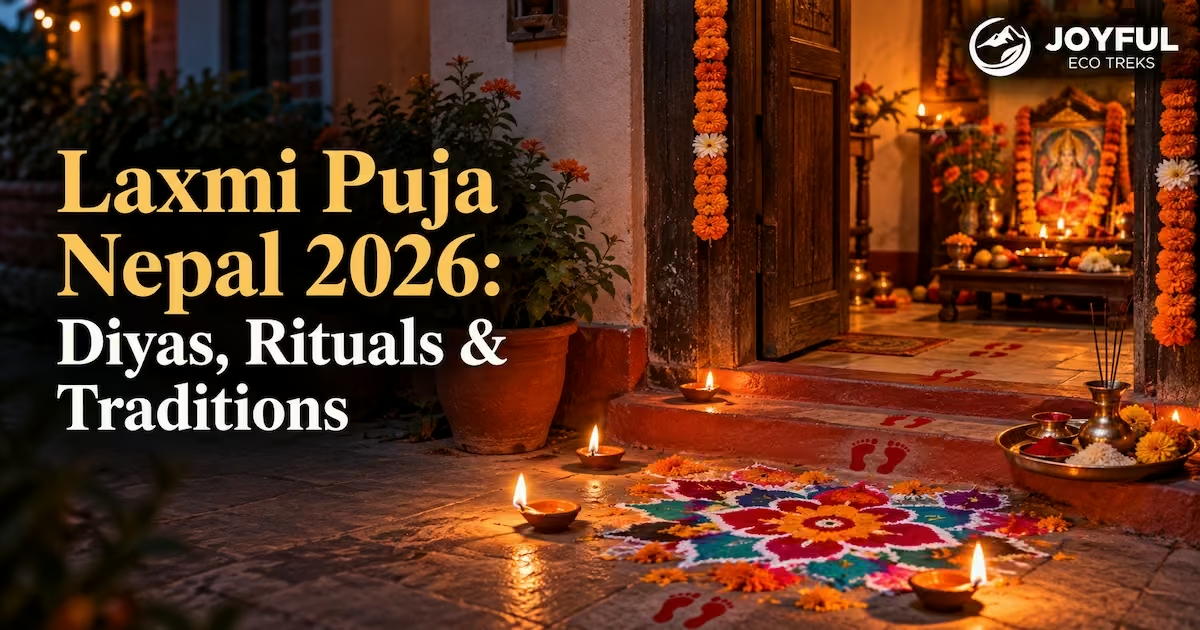
Laxmi Puja Nepal 2026 falls on Sunday, November 8, and on that night many families open their front doors after sunset and light diyas around the entrance, windows, and worship space. Those gestures explain much of the ritual. Laxmi, the goddess of wealth, is believed to walk in off the road, and rows of diyas and footprints leading inward symbolically welcome her toward the household's worship space. These are the mechanics behind the spectacle, the logic the travel photos never show.
Most guides stop at the lights and the sweets. What follows is the order of operations: when the puja is traditionally performed, where families place the lamps, what each offering signals, and how a visitor moves through the night without stepping on something sacred.
Laxmi Puja and the Night Tihar Turns Sacred
Tihar spans five evenings, and most of them honor a relationship: crows, dogs, cows, brothers. One evening belongs to Laxmi, and Nepalis treat it as the festival's spiritual peak. Dashain is about victory and the family tika. Tihar is about reciprocity with the living world, and on Laxmi Puja night that reciprocity turns financial. That night, a household is applying to be chosen.
The economic weight is literal. Shopkeepers lower their shutters and worship their account books. Some families prepare their savings and account books for blessing, although Tihar does not mark the start of Nepal's national fiscal year. The belief underneath runs doctrinal rather than decorative: Laxmi is welcomed into a home that has been readied for her, which is why cleaning, timing, and offerings carry ritual importance, even as practices vary by family.
When Laxmi Puja Falls in Nepal: The 2026 Date and Timing
Laxmi Puja Nepal 2026 breaks the usual pattern, and travelers who booked around a standard year should recheck their dates. The festival ordinarily puts Laxmi Puja on Tihar's third evening. This year it falls on the second, Sunday, November 8 (Kartik 22, 2083 BS), because Kukur Tihar and Laxmi Puja share November 8, while Gai Tihar falls on November 9. Tihar still spans November 7 to 11, but the peak spectacle arrives a day earlier than a normal schedule would imply. Show up on the third evening expecting the lamps, and you will have missed them.
The ritual is not pinned to a weekday but to the dark-moon tithi. Laxmi Puja follows Kartik Amavasya, the new moon of the month of Kartik. For 2026, that Amavasya runs from 11:42 AM on November 8 to 12:46 PM on November 9 in Kathmandu, per Drikpanchang.
Pradosh Kaal: The Window the Puja Has to Hit
Timing here is not loose. The puja is commonly performed in pradosh kaal, the stretch just after sunset. For Kathmandu on November 8, 2026, Pradosh Kaal runs from 5:15 PM to 7:52 PM, while the preferred Laxmi Puja muhurat within it runs from 5:38 PM to 7:34 PM, per Drik Panchang. Drik Panchang also lists Mahanishita Kaal from 11:21 PM to 12:14 AM, but recommends that later period mainly for experienced ritual practitioners, not as the standard household fallback.
Why so exact? The preferred muhurat that evening falls within Pradosh Kaal and coincides with Vrishabha (Taurus) rising, a lagna classed as sthir, or fixed. The reasoning is tidy: wealth invited under a fixed sign is believed to stay put rather than pass through, the difference between a guest who sits down and one who waves from the gate. Most travel pages simply say "after dark." The fixed-sign logic explains why the evening muhurat is preferred to choosing just any time after dark.
The Puja Tray: Five Offerings and What Each One Signals
Assemble a Laxmi Puja tray and five things recur across Nepali homes. Start with the one outsiders misread most: akshat, the rice. Akshat traditionally consists of whole, unbroken grains. The unbroken grain is associated with completeness in worship, though the preparation of offerings varies between households.
The clay diya is the most elemental item on the tray: fire carried inside earth, the oldest welcome a household can offer. Marigolds are widely used for their bright orange-gold color, often associated with prosperity, although households also use other flowers in their offerings. Red sindoor may be used in auspicious markings around the ritual space rather than simply as decoration. Then the money. Coins and folded currency notes may be placed on the tray as tangible symbols of the household's savings, brought into the rite to seek Laxmi's blessing.
The Safe Gets Its Own Altar
In some homes, one object receives a puja of its own: the family safe or cash box. Set up as a small separate altar, with coins and notes laid directly on it, it becomes one focus of the household's prayers for prosperity. Some business families also worship ledgers and account books before Laxmi. In Newar tradition, the observance can mark the closing of accounts ahead of Nepal Sambat New Year, rather than the beginning of Nepal's national fiscal year. Some shopkeepers close for family or business worship, even as other areas remain lively with festival lights and visitors.
Diya Placement: Which Spots Get Lit, and in What Order
The lamps are not scattered for ambience. Their placement is an important part of Laxmi Puja Nepal, with lamps commonly set around gates, thresholds, windows, and worship spaces to welcome the goddess into the home.
At many homes, diyas appear by the outer gate, on outdoor steps, and beside the threshold. From there the lamps climb the windowsills along the building's face, so the facade reads as a lit boundary from the road. Inside, lamps may also be placed near the family shrine or cash box, depending on household custom. The welcoming symbolism matters more than any single prescribed lighting order.
Customs also vary at the main altar. Some families place a principal ghee or oil lamp beside Laxmi's image, while the exact arrangement depends on the household's ritual practice. Some households keep a lamp burning through the night. There is no single diya count observed by every Nepali family; some light a handful, while others illuminate the gate, steps, windowsills, and altar with many more.
Rangoli and Marigold Footprints: Drawing Laxmi's Path Inside
Two visual traditions get flattened into one word on most travel blogs, and they are not the same practice. They differ in material, tool, and method, not merely in how they look.
Some hill-community households draw with dry rice flour or colored powder, worked freehand into geometric patterns at the threshold and in the courtyard. Maithili families from the Terai make aripan, which is a different craft entirely. Aripan is drawn in pithar, a wet paste made from soaked rice, traditionally applied with the fingers, although tools and techniques can vary. The floor may be prepared before drawing, and practiced artists often work from memory rather than from a sketch. Aripan patterns carry different meanings across Maithili ceremonies, including Laxmi Puja and weddings. The dry powder patterns found in some hill communities and the wet rice-paste designs of Mithila show different ways of honoring the same goddess.
Then the footprints. Small prints in flour mixed with red powder, or in marigold petals, are laid from the entrance gate through the rooms to the main altar. They represent Laxmi walking in, and they traditionally point inward, symbolizing Laxmi's welcome. Where the trail ends is where the family most wants her to arrive, often a family shrine or place of worship.
From House Cleaning to the Aarti Flame: The Puja Sequence
Before the evening lamps are lit, many families clean the house, and this is theology, not just housekeeping. The belief is plain: a clean and welcoming home is considered auspicious for Laxmi, so cleaning and washing the threshold form an important part of preparation.
Once the space is clean and the altar laid, the sequence has an order worth knowing if you are watching one. Ganesha is commonly worshipped first, on the principle that wisdom must precede wealth, a bit of sequencing that tells you something about the value system underneath. Laxmi follows, sometimes honored with the sixteen upachaar, or sixteen traditional forms of offering. Coins and account books are placed before her. Mantras are recited. The night closes with aarti, a lit diya rotated clockwise before the goddess while the household sings, followed by pranam and the sharing of prasad.
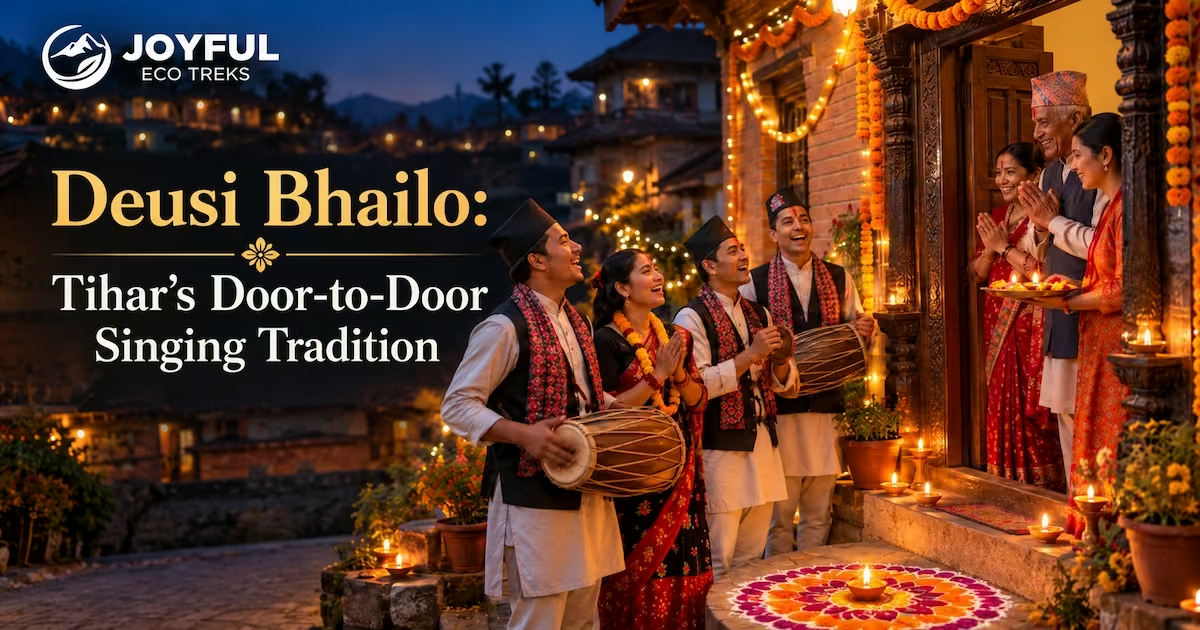
The singing you hear drifting between houses on this night, the bhailo groups moving door to door, belongs to a parallel Tihar tradition covered in the Deusi Bhailo singing tradition guide.
Walking Kathmandu on Laxmi Puja Night
Step out after sunset on Laxmi Puja Nepal night, and the older cores of the valley do the heavy lifting. The dense, low-rise lanes where facades sit close to the street carry the thickest runs of diyas, their light doubled by the open doors behind them. (For a full neighborhood route, see our Kathmandu lights guide.) The more useful question for a respectful visitor is not where to stand but how far in to go.
Three tiers of access define the night.
Tier | What it covers |
|---|---|
Watch freely from the street | Facade diyas, threshold rangoli, marigold garlands, the glow of open homes from the road |
Only with a host's invitation | Stepping inside, viewing the altar or puja tray, joining the aarti |
Avoid without clear permission | Touching altar items, photographing the family safe or currency offerings, photographing people or their sindoor markings, or crossing the threshold before the host welcomes you in |
The altar and the safe are the two places to be most careful with a camera. Both may hold the family's money and its blessing, so ask before photographing either, even when the hosts are warm and welcoming.
Four Misunderstandings Travelers Bring to the Night
Four assumptions trip up first-time visitors to Laxmi Puja Nepal, and each is easy to correct.
It is always the third night. Usually, yes. In 2026 it is the second evening, November 8, because Kukur Tihar shares November 8 with Laxmi Puja, while Gai Tihar falls on November 9.
Any time after dark works. It does not. The preferred puja muhurat falls within Pradosh Kaal, from 5:38 PM to 7:34 PM in Kathmandu this year; the broader Pradosh Kaal runs from 5:15 PM to 7:52 PM. The later Mahanishita Kaal is not a routine fallback for household worship.
The footprints are just decoration. Directional, not decorative. They mark the goddess's path and traditionally point inward, often toward the family shrine.
The floor art is all colored powder. Some hill communities use dry flour and colored powder, while Maithili aripan is made with wet rice paste, often drawn by hand, with designs that vary by occasion.
What Visitors Most Often Ask About Laxmi Puja in Nepal
What time does Laxmi Puja start and finish on Tihar night?
In Kathmandu on November 8, 2026, the preferred Laxmi Puja muhurat runs from 5:38 PM to 7:34 PM within Pradosh Kaal, which lasts from 5:15 PM to 7:52 PM, per Drik Panchang. Its listed Mahanishita Kaal is 11:21 PM to 12:14 AM, a period generally recommended for experienced ritual practitioners rather than a standard family fallback. The timing shifts slightly by year and location because it is tied to sunset and the rising sign.
Is the footprint rangoli made with marigold petals or powder?
Both are traditional. Many families press small prints in flour mixed with red powder, others lay marigold petals, and some combine them. Whichever material is used, the prints traditionally point inward from the doorstep, symbolically tracing Laxmi's welcome into the home.
How many diyas does a typical Nepali family light?
There is no fixed number of diyas for every Nepali household. Families may light a few or many around gates, steps, windowsills, and altars, and some keep a lamp burning through the night.
Can visitors join a family's Laxmi Puja or only observe?
You can observe the exterior freely from the street: the lamps, the rangoli, the decorated doorways. Stepping inside, seeing the altar, or joining the aarti requires an explicit invitation from the host. Without one, enjoy the night from the road and do not cross the threshold uninvited.
Why are coins and currency notes placed on the puja tray?
Some households place their money before Laxmi as a symbol of savings and a prayer for prosperity. Business families may also worship account books; in Newar tradition, closing the accounts can be associated with the end of the Nepal Sambat year, not Nepal's national fiscal year.
Understand the path, the timing, and the few things not to touch, and that covers what Laxmi Puja Nepal 2026 asks of a respectful visitor. Planning to be in Nepal during Tihar? Our full Tihar 2026 guide lays out exact dates across all five days, city logistics, and everything the festival holds beyond Laxmi Puja night. For the wider cosmology behind the sequence, the five days of Tihar piece maps how each evening connects to the next.