By the time the marigold garlands go up, the frying has already begun. What makes tihar food nepal distinctive is not one signature sweet but a calendar: five days with different offerings and feasts. Newar and Pahadi household traditions diverge most visibly on Day 4. Most guides hand you a flat list. This one maps every dish to its day, its community, and whether it belongs on an altar or a dinner plate.
Why Tihar Food Nepal Follows a 5-Day Calendar
Tihar food sits inside the wider world of traditional Nepali food, but it runs on its own festival schedule, hour by hour. For the meaning behind each day, see our guide to the five days of Tihar; here the focus is purely the food.
Day | Signature dishes | Community | Offering or feast |
|---|---|---|---|
1, Kaag Tihar | Rice, dal, tarkari, a sweet set out for crows | Shared | Offering |
2, Kukur Tihar | Plain cooked egg or meat for dogs (varies by household) | Shared | Offering |
3, Gai Tihar /Laxmi Puja (varies by year) | Cows: grass, grains, fruit. Laxmi Puja: sel roti, anarsa, malpuwa, fini roti | Shared (varies by home) | Both |
4, Goru Tihar / Mha Puja | Pahadi: fruit, grain, grass for the ox. Newar: bara, egg, fish, meat, aaila, swan puka | Splits | Both |
5, Bhai Tika / Kija Puja | Pahadi: sel roti, fruit, kheer or chiura. Newar: aaila, meat, fish, bara, egg | Splits | Feast |
In 2026, Kukur Tihar and Laxmi Puja fall on November 8, Gai Tihar on November 9, Goru Tihar and Mha Puja on November 10, and Bhai Tika on November 11. In 2026, Laxmi Puja is observed on the second calendar day even though it is often grouped with third-day rituals in general guides.
Offering dishes vs. feast dishes: how the distinction shapes the menu
Every Tihar dish has a destination. Offering dishes go out first: to the crow on Day 1, the dog on Day 2, Goddess Laxmi at Laxmi Puja, the cow on Day 3, and the ox on Day 4, the brother on Day 5. Feast dishes are what the household eats afterward. The same batch of sel roti often does both jobs, which is why the cooking starts days before anyone sits down to eat.
Sel roti as the thread that runs through all five days
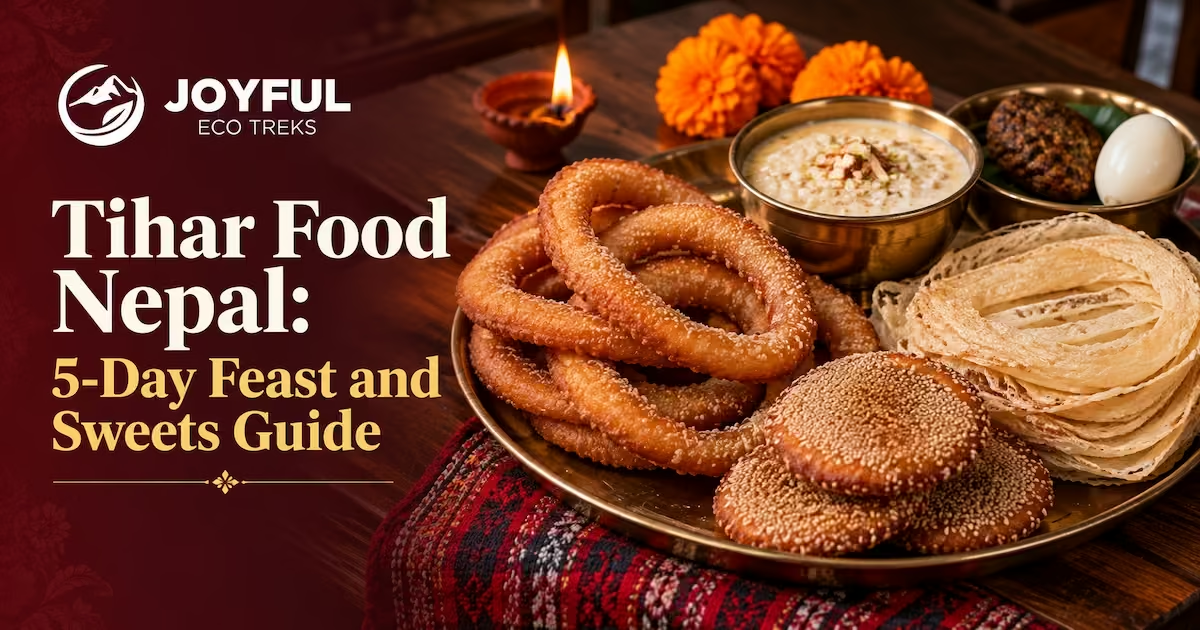
Sel roti appears on all five days. A ring of rice-flour batter sweetened with sugar and ghee, scented with cardamom and clove, it is deep-fried into a crisp golden hoop. A food-science study found that batter aged for six hours at around 30°C produced good results, while fat uptake generally decreased with ageing. Research also reports a shelf life of about two weeks for sel roti, though this depends on preparation and storage conditions. That is one practical reason production can begin on Day 1 or 2: a household needs enough stock to gift neighbours and feed Deusi-Bhailo singers right through Bhai Tika.
Days 1 and 2: Crow and Dog Offerings Before the Main Feast
The first two mornings are about animals, not banquets. The offerings are modest, but the kitchen is already preparing for Laxmi Puja.
What goes on a kaag offering plate on Kaag Tihar
Before sunrise on Day 1, a small plate goes out for the crows: cooked rice, a little dal and tarkari, and a sweet. Ordinary household food, not a special dish. Behind that simple offering, the real work has already started: the first sel roti batter is resting for the frying to come.
Kukur Tihar dog offerings and what the kitchen is already preparing
On Day 2, the dog eats well: households may offer plain cooked egg or meat, or other dog-safe food, depending on custom. (The ceremony is covered in our Kukur Tihar article.) In food terms, Day 2 can also be a preparation day. Cooks fry sel roti in volume and grind rice for the sweets that Laxmi Puja demands.
Day 3: Gai Tihar and the Laxmi Puja Sweets
Around Laxmi Puja, the frying peaks. Rings come out by the dozen, stacked for the offering tray, the family plate, and the gift baskets moving between houses all evening.
Sel roti: the rice-flour ring at the centre of Laxmi Puja
By Day 3, the frying peaks. Rings come out by the dozen, stacked for the offering tray, the family plate, and the gift baskets moving between houses all evening.
Anarsa, malpuwa, and the Laxmi Puja sweets plate
Of all the tihar festival food produced this week, anarsa is one of the sweets most closely associated with this festival. Soaked rice is dried, ground, mixed with jaggery into a dough, rolled in seeds, shaped into round disks, and fried in ghee until the surface blisters. Recipes use sesame or poppy seeds, depending on household tradition. Alongside it comes malpuwa, a pan-fried sweet pancake that may be served with kheer during Tihar.
What Goddess Laxmi's offering tray actually contains
The tray set for Laxmi is a composition, not a pile. Fruit, a few coins, rings of sel roti, sweets such as anarsa, and burning incense are arranged among the oil lamps that line the doorway to guide the goddess in. Some homes add fini roti, a laminated crisp bread of all-purpose and rice flour layered with a ghee-and-rice-flour paste, then sliced and deep-fried into flaky sheets. Fini roti is also prepared for other Nepali festivals and celebrations.
Day 4: Goru Tihar Offerings and the Newar Mha Puja Table
Day 4 is where the two traditions part most visibly. It is the day that flat food lists handed to Nepal travellers never explain: one household honours the ox; another observes Mha Puja.
Fruit, grain, and the ox's food in Pahadi households
In many Pahadi homes, Day 4 is Goru Tihar. The ox receives fruit, grains, and fresh grass as a thank-you to the animal that pulls the plough. For family meals, sel roti, sweets, and other home-cooked dishes may be shared.
How Newar kitchens shift to the Mha Puja sagun
Many Newar households mark Day 4 with Mha Puja, a ritual of self-worship, and the plate reflects it. Before each person sits a sagun carrying bara, a thick black-lentil patty cooked in a heavy-bottomed pan and sometimes topped with egg or minced meat, plus a boiled egg, dried fish, dried meat, shallow-fried ginger and garlic, and aaila, the homemade rice liquor. Each element maps to a Tantric concept: bara is space, egg is air, fish is water, meat is earth, aaila is fire. Some Newar festive meals also include swan puka, goat lungs filled with spiced batter through the windpipe, boiled, sliced, and pan-fried. The ritual itself is covered in the Mha Puja article; here it is enough to say the food amounts to a full feast, not a token gesture.
Day 5: Bhai Tika with Kheer, Chiura, and the Sibling Feast
The festival closes with siblings, and the menu softens.
What sisters cook for brothers on Bhai Tika
Sisters prepare the Bhai Tika spread, which may include kheer: a slow-cooked rice pudding thickened with milk and sugar and scented with cardamom. Alongside it may sit chiura, the beaten-rice base that offsets the sweetness, plus sel roti, fruit, and dry snacks. The exact spread varies by household, with sel roti, sweets, fruit, and other dishes also taking a prominent place.
Kija Puja: the Newar five-item sagun
Newar families mark the same day as Kija Puja, and the offering often includes a five-item sagun alongside the family meal. Sisters may present aaila (traditional rice liquor), meat, fish, bara (a lentil cake), and a boiled egg, commonly associated with fire, earth, water, space, and air respectively. Set beside a Pahadi kheer-and-chiura plate, this is the cleanest illustration of how one festival, on one shared day, produces two distinct tables.
Newar Tihar Dishes vs. Pahadi Tihar Dishes
Bara, swan puka, and dishes specific to Newar households
The Newar table often adds a savoury, protein-heavy layer that may be less prominent in Pahadi festival meals. Bara and swan puka are particularly associated with Newar cuisine. The broader samay baji platter, a ceremonial arrangement of chiura, fried black soybeans, bara, buffalo meat, egg, fish, and greens, can appear at festive family gatherings, including during Tihar.
Where the two traditions overlap and where they split
Both communities share many sweets: sel roti, anarsa, and kheer appear in different households. The split falls on the savoury and the ritual plate. Pahadi Tihar offerings often feature fruit and sweets; the Newar sagun is built on egg, fish, meat, and rice liquor keyed to the five elements. Unlike the goat-curry heart of the Dashain feast, Tihar's shared core is sweet, but that divergence between the two tables is the real story of tihar food nepal.
Where to Taste Tihar Food in Kathmandu as a Visitor
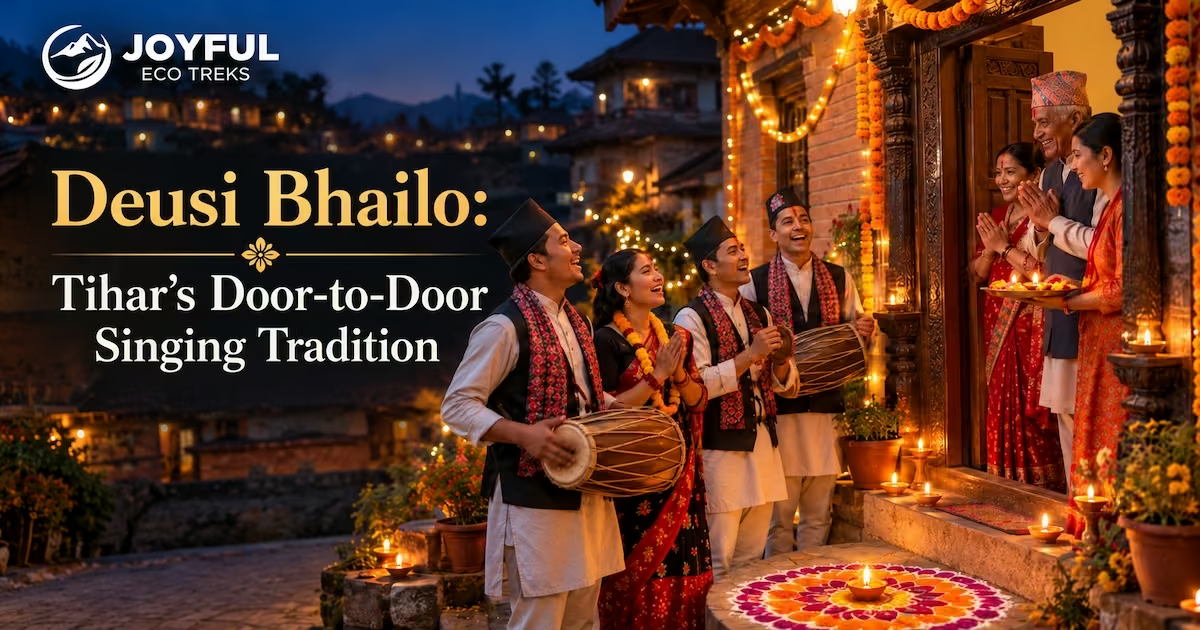
Most Tihar food is homemade, cooked as an act of care rather than sold, so the best route in is an invitation. Short of that, the old-city sweet shops around Ason and Indrachowk stock sel roti, anarsa, and the other Tihar sweets that Kathmandu households buy when supplies run short, and the counters are busiest in the days around Laxmi Puja. If a Deusi-Bhailo group sings at your guesthouse, the sweets passed out in thanks are the real thing. For dates and where to see the lamp-lit streets, use our Tihar 2026 travel guide, and for how Tihar sits in the wider calendar, see the month-by-month festival guide.
Tihar Food FAQs
What is sel roti and why is it made specifically during Tihar?
Sel roti is a ring-shaped, sweet, deep-fried bread made from rice-flour batter. Households make it for Tihar because it can keep for an extended period when prepared and stored properly; some studies report around two weeks, although actual shelf life varies. This allows batches fried early in the festival to cover gifts for neighbours and sweets for Deusi-Bhailo singers across all five days.
Do Newar families eat different Tihar foods than Pahadi families?
Yes, most clearly on Days 4 and 5. Many Newar households prepare a Mha Puja sagun of bara, egg, fish, meat, and aaila, then a five-item Kija Puja plate on Day 5, while many Pahadi households prepare sel roti, Goru Tihar ox offerings, and Bhai Tika meals that may include kheer and chiura. The sweets overlap; the savoury and ritual dishes differ, and that contrast is the heart of tihar food nepal.
Can visitors buy or taste Tihar sweets in Kathmandu during the festival?
Yes. Sweet shops in the old city around Ason and Indrachowk sell sel roti, anarsa, and other festival sweets throughout the week, with the busiest period around Laxmi Puja. Most home-cooked dishes reach visitors through invitations or the sweets handed to Deusi-Bhailo singers.
What food is placed on the Laxmi Puja offering plate on Day 3?
The Laxmi Puja tray holds fruit, a few coins, sel roti, sweets such as anarsa, and incense, arranged among the oil lamps at the doorway. Some homes add fini roti, a flaky laminated bread offered to Laxmi.
Is anarsa made only during Tihar or is it available year-round?
Anarsa is closely tied to Tihar and prepared in quantity for the festival by households and old-city sweet shops. It is also made for other occasions, though its strongest association is with Tihar festival food.
Planning to be in Kathmandu during Tihar? Read the complete Tihar 2026 travel guide for exact dates, where to see the lights, and how to join the celebrations as a visitor.