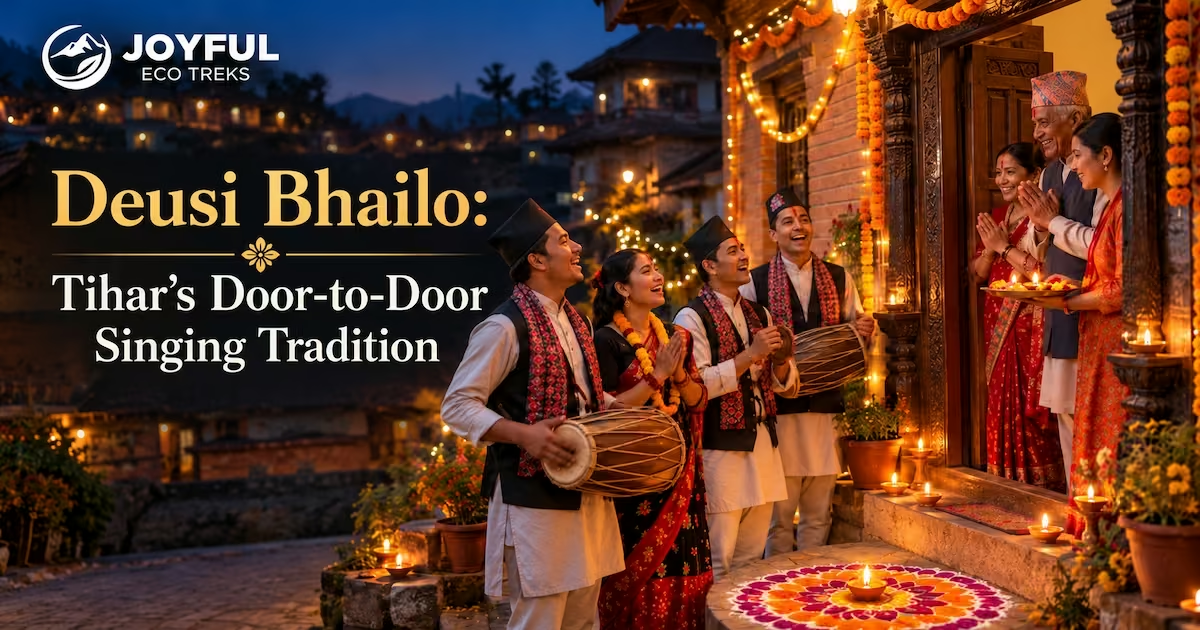
On the third and fourth nights of Tihar, you hear them before you see them: a madal's steady pulse, the crash of jhyali cymbals, and a dozen voices throwing one line back at a single caller down the lane. That sound is deusi bhailo, the door-to-door singing that turns a whole neighbourhood into one moving performance for a few bright autumn nights.
Most guides flatten it to "groups sing, households give gifts." That misses almost everything worth knowing. This is a structured social exchange with its own rules: who sings on which night, a call-and-response you can actually trace by ear, and a pooled fund that has, in one documented case, bought an ambulance. Here is the working model, not the postcard.
What Deusi Bhailo Actually Is
Strip away the festival gloss and deusi bhailo is a social contract set to music. A group arrives at the gate, sings, blesses the house, and receives something back. The detail surface explainers drop is that "the group" traditionally includes different singers and song styles, often heard on different nights.
Two groups, two songs: who sings Deusi and who sings Bhailo
Bhailo is traditionally sung by girls and young women. They commonly go out on the night of Laxmi Puja and sing together, every voice carrying the same line at once. Deusi is traditionally sung by boys and men, and it has a completely different architecture: one lead singer, the Bhatyaune, calls each poetic line, and the whole group answers "Deusi Re" behind him. You can hear the difference from the next courtyard. One is a choir; the other is a caller working a crowd. Mixed Deusi-Bhailo teams also perform today, but that split remains the traditional backbone.
The King Bali story that sends the singers to your door
The singers are not improvising a reason to knock. The mainstream account roots the tradition in King Mahabali, the demon king whom Vishnu, in his dwarf Vamana avatar, pressed into the netherworld. Bali was granted permission to return to the mortal world, Mrityuloka, for five days during the Yama Panchak period of Tihar, and the Deusi group arrives at each house as messengers announcing that annual visit. Other regional origin stories are distinct: one connects Deusi to a King Bali of Jumla, while a Limbuwan oral account tells of Magar soldiers defending King Bali Hang and chanting "Deusurey Failo," interpreted in that telling as "We Saved." These are traditions of storytelling, not established historical accounts. Both stories end at the same doorstep.
Which Nights of Tihar Deusi and Bhailo Fall On
The two performances are traditionally associated with different nights, though groups may sing on other Tihar evenings too, and getting that distinction straight is the fastest way to read the scene correctly.
Bhailo on Laxmi Puja night, and why women lead it
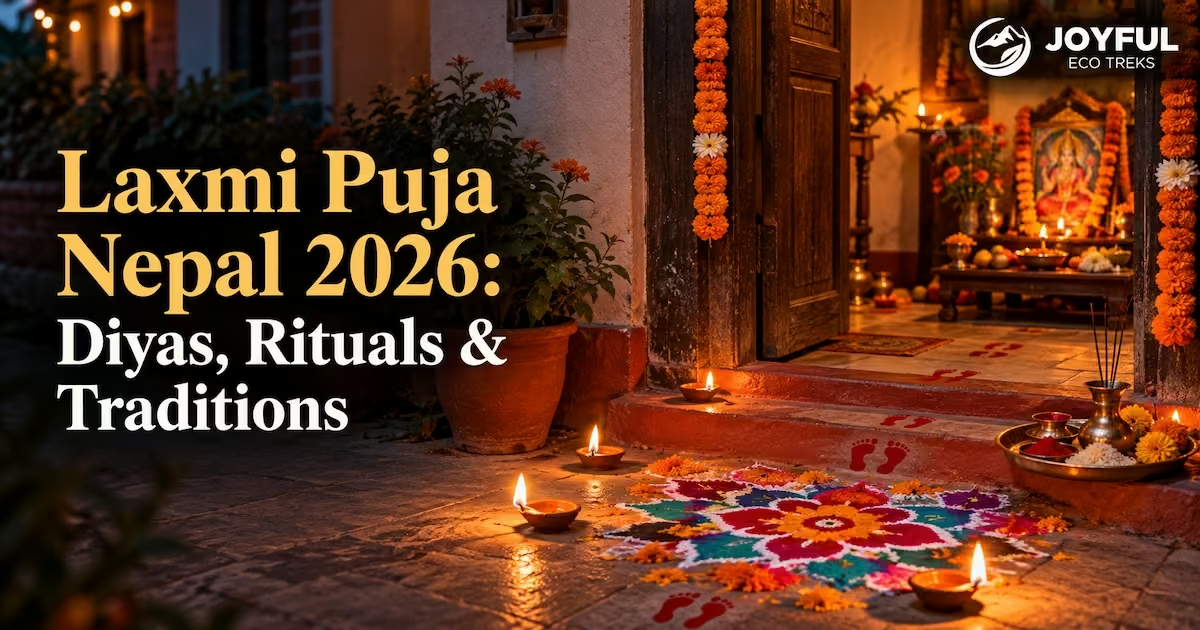
Bhailo is traditionally sung on Laxmi Puja night, usually described as the third night of Tihar, when homes are lit with oil lamps for the goddess of wealth. In 2026, that night is November 8, which this year also coincides with Kukur Tihar because of the lunar alignment, so November 8 is the traditional Bhailo evening this year, though performances may take place on other Tihar nights. For the full day-by-day calendar, see our Tihar 2026 dates and rituals guide. Women lead this night for a reason that fits the occasion: the blessing they carry into a house lamplit for Laxmi is a blessing of prosperity.
Deusi on Govardhan Puja, and who joins the group
Deusi is traditionally associated with Govardhan Puja and Goru Tihar, often called the fourth night. In 2026, Hamro Patro and Kathmandu Metropolitan City list Govardhan Puja on November 10, two days after Laxmi Puja on November 8. A group may still choose to perform on other evenings. The group itself is loose and inclusive: a Bhatyaune up front, instrumentalists on madal and jhyali, and a chorus of anyone in the tole who can hold a line.
How long a group sings and how far it walks
Groups do not sprint through a city. A stop can run roughly 10 to 30 minutes per household, though the duration varies: a quick blessing at one house, a longer set where the hosts invite the group to stay. A single group generally works its own few lanes, not the whole ward, so what you witness is intensely local.
How the Call and Response Works at the Door
The 'Deusi re' call and the chorus that answers
The Deusi set often opens with a refrain you will hear repeated all night: "Deusi Re, Deusi Re." The Bhatyaune calls a line of verse, the chorus answers "Deusi Re," and the pattern rolls forward. A common invocation that kicks it off is "Aahai, bhana mera bhai ho!", which translates to "Call out, my brothers!" Bhailo, by contrast, needs no caller; the whole group simply sings the verse together.
What the verses ask for and what they promise back
The verses do two jobs at once: they ask the household for an offering, and they promise a blessing in return. The blessings often wish the household wealth and well-being in return for generosity. The transaction is explicit and cheerful, generosity now and prosperity later, with the singers as the go-betweens.
Where modern pop songs slip into the old structure
Walk through Kathmandu on a Deusi night and you will catch verses of current Nepali pop folded into the set. The skeleton holds, though. Think of it like a jazz standard reharmonized for a new crowd: the melody on top changes, but the call-and-response structure underneath stays exactly where it always was.
What Households Give and Where the Money Goes
Cash, sel roti, and fruit on the offering plate
Households give cash, sel roti (the ring-shaped sweet rice bread of the season), seasonal fruit, and sweets, usually carried out on a plate lit with a diyo. There is no fixed cash amount; what people offer varies with the household, the group, and the night.
How a tole youth club spends the pooled fund
Some groups divide their earnings or spend them on a picnic, while others pool the money for a tole sudhar samiti, local youth club, or community cause, and the scale this reaches is genuinely striking. A group of 12 children in Bhakunde-Jyamire collected Rs 12,120, the Himalayan Times reported, and donated it to a children's care centre in Besisahar, continuing a five-year habit of giving it away. In Banke, a school community raised Rs 62,615 through Deusi Bhailo and used it for electricity and fans, according to an RSS report. At the top end, Parbat's Pun Yuwa Club collected Rs 485,000 in the 2014 season for social projects, the Kathmandu Post reported. It had bought a community ambulance the previous year using Deusi earnings saved over three years, and offered free service to those who could not pay.
What does a single ordinary evening actually yield? No ranking page bothers to work it out, and the total depends on how many houses a group reaches, how long it performs, and what each household gives. Without records from a specific group, a one-night cash figure is only a guess. Stack earnings across several evenings and a whole tole's worth of houses, and the ambulance math stops looking far-fetched.
What Travellers Will See on Deusi Bhailo Nights
Where groups perform in Kathmandu and Pokhara
The liveliest deusi bhailo runs through residential toles rather than tourist strips. In Kathmandu, that means the older wards and lanes of places like Patan and Kirtipur far more than the restaurant blocks of Thamel. Pokhara is liveliest through the Lakeside neighbourhoods and the streets just back from the water. If you want the wider festival calendar to plan around, our month-by-month Himalayan festivals guide maps where to be and when.
What to do if a group reaches your guesthouse door
Welcome them. Listen to a verse or two, then give a modest cash note; you do not need to know the words, and nobody expects a foreigner to. Clap along and join the "Deusi Re" response if the mood takes you, and ask the performers before filming. The one thing to avoid is waving the group off like street vendors, because that misreads a blessing as a nuisance. If you would rather meet traditions like this with a guide who can translate the moment, our cultural tour of Nepal is built around exactly these encounters.
Deusi Bhailo Is Not Begging, and Its Traditions Are Changing
The exchange is reciprocal: a performance and a blessing for an offering, not charity with a song attached. The timing and casting are not random, either. Bhailo and Deusi follow traditional night and group patterns, built around song forms old enough to carry mythology inside them. What looks spontaneous from the street is actually a tradition with long-established roots. As for dying out, the picture is mixed: some communities report fewer traditional groups, while others keep performing, absorbing pop melodies along the way and raising money for schools and ambulances. Read our full Five Days of Tihar breakdown to see where deusi bhailo fits within the festival's complete ritual arc.
Frequently Asked Questions About Deusi Bhailo
What is the difference between Deusi and Bhailo?
They are two related performances within the same tradition. Bhailo is traditionally sung by girls and young women, often together on Laxmi Puja night, while Deusi is traditionally sung by boys and men, commonly around Govardhan Puja, using a call-and-response form where a lead singer called the Bhatyaune calls each line and the group answers "Deusi Re." Mixed groups also perform today.
Which nights of Tihar are Deusi and Bhailo performed?
Bhailo is traditionally associated with Laxmi Puja night, and Deusi with Govardhan Puja or Goru Tihar. In 2026, Laxmi Puja falls on November 8 (overlapping Kukur Tihar), while Govardhan Puja falls on November 10. Groups may perform on other Tihar evenings too.
What do households typically give to Deusi Bhailo groups?
Households typically give a mix of cash, sel roti, seasonal fruit, and sweets, usually presented on a lamp-lit plate. There is no fixed cash range; offerings vary by household and group.
Where does the money collected during Deusi Bhailo go?
It depends on the group: some divide the money or use it for a picnic, while others pool it for a local tole sudhar samiti, youth club, or community cause. Documented examples range from children donating Rs 12,120 to a care centre to a Parbat club buying an ambulance in 2013 with savings from earlier Deusi performances. The club separately raised Rs 485,000 in 2014 for social projects.
Can foreign visitors participate in or join a Deusi Bhailo group?
Yes, informally. Visitors are welcome to listen, clap, join the "Deusi Re" chorus, and give a small cash offering when a group arrives at a guesthouse or homestay door. Being invited to walk a few houses with a neighbourhood group does happen, though it is a courtesy extended by the group rather than something to expect.