
Motorbike Tour to Manang
Kathmandu, Lamjung and Manang District, Gandaki Province, Nepal
Group size
2–16 travelers (Private & Small Group)
Overview
Some journeys are not only about where you go, but how the road makes you feel along the way. The Motorbike Tour to Manang gives you that feeling from the moment Kathmandu fades behind you, and the road begins to climb toward the Annapurna side of Nepal. Smooth highways slowly turn into gravel tracks, narrow bends, and mountain roads that ask for focus, patience, and a good sense of adventure.
As you ride deeper into the Manang region, the landscape keeps changing around you. Green hills give way to pine forests, river cliffs, dry valleys, and open mountain views. By the time you reach Manang, your ride feels less like a simple tour and more like a full Himalayan experience on two wheels.
Trip Info
- Accommodation
- 5-star hotels in Kathmandu and mountain guesthouses
- Meals
- Breakfast, lunch, and dinner
- Maximum Altitude
- Khangsar, approx. 3,734 to 3,756 m / 12,251 to 12,323 ft

Why Choose the Motorbike Tour to Manang?
The Motorbike Tour to Manang brings together three things riders often look for: adventure, scenery, and local culture. You do not spend every day only riding from one stop to another. Your route also gives you time to see villages, monasteries, prayer flags, apple farms, and mountain life along the way.
The beauty of this ride comes from how naturally the landscape changes. One moment you ride beside the Marsyangdi River, and the next you climb above forests and villages toward colder mountain air. Each day feels different, so the journey does not become repetitive.
This tour is ideal when you want a guided ride that still feels personal. You follow a planned route with support, but the road gives you plenty of moments that feel your own. A quiet stop beside the river, a tea break in a village, or the first clear view of the Annapurna range becomes the part you remember most.
Tour Highlights
- Ride from Kathmandu toward Manang through highways, river valleys, rough mountain roads, and high Himalayan settlements.
- Follow the Marsyangdi River route through Besisahar, Shyange, Chame, Pisang, Manang, Khangsar, and nearby villages.
- Experience changing road conditions, from smooth paved sections to gravel, rocky tracks, narrow bends, and dusty mountain trails.
- See waterfalls, suspension bridges, pine forests, cliffside roads, prayer flags, monasteries, and traditional stone houses along the route.
- Explore Manang Valley, where dry hills, wide skies, old villages, and close mountain views give the ride a different feel.
- Ride toward Khangsar, a peaceful village on the route to Tilicho Lake, without adding the long hike to the lake.
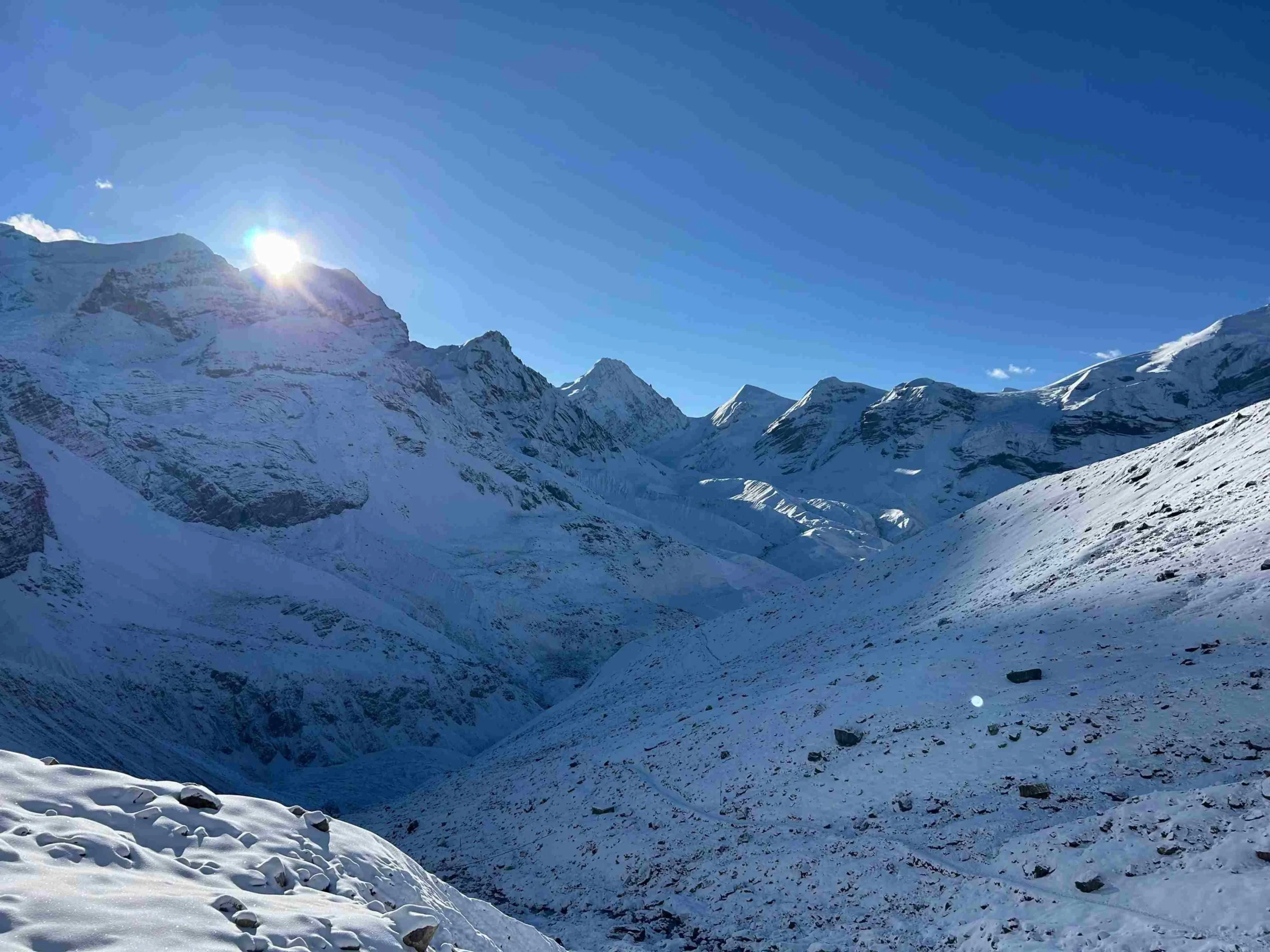
- Enjoy clear-day views of Annapurna II, Annapurna III, Gangapurna, Pisang Peak, Tilicho Peak, and Lamjung Himal.
- Travel with a guided team that supports route planning, permits, bike handling, road safety, and basic mechanical needs.
Tour Plan
Day 01Arrival in Kathmandu | 30 to 40 mins Drive
Your journey begins at Tribhuvan International Airport in Kathmandu. Our team meets you at the arrival area and transfers you to your hotel by private vehicle. After check-in, you have time to rest from your flight and settle into the city.
Later, you meet your guide for a short introduction to the route. You review the riding plan, road conditions, permits, bike rules, safety points, and the gear you need for the Manang road.
After the briefing, you go to the bike rental station to choose your motorcycle. The mechanics check the brakes, clutch, lights, tires, chain, engine, and gear system. You also take a short test ride with your guide to get comfortable with the bike before the tour begins.
- Drive duration: 30 to 40 minutes
- Drive distance: 6 to 8 km / 3.7 to 5 miles
Note: Keep your motorcycle license, passport, insurance details, and riding gear ready for the next day’s preparation.
Day 02Ride from Kathmandu to Besisahar | 175 to 185 km | 109 to 115 miles
The ride begins after breakfast as you leave Kathmandu and follow the highway toward the west. The first part of the day feels busy, with city traffic, market towns, and highway bends along the way.
As you move toward Dumre and Besisahar, the road slowly shifts into greener hill country. You ride past river valleys, small settlements, roadside tea shops, and terraced farms before reaching Lamjung District.
Besisahar is known as the gateway to Manang. The town gives you a practical overnight stop before the road becomes rougher and more adventurous the next day.
- Ride duration: 6 to 8 hours
- Ride distance: 175 to 185 km / 109 to 115 miles
Note: Ride with patience on the highway because traffic, road repairs, and local vehicles may slow the journey.
Day 03Ride from Besisahar to Chame | 65 to 70 km | 40 to 43 miles
From here, the real mountain ride begins. Your ride leaves Besisahar and enters the rougher Manang road. The smooth highway feel starts to disappear as the track follows the Marsyangdi River through narrow valleys, rocky bends, and dusty climbs.
You pass villages like Syange, Jagat, Tal, and Dharapani, where the landscape begins to feel more alpine. Along the way, you ride past waterfalls, cliffside sections, forest patches, and river crossings that make this one of the most adventurous riding days of the tour.
By the time you reach Chame, the air feels cooler and the mountain setting becomes stronger. Chame is the administrative center of Manang District and a comfortable stop before entering the upper valley.
- Ride duration: 6 to 8 hours
- Ride distance: 65 to 70 km / 40 to 43 miles
- Maximum altitude: Chame, approx. 2,650 m / 8,694 ft
- Elevation gain: +1,890 m / +6,201 ft
Note: Besisahar is the last official fuel pump station, so completely top off motorbikes and carry extra fuel in cans for the round-trip up to Manang and back.
Day 04Ride from Chame to Manang Valley | 30 to 35 km | 19 to 22 miles
The ride from Chame to Manang is shorter in distance, but it gives you some of the best scenery of the tour. From this cool district town, the road follows the Marsyangdi Valley through pine forests, rocky bends, and open mountain sections.
The route moves through Bhratang, Dhukur Pokhari, and Pisang, where the scenery becomes wider and drier. You see apple-growing areas, prayer flags, old village settlements, and strong views of Annapurna II, Pisang Peak, and nearby ridges.
As you approach Manang, the landscape becomes drier and more open. You reach the village area, settle into your lodge, and enjoy the mountain atmosphere without rushing.
- Ride duration: 3 to 5 hours
- Ride distance: 30 to 35 km / 19 to 22 miles
- Maximum altitude: Manang, approx. 3,519 m / 11,545 ft
- Elevation gain: +869 m / +2,851 ft
Note: Drink enough water because the altitude gain becomes more noticeable after Chame.
Day 05Explore Manang Valley and Ride to Khangsar | 10 to 15 km | 6 to 9 miles
The ride takes a slower rhythm in Manang, and that pause makes the journey more enjoyable. You spend the morning around the valley, where the dry mountain landscape, stone walls, and glacier views create a strong contrast with the lower green hills.
The exploration takes you toward Gangapurna Lake, nearby viewpoints, village paths, or small monastery areas. These short visits help you understand Manang beyond the road, as you see how people live in a cold, high-altitude valley.
Later, you ride toward Khangsar, a traditional village on the way to Tilicho Lake. The road feels quieter here, and the landscape becomes even more rugged as you move away from the main Manang settlement.
- Ride duration: 1.5 to 2.5 hours, plus local exploration
- Ride distance: 10 to 15 km / 6 to 9 miles
- Maximum altitude: Khangsar, approx. 3,734 to 3,756 m / 12,251 to 12,323 ft
- Elevation gain: +215 to 237 m / +705 to 778 ft
Note: Move slowly and avoid heavy activity if you feel a headache, dizziness, or unusual tiredness.
Day 06Ride from Khangsar to Pisang | 25 to 35 km | 16 to 22 miles
Khangsar gives the ride a remote high-valley feeling before the route turns back toward the main Manang road. You leave the dry slopes around the village and ride back through open terrain, stone settlements, and wide mountain views.
The route gradually reconnects with the Manang Valley and continues toward Pisang. As the road drops, the landscape begins to change again, with more river views, wind-carved cliffs, prayer flags, and scattered village homes along the way.
Pisang feels like a softer stop after the higher and drier setting of Khangsar. The village sits below Pisang Peak, with views toward Annapurna II, old houses, and a peaceful mountain atmosphere around the lodge area.
- Ride duration: 3 to 4 hours
- Ride distance: 25 to 35 km / 16 to 22 miles
- Maximum altitude: Khangsar, approx. 3,734 to 3,756 m / 12,251 to 12,323 ft
- Elevation loss: -480 to 500 m / -1,575 to 1,640 ft
Note: The route may include dusty and uneven sections, so keep your visor clean and protect your eyes.
Day 07Ride from Pisang to Shyange | 90 to 105 km | 56 to 65 miles
From Pisang, the ride begins with a long descent through the upper Marsyangdi Valley. The cold, dry landscape around Pisang slowly changes as the road drops toward Chame, Dharapani, Tal, Jagat, and the lower river settlements.
This section needs steady control because the downhill road includes loose gravel, stone patches, narrow bends, and dusty tracks. You pass pine forests, waterfalls, suspension bridges, river cliffs, and villages that show how quickly the Manang route changes with altitude.
Shyange brings you back to a warmer riverside setting after several nights in higher mountain villages. The evening stays simple, with time to rest, clean your gear, and recover from one of the longer riding sections of the return route.
- Ride duration: 6 to 8 hours
- Ride distance: 90 to 105 km / 56 to 65 miles
- Maximum altitude: Pisang, approx. 3,250 m / 10,663 ft
- Elevation loss: -2,100 to 2,200 m / -6,890 to 7,218 ft
Note: Downhill riding needs extra control, so avoid speeding on loose gravel and sharp bends.
Day 08Rest and Short Local Ride Around Shyange | Minimal Riding
Shyange works as a practical recovery stop after the long descent from Pisang. The warmer valley air, river sound, and slower village pace make this day useful for both your body and your bike.
The plan stays close to the village instead of adding another long ride. You can take a short walk near the Marsyangdi River, explore nearby settlement paths, visit local tea shops, or enjoy waterfall and cliff views around the lower valley.
Your guide also checks the motorcycles, road updates, and return plan for Kathmandu. This lighter day helps you leave the Manang road with more energy and better focus for the final highway ride.
- Ride duration: Minimal riding
- Ride distance: Local movement only
- Walking duration: 1 to 2 hours, optional
- Maximum altitude: Shyange area, approx. 1,100 m / 3,609 ft
Note: Use this day to rest, stretch, and check your riding gear before the long return to Kathmandu.
Day 09Ride from Shyange to Kathmandu | 200 to 220 km | 124 to 137 miles
With your gear sorted and the bikes checked, the return ride leaves the Marsyangdi Valley behind. The first section follows the rough lower Manang road back toward Besisahar, where river views, village roads, and uneven tracks still need careful riding.
From Besisahar, the route joins the main road toward Dumre and continues along the highway to Kathmandu. The landscape changes from quiet hill valleys to busier towns, highway traffic, roadside markets, and wider river corridors.
By the time you enter Kathmandu Valley, the ride feels completely different from the mountain sections around Manang. Your guide leads the group through the city traffic and brings you back to the hotel for a well-earned rest.
- Ride duration: 7 to 9 hours
- Ride distance: Approximately 200 to 220 km / 124 to 137 miles
Note: This is a long return day. Start early and follow your road captain closely near traffic-heavy areas.
Day 10Final Departure from Kathmandu
The riding part of your Manang motorbike tour is complete, so the morning stays simple and relaxed. After breakfast, our team transfers you from your hotel to Tribhuvan International Airport.
If your flight is later in the day, you may have time to rest at the hotel or enjoy a short walk nearby. Your guide confirms the airport timing so the departure does not feel rushed.
The tour ends with memories of rough roads, river valleys, mountain villages, and the ride into Manang’s wide Himalayan landscape.
- Drive duration: 30 to 40 minutes
- Drive distance: Approximately 6 to 8 km / 3.7 to 5 miles
Note: Reach the airport at least 3 hours before your international flight.
What’s Included & Excluded
Cost Includes
- Airport pickup and drop-off in Kathmandu
- Hotel accommodation in Kathmandu
- Guesthouse accommodation during the ride
- Motorbike rental during the riding route (Honda XR 190 CC, Royal Enfield Classic 350 CC / 500 CC, Himalayan 450 CC)
- Fuel for the planned itinerary
- A basic first aid kit and an oximeter, carried by the guide
- Breakfast, lunch, and dinner during the riding days
- Professional road captain or motorbike guide
- Basic mechanic support during the tour
- Annapurna Conservation Area Project (ACAP) permit and required local route documents
- Basic spare parts support during the route
- Government taxes and service charges
Cost Excludes
- International flights to/from Nepal
- Nepal visa fee
- Travel insurance
- Motorcycle riding insurance or rescue coverage
- Personal riding gear
- Drinks, snacks, laundry, and personal expenses
- Tips for guide, mechanic, and support staff
- Repair cost for damage caused by rider error or accident
- Extra nights caused by weather, road blockage, or flight delay
- Optional activities not listed in the itinerary
Packing List for Motorbike Tour to Manang
This 10-day Motorbike Tour to Manang takes you from warm valleys to high mountain settlements, so your packing needs to cover both comfort and safety. You do not need to overpack, but you should carry proper riding gear because the road to Manang includes dust, stones, cold wind, and rough off-road sections.
What to Pack17 items
- Valid motorcycle driving license
- International driving permit, if available
- Passport copy and travel insurance documents
- Full-face helmet
- Riding jacket and riding pants with protection
- Riding gloves
- Strong riding boots
- Warm inner layers for Manang and Khangsar
- Windproof and waterproof outer layer
- Neck buff or scarf
- Sunglasses and sunscreen
- Small daypack
- Reusable water bottle
- Personal medicine
- Power bank and charging cable
- Waterproof bag or dry sack for electronics
- Camera or phone for photos
Ready for the Motorbike Tour to Manang?
Book your ride with Joyful Eco Treks and experience one of Nepal’s most exciting Himalayan routes with a trusted local team by your side. Share your travel dates, riding experience, group size, and bike preference with us. Our team will help you plan the Motorbike Tour to Manang with clear route details, required permits, accommodation, guide support, safety planning, and daily riding distance.
Motorbike Tour to Manang
Frequently Asked Questions
Practical answers about the Manang ride, road conditions, bikes, permits, and altitude.
How difficult is the Motorbike Tour to Manang?
The tour is challenging because the road includes rough tracks, gravel, dust, rocky turns, and narrow cliffside sections. Riders should have good motorcycle control and some experience on uneven roads.
Do I need previous off-road riding experience?
Previous off-road experience is highly recommended. Confident road riders may join with proper guidance, but the route feels much easier and safer when you already know how to handle gravel, stones, and loose surfaces.
What license do I need for a motorbike tour to Manang?
You should carry a valid motorcycle driving license from your country. An international driving permit is also recommended because rules and checks can vary during travel.
Is Tilicho Lake included in this itinerary?
No, this itinerary reaches Khangsar, which lies on the route toward Tilicho Lake. Tilicho Lake requires extra time, trekking, weather checks, and a separate plan.
What is the highest point of the tour?
The highest overnight point is Khangsar, around 3,750m / 12,300ft. Manang Valley also sits above 3,500m, so riders should move slowly and drink enough water.
What type of bike is suitable for the Manang route?
A dual-sport or off-road-capable motorcycle is suitable for this route. The bike should handle gravel, stones, mud, rough climbs, and long downhill sections.
Are permits required for this tour?
Yes, the Manang motorbike tour route enters the Annapurna Conservation Area, so an ACAP permit is required. You also need a TIMS Card for identity tracking and safety logistics at checkpoints. The team handles the required local documents according to the route and current rules.
Can a pillion rider join the tour?
A pillion rider may join if the rider is experienced and the road conditions are suitable. Rough sections after Besisahar can feel uncomfortable for pillion travel, so the final decision should follow the guide’s safety advice.
What happens if the road is blocked?
If the route is blocked, the guide checks the road condition and adjusts the plan when needed. Landslides, snow, rain, or roadwork may change the schedule, so keeping one buffer day is always helpful.
Is the Manang motorbike tour suitable for beginners?
The Manang motorbike tour is not ideal for complete beginners. New riders should choose an easier short ride first before attempting the Manang route.