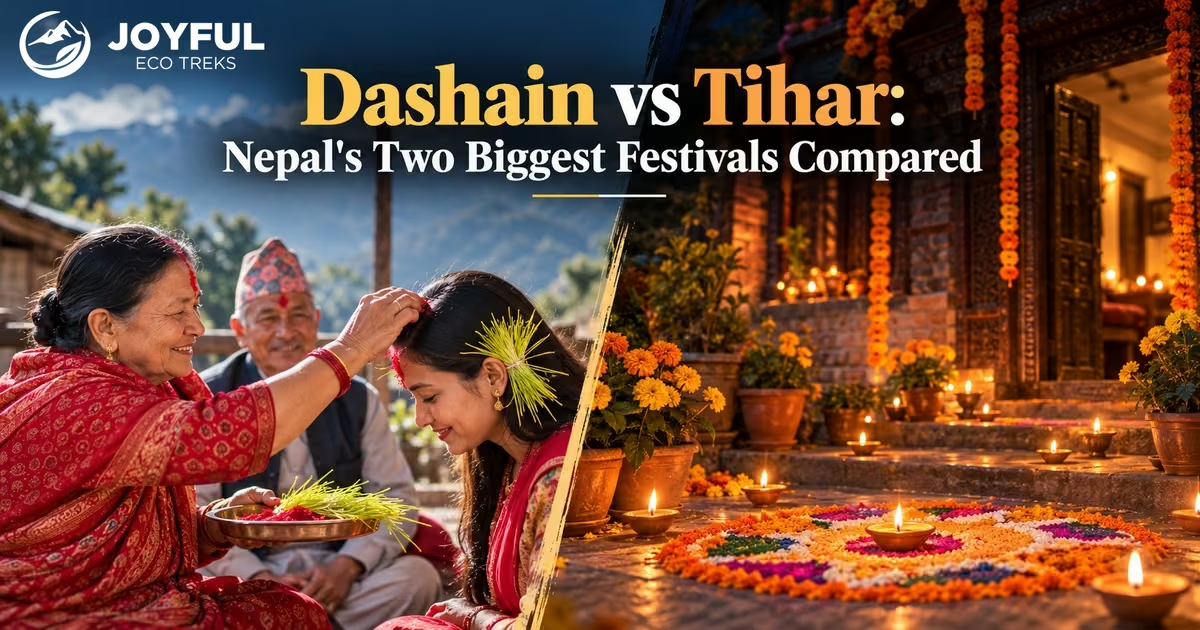
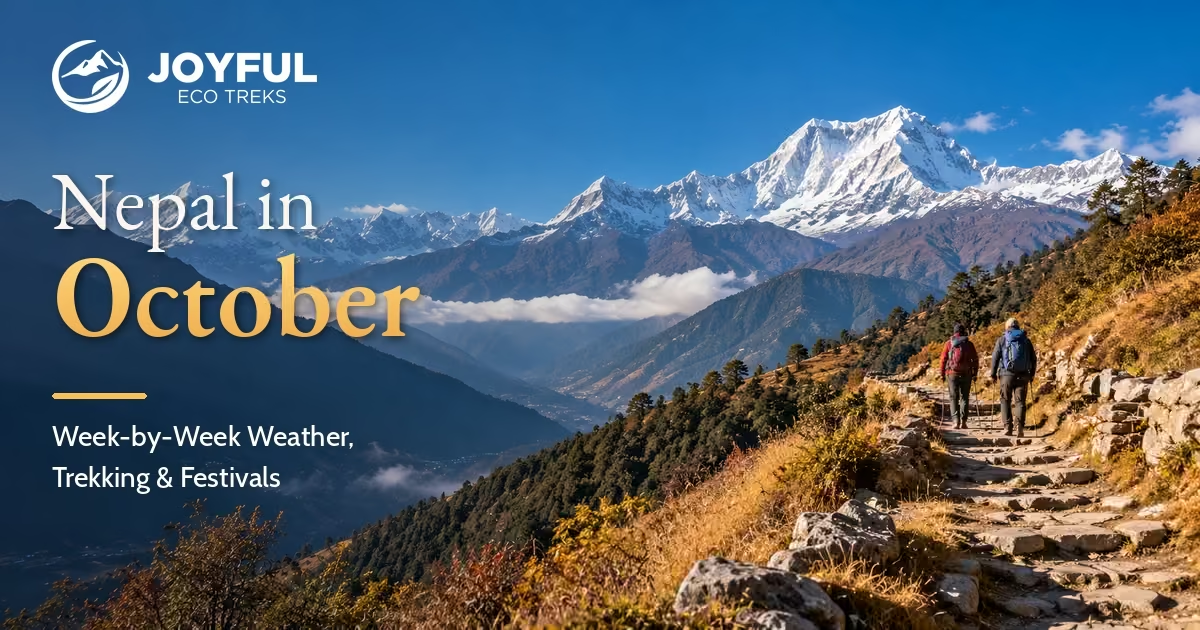
Plan around the month and you will miss the only decision that actually matters: which week you land. In 2026, Nepal in October splits into three travel windows, and they do not overlap the way most guides imply. Dashain runs October 11 to 25, with Tika day on October 21. Tihar, the festival of lights that nearly every October guide pairs with it, falls entirely outside the month this year. It runs November 7 to 11. That single calendar fact rewrites the back half of October and turns arrival timing into a genuine planning variable.
The real question is not whether to visit. October often brings some of the clearest mountain skies of the trekking year, though individual weather events can interrupt that pattern. The question is whether you are flying in for festivals, for post-monsoon trail conditions, or for a careful combination of both, because the ideal arrival date differs for each.
October in Nepal: Three Travel Windows in One Month
The 2026 Festival Calendar: When Dashain and Tihar Land
Dashain 2026 opens with Ghatasthapana on October 11 and builds to Vijaya Dashami (Tika day) on Wednesday October 21. Fulpati falls on October 17, Maha Ashtami on October 18, Maha Navami on October 20, and Kojagrat Purnima closes the cycle on October 25.
Tihar is the surprise. Most published schedules still slot it into late October; in 2026, it runs November 7 to 11, with Laxmi Puja on November 8. The night of lamps lands on day two this year alongside Kukur Tihar, so even schedules that get the month right often get the day order wrong. For the ceremony-by-ceremony detail, our Dashain vs Tihar guide and Tihar 2026 guide cover the rituals in full; here the dates serve only as scheduling anchors.
How Post-Monsoon October Compares to April and November
Kathmandu's skies clear measurably across the month. WeatherSpark's long-term data puts the daily chance of rain at roughly 27% on October 1, falling to around 4% by October 31, when skies are clear, mostly clear, or partly cloudy about 92% of the time. Set that against August, the monsoon peak, when rain soaks most of the month and the valley rarely sees a full clear day. That is why October usually favors outdoor planning, though historical averages cannot guarantee conditions on any particular day: the trails dry out, and the clouds lift as the month progresses, and Pokhara tracks a similar curve, trading its monsoon-soaked August for a largely dry October.
April, the other peak season, brings warmer trekking nights but hazier air and more afternoon cloud. October trades that warmth for clarity. At Namche Bazaar, April days run a few degrees warmer than late October, a gap you feel at altitude but one the clearer skies more than repay. Gosaikunda (4,380m on the Langtang circuit) carries overnight frost in both seasons; April afternoons are milder, yet late October delivers consistently sharper morning views before the haze builds. At Thorong La (5,416m on the Annapurna Circuit), April generally offers slightly warmer days but a higher chance of snow from late-season storms, while late October is often drier but can still bring heavy snow and pass closures. November can also bring snow and disrupted crossings, so real-time forecasts matter in both months. For mountain visibility over warmth, October out-ranks April.
Nepal Weather in October by Region
Kathmandu Valley: Post-Monsoon Skies and the Dashain Window
Expect Kathmandu's average daytime highs to ease from around 27°C to 24°C through October, with typical nighttime lows falling from about 17°C to 11°C. During Dashain the capital empties of its working population as families travel to home villages for Tika. The upside for a visitor is quiet streets and clean light; the downside is intercity transport booked solid. Our guide to what stays open and closed during Dashain covers the practical side of that week.
Pokhara and the Annapurna Foothills in October
Pokhara runs a touch warmer, roughly 18 to 28°C, with the Annapurna skyline mirroring off Phewa Lake on the clear mornings the month delivers. The lakeside serves as the natural staging point for Annapurna treks and stays comfortably temperate when the high camps are already freezing overnight. With only a handful of rain days in October against August's waterlogged weeks, the difference in trail quality is tangible from the first day on the route.
Above 3,500m: Daytime Highs, Overnight Lows, and First Snow
Above 3,500 metres, conditions change fast. By late October, nights drop below freezing at altitude. In the Everest corridor near 5,300 metres, daytime readings hover around freezing in the final week of the month, with nights far colder. Choose a sleeping bag rated for the expected subzero overnight temperatures, along with a proper down layer for when the sun drops behind the ridgeline. Do not rely on a seasonal label alone to judge sleeping-bag warmth.
Nepal Trekking in October: Route Conditions and Crowd Reality
Everest Base Camp: Permit Pressure and the Ramechhap Catch
October is the busiest month on the Everest Base Camp trail. Lodge beds at Namche, Dingboche and Lobuche fill up well in advance, and the trail carries a steady file of trekkers through the middle of the day.
One October-specific trap catches first-timers. During the busy trekking season, many scheduled Lukla flights depart from Ramechhap (Manthali) Airport rather than Kathmandu's Tribhuvan airport; Manthali is roughly five to six hours by road from the capital. Check the departure airport on your actual ticket before booking onward travel. If it is Manthali, build the drive, usually a pre-dawn start, into day one of the itinerary. Factor this logistics overhead into your planning rather than treating Lukla as a simple short hop from Kathmandu.
Annapurna Circuit and Base Camp: The Full-Loop Trade-Off
The Annapurna Circuit crosses Thorong La at 5,416 metres. October is generally a favorable time for the loop, but snow and sudden storms can affect Thorong La in either late October or November. Check the current pass status and weather before attempting the crossing. For the headline scenery without the pass and the three weeks it demands, Annapurna Base Camp delivers a shorter route from Pokhara that still reaches a genuine high-mountain amphitheatre.
Langtang Valley and Gokyo Lakes as Quieter Alternatives
Langtang reopened on October 23, 2026, after an August 26 flash flood in Rasuwa District tore out the Betrabati bridge. TAAN has confirmed access via a Bailey bridge at Betrabati, with Gosaikunda and the Tamang Heritage Trail open as well. One wrinkle on day one: check current accommodation availability in Syabrubesi and along the alternative approach before setting out, rather than assuming the old trailhead has operating lodges. Two approaches now exist, the standard Trishuli-to-Betrabati-to-Dhunche road or the Helambu-to-Gosaikunda crossing from the Kathmandu side. Reports citing TAAN advise verifying trail conditions before departure, sound counsel on any recently reopened route; the separate October 29 weather advisory is also essential during the current storm period. Gokyo Lakes, reached from the same Lukla corridor as Everest Base Camp, carries noticeably less foot traffic than the main EBC line for travelers who want altitude without the queue.
Dashain and Tihar 2026: What Each Window Changes
Dashain Week: Transport Closures and the Kathmandu Mood
The days around Vijaya Dashami, roughly October 19 to 22, are when domestic flights and long-distance buses can fill quickly as the country travels home. The trade is real: the atmosphere in the valley is at its fullest, but moving in or out of Kathmandu gets hard. For trailhead logistics during the festival, the dedicated piece covers the moving parts.
Why Tihar Sits in November This Year, Not October
Because Tihar runs November 7 to 11 in 2026, the final week of October carries none of the lights-festival atmosphere most guides promise. Instead it can offer a post-Dashain, pre-Tihar trekking window, but services may take time to normalize. In 2026, Nepal Tourism Board's October 29 weather advisory also warns against high-altitude travel during the expected heavy rain and mountain snowfall around October 30–31. Catching Tihar requires extending into early November, not staying inside October.
Week-by-Week October Arrival Framework
Each traveler type has a different sweet spot. Three profiles cover almost everyone.
Weeks One and Two: Festival Immersion, Reduced Services
Arriving October 10 to 15 puts you at the start of Dashain, which begins on October 11, with Tika on October 21 as the centrepiece. The cost is real: trailhead logistics slow down, and domestic flights around the 21st can fill early. This window suits a festival-first traveler who treats any trekking as a short add-on rather than the main event.
Week Three: Dashain Celebrations and Travel Demand
Arrive around October 15 to 21 and you enter Dashain's central celebrations, with Tika on October 21. Transport demand is high, some services may run on reduced schedules, and accommodation arrangements can vary. For a festival-first trip, this is the week to plan around the celebrations rather than a guaranteed smooth trek departure.
Week Four into November: Post-Dashain Travel and Tihar
After Kojagrat Purnima on October 25, festival travel pressure may ease, but the final days of October are not guaranteed to be safe for high-altitude trekking. Nepal Tourism Board's October 29 advisory warns of heavy rain and possible snowstorms and avalanches on October 30–31; postpone high-altitude travel while hazardous conditions persist. Return to Kathmandu by November 7 for Tihar's start and stay through November 8 for Laxmi Puja's main evening of lamps. A trek and Tihar can fit one extended trip, but seeing both Dashain Tika and Tihar also requires staying from October 21 into November.
Permits, Booking Lead Times, and October Costs
TIMS Card and National Park Permit Fees for 2026
For visitors from outside SAARC countries, Nepal Tourism Board lists NPR 2,000 for a TIMS card where required, NPR 3,000 for Sagarmatha National Park, NPR 3,000 for the Annapurna Conservation Area (ACAP), and NPR 3,000 for Langtang National Park. Khumbu Pasanglhamu Rural Municipality also lists NPR 3,000 for its local Trek-Card for visitors from outside SAARC countries and China. On the Everest Base Camp route, the park entry and local Trek-Card alone total NPR 6,000; confirm whether the national TIMS requirement applies to your itinerary, because published national guidance and local practice differ. Fee schedules can change, so check the Nepal Tourism Board and the relevant local authority before you budget.
Booking Lukla Flights and EBC Lodges for October
For a mid-to-late October trek, book Lukla flights and Everest Base Camp lodges three to four months in advance, which in practice means committing by late July. October is the single highest-demand month; lodge capacity at the upper villages is finite, and the best-run teahouses sell out first. Flight delays into and out of Lukla are common in any season, so build a buffer day at each end rather than scheduling an international connection against a same-day return.
Three October Itineraries Based on What You Want
No single itinerary fits Nepal in October; the right shape depends on whether festivals, trekking, or both pull harder.
Festival-First: 10 to 14 Days in Kathmandu and the Valley
Arrive by October 15 and settle into the Kathmandu Valley for Tika on October 21. Fill the surrounding days with Bhaktapur, Patan and the valley rim viewpoints, keeping any walking to day hikes rather than a committed high trek. You get the festival at full volume without fighting the altitude logistics.
Trek-First: 18 to 22 Days from Lukla or Pokhara
For a full Everest Base Camp or Annapurna Circuit trip, allow time for acclimatization and choose departure dates around confirmed weather and trail conditions rather than assuming an October 22 to 24 arrival guarantees safe trekking. Build in a rest day at Namche (3,440m) on the Everest side and another around Dingboche before pushing higher. Above 3,000 metres, aim to increase sleeping altitude by no more than about 500 metres per day, with extra acclimatization nights. Rushing the ascent profile is how fit, under-acclimatized trekkers end up turning back from routes they had the fitness to complete.
Late-October Crossover: 14 Days with Tihar and a High Route
Plan any trek around the latest forecasts and route advisories instead of assuming the final week of October will be clear. Descend to Kathmandu in time for Laxmi Puja on November 8 if you want to see Tihar's main evening of lamps. A 14-day crossover can pair a suitable trek with Tihar if conditions allow, but it cannot include both Dashain Tika on October 21 and Laxmi Puja on November 8.
October in Nepal: Frequently Asked Questions
Which week of October is best for trekking around the festivals?
After the main Dashain celebrations, October 26 to 28 may bring fewer festival-related travel disruptions, but clear skies and open trails are not guaranteed. In 2026, the official October 29 warning makes the final days of the month unsuitable for starting a high-altitude trek during hazardous weather. Check forecasts and local trail reports before choosing your arrival week.
Can you see both Dashain and Tihar in one October trip?
Not within October alone this year. Dashain's Tika is October 21, but Tihar runs November 7 to 11. Catching both means attending Tika on October 21 and extending into November for Laxmi Puja on November 8, with any trekking in between subject to current weather and route advisories.
How cold is Everest Base Camp in late October?
Near Base Camp at roughly 5,300 metres, daytime temperatures hover around freezing in late October, with nights falling well below it. A sleeping bag rated for expected subzero nights, an insulated down jacket, and a full layering system are essential for the upper villages.
Does Dashain affect lodge availability on the trekking routes?
Less than you would expect on the trails, more than you would expect getting to them. Trailhead transport and domestic flights book out around October 21; lodge beds fill because October is peak season generally, not specifically because of the festival. Reserve three to four months ahead regardless of which dates you choose.
Late October or early November for the Annapurna Circuit?
Late October often offers favorable seasonal conditions, but Thorong La can receive snow in either late October or early November. During the October 29–31, 2026 weather warning, do not attempt a hazardous crossing; rely on current forecasts and verified pass conditions rather than the calendar alone.
Ready to pin down your dates? Explore our Dashain and Tihar guides to build your October festival itinerary around the exact week you want to land.