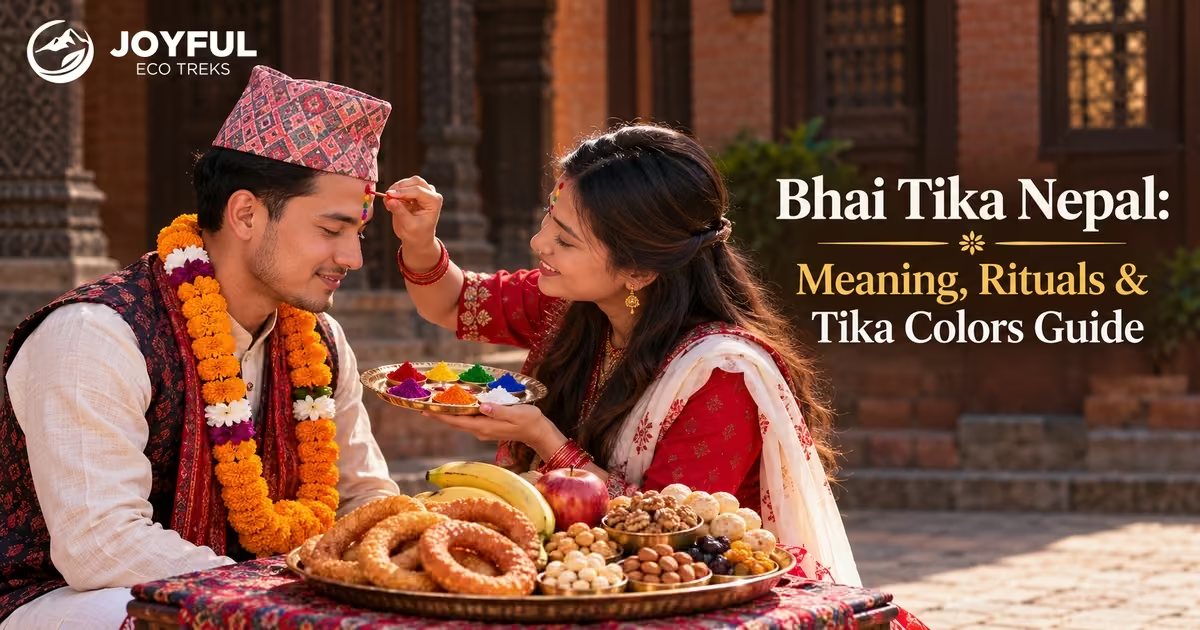
On the fifth morning of Tihar, sisters across Nepal wake before the auspicious hour to grind rice into paste, warm mustard oil, and thread garlands chosen because they refuse to wilt. Bhai Tika Nepal asks them to do nothing less than hold death at a distance from their brothers. Seen from the doorway, the rite looks plain: a sister lays a band of color on her brother's forehead, feeds him, and receives a gift in return. Underneath runs a dense logic, a seven-color tika most English sources leave undecoded, and a sequence of invocations that can occupy a family for the better part of a morning. This guide works from that logic outward, from the myth that gives each gesture its reason to the saptarangi colors whose meanings even Nepali scholars debate.
Bhai Tika as the Fifth and Final Day of Tihar
Where the Day Sits in the Tihar Calendar
Bhai Tika falls on Kartik Shukla Dwitiya, the second day of the bright lunar fortnight of Kartik, placing it as the fifth and closing day of Tihar. The four days before it look outward and upward: crows, dogs, and cows receive their honors, Laxmi is welcomed for wealth, and Newar households turn inward for Mha Puja. In 2026, Bhai Tika falls on Wednesday, November 11 (Kartik 25, 2083 BS). Cross-check the Tihar 2026 Nepal dates guide for the full festival calendar, since the lunar calendar shifts the festival slightly each year.
Why the Finale Belongs to the Sibling Bond
By the fifth day, the household has thanked its animals, its goddess, and itself. What remains is the relationship a family carries longest. Bhai Tika closes the festival on its most human note: one person formally wishing another a long life, and backing the wish with ritual rather than words alone.
The Yamuna and Yama Legend Behind Every Ritual Step
How a Sister Bargained with the God of Death
In one Nepali telling, the Kirati king Bali Hang lay gravely ill when Yamaraj, the god of death, came for him. His sister Jamuna met him with a ceremony built to buy time, marking her brother's forehead with tika, circling him with sprinkled water, hanging a garland of slow-fading flowers at his neck, and laying out offerings. Then she set her conditions. Death could claim her brother only once the tika had faded from his skin, the sprinkled water had fully dried, and the garland had wilted. In this telling, her brother was spared.
Why the Names and Legends Differ
The brother's name is where tellings diverge. Sanskrit-leaning sources call him Govardhan; Nepali folk tradition names him Bali Hang; other popular retellings supply still different names. The variation is worth stating plainly rather than smoothing over, because it marks the exact seam where a pan-Hindu myth was absorbed into local Nepali storytelling. A guide that pretends the name is settled quietly rewrites the record.
What Each Condition Became in Today's Ceremony
Several objects a sister handles on Bhai Tika morning can be read as Jamuna's conditions made physical. The tika is drawn with sindoor and layered color precisely because the myth hinges on a mark that fades slowly. Circles of oil and water around the brother echo the protective boundary described in Nepali tellings. The garland is woven from makhamali, the globe amaranth, chosen because it holds its color like dried paint and takes an unusually long time to wilt, stretching the third condition as far as a flower can stretch it. Read this way, the ceremony is less a set of customs than a single, repeated argument with death.
The Saptarangi Tika: What Each of the Seven Colors Means
Start with a disagreement most travel guides never mention: nobody fully agrees on how many colors the tika should have. Prof. Dr. Devmani Bhattarai of the Nepal Panchang Nirnayak Bikash Samiti holds that classical religious texts prescribe five colors, red, white, yellow, green, and blue. The seven-color saptarangi tika that now dominates Nepali markets every autumn is, by this reading, a newer popular development rather than a scriptural rule. A widely sung Bhai Tika festival song associated with Dr. Vasudev Krishna Shastri, also known as Dr. Vasudev Koirala, did much to push public taste toward seven.
On the meanings themselves, the authorities diverge again. Dr. Koirala assigns the seven colors as follows: white for peace, blue for health, black for resistance and protection, yellow for spirituality, green for growth, purple for freedom, and red for courage. Prof. Mukunda Raj Aryal, quoted in a newspaper decoding of the saptarangi tika, reads part of the spectrum differently: white for purity and peace, red for good fortune and valor, green to clear obstacles, yellow to guard against disease, and blue for spreading one's glory, with the remaining hues treated as part of the rainbow rather than carrying discrete blessings.
The table below presents both scholarly framings for each color side by side. It does not impose a fixed order, because the sequence varies across families and practices.
Color | Nepali Name | Position | Dr. Koirala's Blessing | Prof. Aryal's Blessing |
|---|---|---|---|---|
White | Seto | 1st | Peace | Purity and peace |
Blue | Nilo | 2nd | Health | Spreading one's glory |
Black | Kalo | 3rd | Resistance and protection | (part of the rainbow arc) |
Yellow | Pahelo | 4th | Spirituality | Protection against disease |
Green | Hariyo | 5th | Growth | Clearing obstacles |
Purple | Baijani | 6th | Freedom | (part of the rainbow arc) |
Red | Rato | 7th | Courage | Good fortune and valor |
Whichever count a family uses, the colors are generally understood through the full rainbow spectrum, and the whole band carries a wish larger than any single hue. Astrologer Dr. Birendra Prasad Kayastha has described the saptarangi tika as a sister's wish that her brother shine with the power of the sun. That framing holds up when the per-color meanings start to contradict each other: taken together, the point is radiance and endurance.
This is also where Nepal's Bhai Tika stands apart from many Indian Bhai Dooj ceremonies. A single red tilak is common in India, while Nepal's saptarangi practice spreads a whole spectrum across the forehead, contested meanings and all. That spectrum is one of the tradition's most recognizable signatures.
How the Bhai Tika Ceremony Unfolds, Step by Step
The Night Before
The work starts the evening before, while the brother is often still out at Deusi Bhailo. Sisters soak and grind rice for akshata, gather sindoor, flowers, fruit, and sweets, and arrange everything on the brass thaal alongside the kalash of sacred water at the center. Nothing about the morning is improvised. By sunrise the thaal is a small, deliberate inventory of everything the myth requires.
Timing Set by the Panchang
No fixed clock time governs the ceremony. The auspicious hour, the muhurta, is recalculated each year by the panchang. In 2023, for instance, panchang astrologers set it at 10:51 in the morning. That hour is preferred, but the tika can also be offered at other times during the day.
The Mandap, the Circles, and the Order of the Gods
Seated inside the mandap, the ritual space, the brother watches his sister begin not with him but with the gods. In a commonly described sequence, the sister worships Ganesh, Yamaraj, the lord of death, Yamuna, the record-keeper Chitragupta, and the Ashtachiranjeevi, the eight immortals, namely Vyasa, Ashwatthama, Parshuram, Kripa, Bali, Hanuman, Vibhishana, and Markandeya, each asked to lend the brother a share of their deathlessness. Some households also invoke the Navagraha, or nine planets; the exact order varies by family. This roll call explains why a full Bhai Tika can run for hours rather than minutes.
With the gods invoked, the sister may circle oil and holy water around her brother, three times in one documented practice, then worship him directly with flowers, akshata, popped rice, and oil smoothed into his hair. Only then comes the tika itself, the saptarangi band pressed onto his forehead, followed by makhamali and marigold garlands at his neck.
Cracking Walnuts to Break Death's Grip
During the ceremony, the sister cracks walnuts, an act often read as symbolically breaking obstacles and guarding her brother against harm. The myth turns briefly physical, death's grip broken with an audible snap.
The Feast and the Gifts
After the tika, the brother bends to touch his forehead to his sister's feet, a gesture of respect that momentarily inverts the usual order of a Nepali household. Then the eating begins. Some families also light rows of oil lamps through the house, by custom as many as 108, a count treated as auspicious across Hindu practice. The brother leaves with the tika still bright on his forehead; a gift of cash or clothing is pressed into his sister's hands in return.
What Sisters Place on the Bhai Tika Thaal
Ritual Items Every Sister Gathers
Every Bhai Tika Nepal thaal carries the same core even as extras vary by family. Sindoor and akshata serve the tika itself; a mustard oil lamp and the kalash of sacred water anchor the arrangement. Two flowers do distinct symbolic work: saypatri, the marigold, and makhamali, the globe amaranth, prized because it keeps its color long after cutting, a living stand-in for a blessing that should not fade. Dubo grass joins them because it never truly withers, making it a plain emblem of immortality. Bimiro, the citron fruit, earns its place through the myth: both Yamaraj and Yamuna are said to favor it, so offering it folds the deities' own tastes into the rite.
Festival Foods Placed Before the Brother
Sel roti, the ring-shaped rice bread, anchors the plate, joined by sweets such as laddu, halwa, and kheer, and fresh fruit including apples, walnuts, and dried figs. Dr. Koirala recommends going further, serving dishes that cover all six tastes: sweet, sour, salty, bitter, pungent, and astringent, so the meal stands for the full balance of a life the sister is wishing long. For the wider festival spread, the Tihar food guide covers the five-day table in detail.
How Newar Kija Puja Differs from the Pahadi Ceremony
Kija Puja: Naming, Calendar, and Ritual Variations
Among Newar families, the same day carries a different name, Kija Puja, from the Nepal Bhasa word for a younger brother. It lands on the identical lunar date, Kartik Shukla Dwitiya, but inside a different rhythm. The Newar festival week peaks the day before with Mha Puja, the self-worship rite that opens Nepal Sambat, the Newar new year, so the sibling ceremony arrives as part of a larger renewal rather than as a standalone finale.
The ritual sequence has distinctive features in many Newar homes. A mandala is prepared for the brother, as in Mha Puja, and offerings can include Jaki Sinha, a tika mixture made with ingredients such as rice, curd, beaten rice, abir, and water, along with Sagun offerings. The details vary by family and locality rather than following a single order everywhere. The naming and the surrounding new-year framing are distinctly Newar; the core acts of tika, oil, garland, and feast are shared. For the broader Mha Puja context, that explainer traces the new-year rites that Kija Puja follows.
Bhai Tika and Bhai Dooj: Where the Two Traditions Diverge
Across the southern border, the sibling festival is Bhai Dooj, and the two are cousins rather than twins. Their shared roots are clear in the Yama–Yamuna story, told in both Nepal and India, even as regional accounts and ritual details diverge. One visible distinction is the tika: a multicolored saptarangi band is familiar in Nepal, while a red tilak is common in many Indian Bhai Dooj ceremonies. The oil-and-water boundary around the brother is another prominent feature of several Nepali observances, though practices vary across communities on both sides of the border. A separate guide handles the India-side Bhai Dooj in full; the short version is that a shared sentiment runs through noticeably different hands.
Witnessing Bhai Tika in Nepal as a First-Time Visitor
Where the Ceremony Happens in Kathmandu
In Kathmandu on the fifth day of Tihar, the first thing to understand is that you are looking for a home, not a venue. Bhai Tika is overwhelmingly a private, indoor family rite performed around a thaal on a living-room floor rather than in a temple courtyard. One documented public exception endures for people without a sibling nearby: Bal Gopaleshwar Temple at Rani Pokhari, which traditionally opens on Bhai Tika so visitors can receive tika there. Beyond that, the festival is something you are far more likely to be invited into than to stumble upon.
What to Do, and What to Leave Alone
If a Nepali family invites you in, a few courtesies matter. Take your shoes off at the door, dress modestly, and ask before photographing the tika itself, since the moment is devotional rather than scenic. Do not step through or over the mandap, accept any prasad or food with your right hand, and resist treating the ceremony as a performance staged for your camera. The surest way to honor the day is to receive it as the family does, as something serious and affectionate at once.
Bhai Tika Nepal: Frequently Asked Questions
What do the seven colors of the bhai tika saptarangi represent?
Together they represent a wish for the brother's long, protected, and prosperous life, with each hue carrying its own blessing in the fuller readings. By Dr. Vasudev Koirala's account, the seven run: white for peace, blue for health, black for protection, yellow for spirituality, green for growth, purple for freedom, and red for courage. Prof. Mukunda Raj Aryal's reading overlaps in places and diverges in others, assigning red to good fortune and valor and blue to spreading one's glory. Treat any single list as one respected framing rather than a fixed code.
What is the difference between bhai tika in Nepal and bhai dooj celebrated in India?
One visible difference is the tika itself: Nepal commonly uses a multi-color saptarangi band, while many Indian Bhai Dooj ceremonies use a red tilak. Both traditions share the Yama–Yamuna legend, but oil-and-water circles are a particularly familiar part of several Nepali ceremonies, with regional variations on both sides of the border.
Can a sister perform the bhai tika ritual if her brother lives abroad or cannot be present?
Yes. When a brother cannot attend, families commonly perform the tika in his absence, sending the blessing and sometimes the prasad on to him, or relying on a cousin or community gathering so no one is left without. In Kathmandu, people without siblings can traditionally receive tika at Bal Gopaleshwar Temple in Rani Pokhari, which opens to the public on Bhai Tika.
What time of day does the bhai tika ceremony traditionally begin?
No single fixed time applies, because the auspicious hour is set fresh each year by the panchang. In 2023, for example, panchang astrologers calculated the muhurta at 10:51 in the morning. Families should check the current year's panchang rather than assuming a standard hour; tika can also be offered outside the preferred muhurta during the day.
What foods are traditionally served to brothers after the bhai tika ceremony?
Sel roti anchors the plate, joined by sweets such as laddu, halwa, and kheer, and fresh fruit including apples, walnuts, and dried figs. Some families follow Dr. Koirala's guidance and serve dishes spanning all six tastes, sweet, sour, salty, bitter, pungent, and astringent, as a symbol of a balanced life.
How do Newar families celebrate bhai tika differently from Pahadi families?
Newar families call the day Kija Puja and observe it as part of the festival week that peaks with Mha Puja and the Newar new year, Nepal Sambat, the day before. Beyond the naming and the surrounding new-year framing, many Newar households prepare a mandala for the brother and offer Jaki Sinha tika and Sagun, although the details differ across families.
Bhai Tika is the quiet, human close to Nepal's loudest festival, and it reads best with the rest of Tihar in view. Read the complete guide to all five days of Tihar to see how the sibling rite fits the full arc, from the crows of the first morning to Laxmi Puja's lamps.