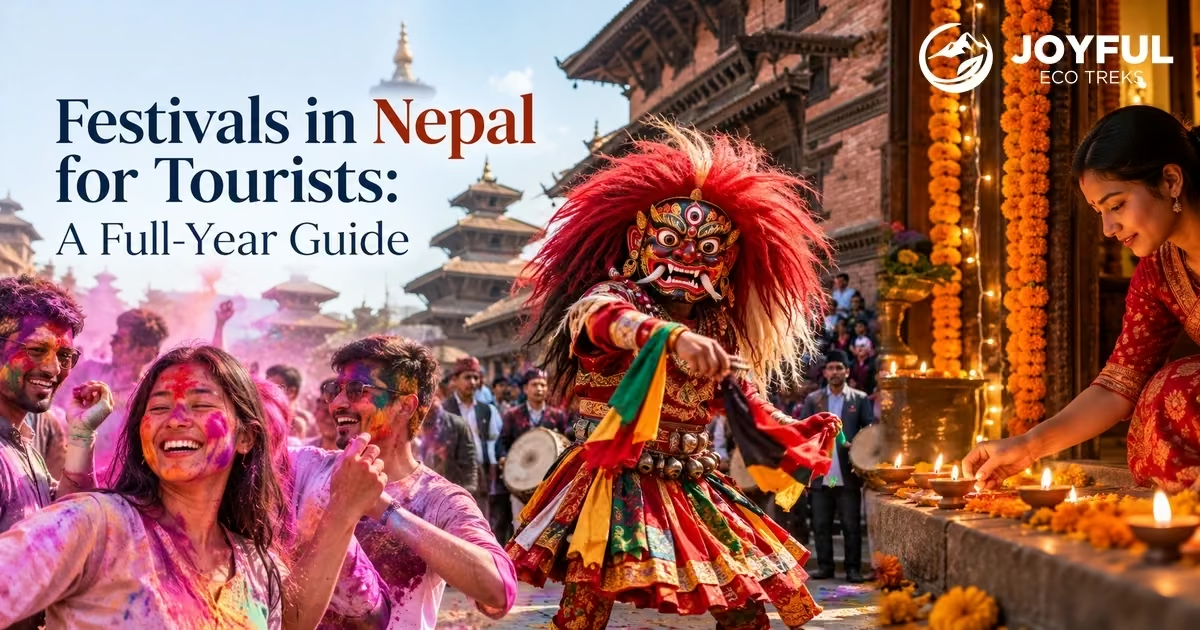
You have two or three weeks for Nepal and a return date you can still move, which means you can build the trip around a festival. The only real question is which one. Most guides to festivals in Nepal for tourists hand you a chronological list and leave the judgment to you, so a quiet dawn ritual and a city-stopping masked parade end up reading as equal claims on your airfare. They are not equal. This guide rates each major festival on the four things a visitor actually feels: how much there is to see, how easy it is to join in as a foreigner, whether it helps or fights your trekking plans, and how hard you will have to compete for a bed and a seat on the plane.
One note on dates before anything else. Nepali festivals follow lunar and lunisolar calendars, so most of them drift by a week or two each year against the Western one. The dates below are confirmed or projected for 2026 and 2027. Lock the exact day against the Nepal Tourism Board calendar once you are inside your booking window, because a festival that shifts three days can be the difference between catching the main procession and watching the cleanup.
When to Go: Nepal's Festival Calendar by Season
Nepal runs two festival seasons that matter to travelers, and they could hardly be more different in feel or in price.
Autumn, September to November: the peak everyone competes for
Four headline festivals stretch across the autumn calendar: Indra Jatra in September, Dashain in October, Tihar in late October or November, and Chhath shortly after it. October and November also bring some of the clearest trekking weather of the year, with settled skies after the monsoon and sharp mountain views. That overlap is exactly the problem. Every trekker, every pilgrim, and every Nepali returning from abroad wants the same weeks, so flights, buses, and hotels run at capacity and at their annual high. If your heart is set on autumn, you are either booking early or paying for the luxury of deciding late.
The spring window: Losar, Holi, and Buddha Jayanti
Spring is the underrated half of the year, and it shapes more smart decisions than the calendar suggests. Gyalpo Losar falls in late February or early March, Holi in March, and Buddha Jayanti on the May full moon. Mountain views hold strong into April, crowds thin out, and room rates sit well below the October ceiling. You give up the sheer density of autumn for breathing room, and for many first-time visitors that is the better trade.
Festivals in Nepal for Tourists: How the Five Big Ones Compare
Here is the comparison the rest of the internet skips. The five festivals in Nepal for tourists that generate the most planning questions are Dashain, Tihar, Indra Jatra, Losar, and Holi. The table below rates each on four axes that decide whether a festival earns a line in your itinerary.
Festival | Visual spectacle | Access for foreign visitors | Trekking-season fit | Advance booking pressure |
|---|---|---|---|---|
Dashain | Low in public; it happens indoors | Low; a private family rite | Peak weather, but services shut | Severe |
Tihar | High; lamps and lights city-wide | High; welcoming and public | Peak weather | High |
Indra Jatra | Very high; masked street theatre | High; public streets and squares | Season's start, trails still busy | Low to moderate |
Losar | Moderate; prayers and gatherings | Varies; join with an invitation | Late winter; cold, some closures | Low |
Holi | High; mass color play | High; join with consent | Spring, clear views | Moderate |
This matrix is Joyful Eco Treks' own reading, built from public festival calendars and the current search landscape rather than any single source. Two patterns fall straight out of it. Dashain is the festival everyone names and the one with the least for a tourist to actually watch, because it unfolds behind family doors while the country closes around you. Indra Jatra is the reverse: the most dramatic thing on a public street all year, and almost nobody plans a trip around it.
Dashain in October: The Biggest Festival and the Shutdown It Brings
Dashain earns its billing as Nepal's largest and most socially important festival. For a visitor, it is also the most overrated on the ground, and knowing why saves you a wasted week. The celebration runs roughly fifteen days, beginning around September 30 in 2027, with tika on October 10, but the portion a tourist can witness is thin. The meaning lives inside the home, in family reunions and blessings, which is precisely the part a stranger cannot step into. Our Dashain festival guide covers the full ritual arc; the task here is to tell you what to expect if you arrive as an outsider.
What tourists actually see on Tika day
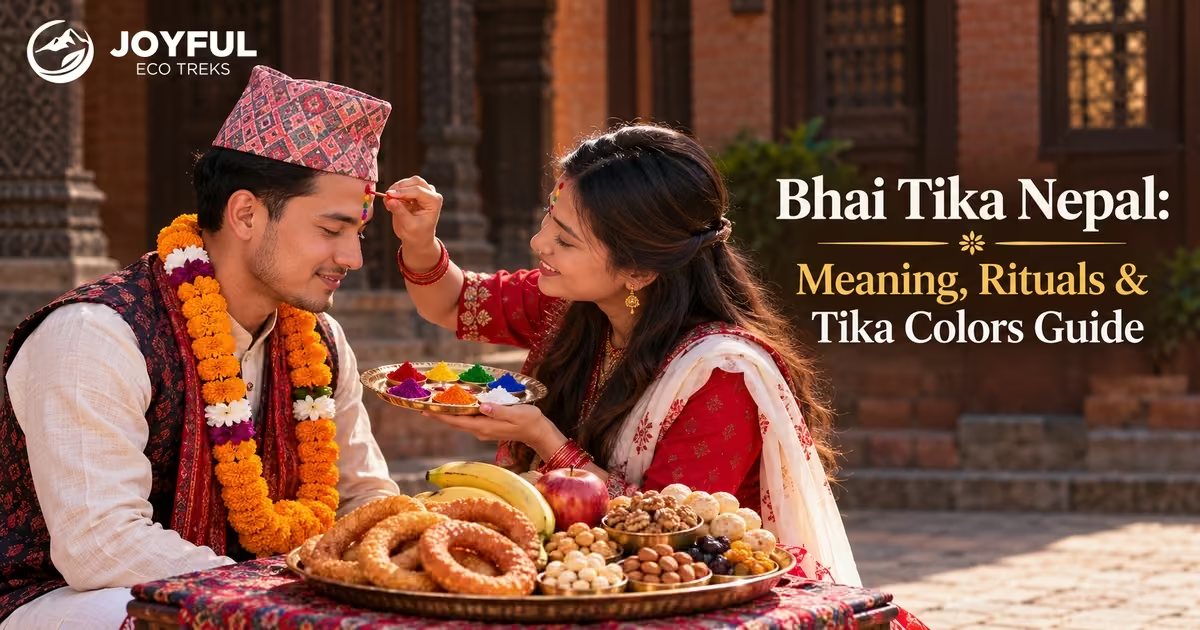
The visible peak is Vijaya Dashami, when elders press a paste of red vermillion, rice, and yogurt onto the foreheads of younger relatives and tuck sprigs of yellow jamara barley behind their ears. Across the city, families dressed in their best cross town to pay respects. Animal sacrifices happen at some temples earlier in the festival. What you will not see is a public spectacle built for onlookers. Tika day is for observation, not participation, and quiet photography, not a crowd event.
The shutdown is the real planning issue
Treat Dashain as a national pause. Across the core days, government offices, banks, and a large share of shops close, and Kathmandu empties as residents travel to their home villages. Long-distance buses fill and run on holiday schedules. Trekking routes are not closed by Dashain itself, but permit services can run on limited holiday schedules, and resupply, transport, and logistics get harder for the week. Plan your cash, your transfers, and your tea-house stops before the shutdown arrives, or build the trip so these days fall on a stretch of trail that needs little from the towns.
Tihar in November: Five Nights of Lights
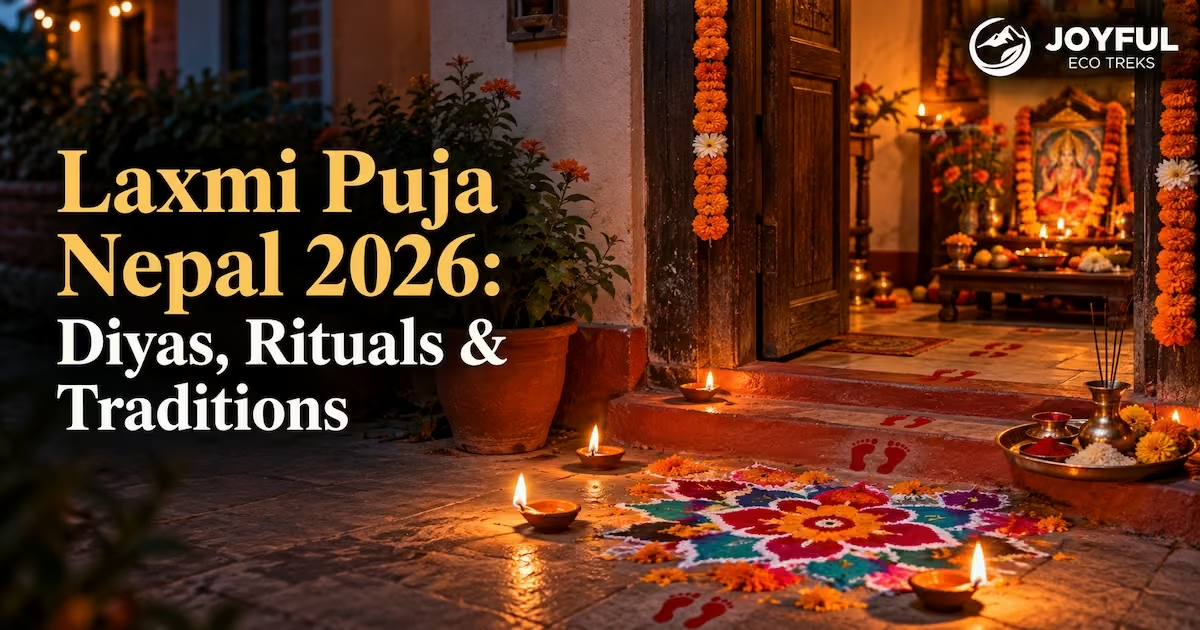
If Dashain is the festival you cannot really join, Tihar is the one that opens its arms. Over five nights, running November 7 to 11 in 2026, Kathmandu turns itself into a field of oil lamps, candles, and electric strings, with marigold garlands over doorways and intricate rangoli patterns chalked onto thresholds. Laxmi Puja on November 8 is the brightest night, when every household lights every lamp to welcome the goddess of wealth. The full day-by-day meaning sits in our Tihar guide. What matters for a visitor is that this festival happens on the street and every street takes part.
Where to see the best light displays in Kathmandu
For concentration and atmosphere, the old quarters carry the most weight. Patan's lanes around its Durbar Square hold the densest lamp displays, and the courtyards of Newari homes there take the detail seriously. Bhaktapur offers the same craft with fewer people. In central Kathmandu, Thamel runs the louder, more commercial version, including roving Deusi-Bhailo singing groups going door to door. One simple rule holds: the more residential and the older the neighborhood, the better the lights and the quieter the night.
Indra Jatra: Kathmandu's Street Festival in September
Indra Jatra is the most underwritten festival on the tourist internet and, for pure spectacle, the one worth sending a first-timer to before any other. Over its eight days in September, with the main Indra Jatra day projected for September 14 in 2027, the stage is Basantapur Durbar Square at Hanuman Dhoka in front of the old palace. King Gunakamadeva founded the festival around the 10th century to mark the founding of the city, and the Kumari chariot procession was added in 1756 under Jaya Prakash Malla.
The Seto Bhairav mask and the beer that flows from it
Start with the moment every competitor page buries or omits. Once a year, a giant gilded mask of Seto Bhairav, the white wrathful deity, is unveiled on the square. A pipe set into its mouth dispenses rice beer and millet spirit (raksi) straight into the crowd pressing below on certain days, and catching a mouthful is held to be a blessing. Loud, physical, and genuinely unlike anything else on the calendar. Stand close if you want the experience and are comfortable in a crush; hang back a row if you would rather photograph it than wear it.
The Kumari chariot and the all-women pull
Three wooden chariots carrying Ganesh, Bhairava, and the Kumari are hauled through the old city over three days, with procession times varying by day. The Kumari, a young girl venerated as a living deity, rides the tallest of them. Since 2012, an all-women team has pulled her chariot on the third day, a recent shift worth knowing if you want to understand what you are watching rather than just filming it. The crowds are serious but good-natured, and the main events unfold across walkable old-city streets and squares, which is a large part of why it is so accessible.
Chhath Puja: Dawn River Rituals in November
Chhath is the quietest spectacle on this list and, in its own restrained way, one of the most moving. Falling November 13 to 16 in 2026, four days after Tihar, it centers on sun worship performed at the water's edge by devotees, mostly women, observing a demanding fast. The detailed ritual structure sits in our dedicated Chhath guide. For a visitor, the relevant thing is the staging: this is a river festival, performed in the open, at the hinge hours of dusk and dawn.
Bagmati ghats and Kamalpokhari: what to see and when
The visual peak is the sunrise arghya on the final day, November 16 in 2026. Devotees stand waist-deep in cold water offering fruit and flowers to the rising sun. In Kathmandu, Gaurighat along the Bagmati River and Kamalpokhari are among the established sites for Chhath gatherings. Arrive well before first light, because the offering is timed to the sun and the crowd settles into stillness as it rises. Keep to the banks, keep quiet, and let the devotees have the water. This is observation, not participation.
Losar: Tibetan New Year on the Trekking Routes
The single most useful thing to know about Losar: it is not one festival. Three separate New Year celebrations carry the name. Tamu Losar is for the Gurung community, Sonam Losar for the Tamang, and Gyalpo Losar for Sherpa and Tibetan communities, each falling on its own date between December and March. Competitor pages collapse all three into one February entry, which leaves a Khumbu-bound trekker with nothing to act on. For the Everest and high Himalayan routes, the one that matters is Gyalpo Losar, falling on Tuesday, March 9 in 2027, a national holiday.
Tengboche and Namche: Losar at altitude
Gyalpo Losar is the rare festival you are better off seeing on the trail than in the capital. At Tengboche Monastery, 3,867 meters on the approach to Everest Base Camp, visitors may encounter Losar prayers and community celebrations; the monastery's famous masked dances belong to Mani Rimdu, a separate autumn festival. In Namche Bazaar, households serve khapse fried pastries and exchange the greeting Tashi Delek. Early March sits in the low season: the trails are often quiet, but cold weather, snow, and seasonal tea-house closures can complicate the trek. Cultural depth and a quiet mountain at the same time are possible, provided you plan for winter conditions.
Holi: Nepal's Color Festival for Tourists
Holi is one of the most participatory days in Nepal, when foreign visitors can join the color play, provided everyone involved is willing. It falls March 21 in the hilly regions, including Kathmandu, and March 22 in the Terai plains in 2027, which puts Nepal's hill celebration a day ahead of the main Indian one. Powder colors and water balloons appear in tika shops about a week out. The old advice to leave your camera at home is dated now that waterproof phone pouches are cheap and everywhere, but the spirit behind it holds: wear clothes you will discard, and assume everything you carry will end up wet and pink.
Basantapur Square versus Pokhara lakeside
The two prime stages have distinct characters. Basantapur, in Kathmandu's Durbar Square, delivers the dense, loud version: thousands of people and sound systems packed into a historic square. Pokhara's lakeside is the mellower choice, more open, more space to step away when you have had enough, and a backdrop of water and hills instead of walls. Maximum intensity sits in central Kathmandu. An easier entry and exit sits at the lake.
Holi for solo female travelers
Holi can be a genuine high point for a solo female traveler, and it also calls for more deliberate choices than any other festival here. The atmosphere can be friendly, but color play involves physical contact: grabbing, smearing, the occasional water dousing, and sometimes unwanted attention. In a dense, anonymous crush, that contact becomes harder to manage alone. The practical answer is not to skip it. Travel with a group for the main hours, favor the open Pokhara lakeside or an organized hotel party over the thick of Basantapur, keep valuables sealed and at your hotel, and set an early finish before the afternoon drinking builds. Handled that way, it is one of the warmest welcomes the country offers.
Bisket Jatra: Bhaktapur's New Year Chariot Pull
Most pages file Bisket Jatra under "another chariot festival" and give you no reason to leave Kathmandu for it. The reason is a 25-meter wooden pole and a tug-of-war fought with a deity's chariot. Anchored to the Nepali New Year, Baisakh 1, the festival runs for about nine days around April 14, which is New Year's Day in 2027. Everything plays out in Bhaktapur, through the city's tight medieval lanes rather than an open square, which makes for a different and more intimate kind of chaos.
The lingo pole at Khalna Tole
The chariot of Bhairava is assembled and then dragged through the streets, moving between Taumadhi Square, the ceremonial heart of the procession route, and Khalna Tole, where the festival reaches its visual peak with the lingo. The lingo is a roughly 25-meter ceremonial pole raised upright at Khalna Tole on the eve of the New Year and pulled down on New Year's Day, a felling that marks the turn. Around it, the upper and lower halves of town haul the heavy chariot in opposite directions, each side working to drag it into their own quarter. Physical, slightly dangerous, and with no stage-managed tourist version. Stand on a temple plinth or a balcony for the pole, because the ground-level crowd around a toppling 25-meter mast is no place to be casual.
Buddha Jayanti: Swayambhu, Boudha, and Lumbini
Buddha Jayanti commemorates the Buddha's birth, enlightenment, and passing on the full moon, projected for May 20 in 2027. Serene and devotional rather than loud, it layers neatly onto a late-spring trip when autumn crowds are gone and the lower hills are green. In Kathmandu the focus splits between Swayambhunath, the hilltop stupa above the valley, and Boudhanath, whose great circuit fills with pilgrims, butter lamps, and prayer flags at full moon.
Lumbini as a trip from Pokhara or Kathmandu
The deepest version of the day is at Lumbini, the Buddha's birthplace in the Terai, where monasteries built by Buddhist nations worldwide hold ceremonies. The road from Pokhara usually takes about six to eight hours by bus, depending on road conditions, with some services connecting through Bhairahawa for the final stretch to Lumbini. From Kathmandu the journey runs longer. Either way, treat Lumbini as a destination in its own right, give it a night, and you will experience the festival far better than a rushed turnaround allows.
Teej: Women's Pilgrimage at Pashupatinath
Teej is a women's festival, falling across August and September, and it produces one of the most photogenic gatherings of the year without being staged for cameras. Married and unmarried women dress in red bridal saris and converge on Pashupatinath, the great Shiva temple complex on the Bagmati in Kathmandu. Many fast for 24 hours and bathe in the river as an act of devotion. The crowds of red against the temple stone are striking, and the atmosphere throughout is communal rather than solemn.
The Dar Khane feast and what visitors can watch
The social heart of Teej is Dar Khane, the rich feast women share the night before the fast begins, often with singing and dancing among female relatives and friends. A visitor will mostly encounter the public face: the processions and the fasting gatherings at Pashupatinath. Watch with restraint, keep a respectful distance at the bathing ghats, and remember that the temple's inner sanctum is open only to Hindus. This is a day to witness a tradition that is not yours, graciously, from its edges.
Gai Jatra: Newari Satire and Memory in Bhaktapur
Gai Jatra is the festival the whole search landscape gets wrong by filing it as a "cow procession for the dead." That description is technically accurate and misses the entire point. Falling around August, it is built on grief and dark comedy at once. Families who have lost a member in the past year lead a cow, or a child dressed as one, through the streets of Bhaktapur and Kathmandu, in the belief that the animal guides the departed soul onward. The public mourning is real, and so is the humor layered deliberately over it.
Why Gai Jatra tells you more than most temples
For one day, ordinary rules of deference relax. Performers lampoon politicians and public figures, Newari newspapers print pages of satirical cartoons, and comedy becomes a sanctioned public release. Nowhere else does a Nepal festival process death and dissent through the same procession. Spend a morning watching it in Bhaktapur and you will read the texture of Newari society, its way of carrying loss lightly and speaking truth sideways, more clearly than a week of monument visits would teach you. That is not a claim most festivals on this list can make.
Three Festivals Worth Rearranging Your Flights For
Most of the calendar is worth catching if you happen to be there. Of all the festivals in Nepal for tourists, only three repay the effort of actively bending a flight schedule around them.
Tihar in Kathmandu, for the fullest visitor experience
Tihar wins on sheer accessibility of wonder. The city becomes genuinely beautiful for five nights, the festival unfolds in public where anyone can share it, and the welcome is warm rather than closed. The most visually rich and openly welcoming festival in Nepal. Accept that you are booking into the autumn peak and plan accordingly.
Indra Jatra, for cultural depth without the Dashain crowds
Indra Jatra delivers the most dramatic public theatre of the year: the Seto Bhairav rite and the living goddess in one walkable square. It draws nothing like the overtourism pressure that surrounds Dashain, and it lands in September just ahead of the booking crunch, so maximum spectacle arrives with comparatively sane logistics. For cultural depth per day spent, nothing else on the calendar competes.
Losar, for trekkers heading to Khumbu or Annapurna
If the mountains are the real reason you are coming, consider timing the trek to Gyalpo Losar on March 9, 2027. You may encounter Sherpa and Tibetan New Year celebrations around Tengboche and Namche, set against quiet low-season trails, but snow, cold, and limited lodging require advance planning. The one festival here that can add a distinctive cultural dimension to a winter-season trek.
Frequently Asked Questions
Which festivals in Nepal are actually worth rearranging flights for?
Three stand out: Tihar for the most accessible visual spectacle, Indra Jatra for unmatched street theatre without the Dashain crowds, and Gyalpo Losar for trekkers, because it pairs Sherpa culture with the year's quietest trails. Dashain, despite its size, is the weakest choice to plan around, since it happens privately and shuts services down.
How do Nepal's festivals affect trekking trail access and tea house availability?
Festivals do not automatically close trekking routes, but permit processing, transport, trail conditions, and lodge operations still need checking for your exact dates. The real effect is on logistics and beds. Autumn festivals coincide with peak season, when flights to Lukla and Pokhara and the better tea houses book out and prices peak. Losar in late winter brings quieter trails, but snow and some seasonal lodge closures can limit options. During Dashain specifically, town-based resupply and transport get harder for about a week.
Is Holi in Nepal safe and enjoyable for solo female travelers?
Yes, with sensible precautions. Holi is overwhelmingly friendly, but it involves close physical contact in dense crowds, which is harder to manage alone. Travel with a group for the main hours, favor the more open Pokhara lakeside or an organized hotel party over the crush at Basantapur, leave valuables at your hotel, and finish by early afternoon before the drinking builds.
Can tourists experience Losar celebrations in the Everest or Annapurna regions?
Yes, although access to individual ceremonies depends on the local community. Gyalpo Losar, the Sherpa and Tibetan New Year on March 9 in 2027, is celebrated around Tengboche and Namche Bazaar through prayers and family or community gatherings. The masked dances at Tengboche are part of Mani Rimdu, not Losar. The timing falls in the quiet low season, but winter weather and some lodge closures need planning.
How far in advance should international visitors book for Dashain and Tihar?
For fixed autumn dates, booking international flights several months before Ghatasthapana, the first day of Dashain, is safer than relying on a four-to-six-week window. Domestic flights to Pokhara and Lukla hit the same crunch simultaneously, and Thamel and Pokhara accommodation follows the same curve. For the autumn window as a whole, earlier is always safer, since the entire six-week period from Indra Jatra through Chhath competes for the same seats and beds.
Ready to plan around the biggest of them? Read our complete Dashain festival guide for the full breakdown of timing, rituals, and logistics behind Nepal's autumn centerpiece.