Search "Vijaya Dashami Nepal" and you will scroll past a hundred near-identical photos of a red smear on a forehead, with almost no explanation of what it is, who applied it, or why it matters. The red mark is the easy thing to photograph and the hard thing to understand. A general festival overview, like our Dashain festival travel guide, walks you through all fifteen days; this piece stays on the tenth, the day the whole festival has been climbing toward, and unpacks the ceremony itself: the three substances in that tika, the pale grass tucked behind the ear, the blessing an elder actually speaks, and what to do if a family waves you into the room.
Where the Tenth Day Sits in the Dashain Calendar
Dashain is Nepal's longest Hindu festival, fifteen days built around the worship of Durga, the Universal Mother Goddess. The first nine, Navaratri, honor her nine forms. The tenth is the payoff.
Why the Tenth Day Carries More Weight Than the Nine Before It
The tenth day commemorates the moment Durga finally killed Mahishasura, the buffalo demon, after nine days of battle. Nine days of worship, one day of victory. Everything before it is preparation: the jamara is sown, the goddess is invoked, the family travels home. All of it lands on this single morning, which is why a visitor who sees only the tenth day still sees the heart of the festival.
What the Name Vijaya Dashami Means in Nepal
Vijaya means victory, and dashami means tenth, so Vijaya Dashami is the victory of the tenth day. The two words tell you the story at once: nine nights of the goddess gathering strength, and then, on the tenth, the win.
Inside the Tika Ceremony, in the Order It Happens
The Elder-to-Younger Order That Runs Every Household
The ceremony has a direction, and it traditionally runs from older to younger. Senior family members generally apply tika first, and the blessing flows down the generations from there, grandparents before parents, parents before children. An invited guest may also receive tika, with their turn guided by the hosting family's customs. Knowing that helps you follow the family's lead the moment you walk in.
The Three Things in the Tika, and What Each One Means
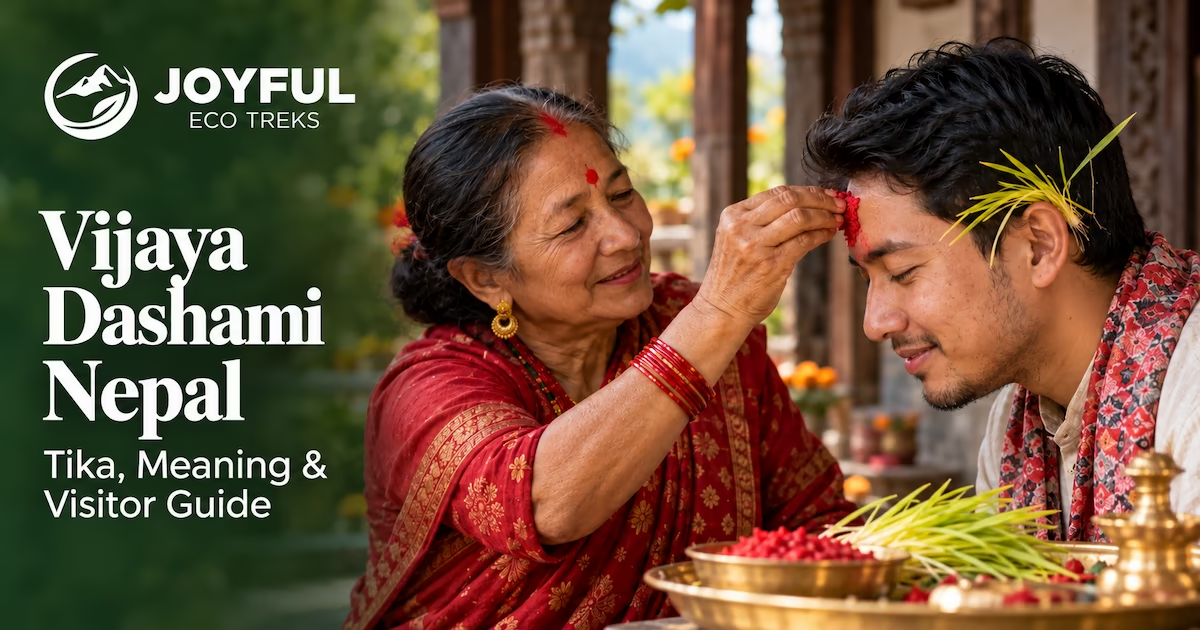
Not one substance but three, worked into a red paste, each carrying its own meaning. The red comes from sindhoor, vermilion powder, and the color is not generic auspiciousness: red is the hue of shakti, the divine feminine power of Durga herself, so the mark stamps the goddess's energy directly onto the recipient. Second comes dahi, plain yogurt, standing for purity. Third are akshata, raw uncooked rice grains pressed into the paste, standing for abundance and the harvest safely in. Applied together over the brow, at the third eye, the three fold protection, purity, and plenty into a single thumb-press.
Not every community uses the red. Gurung and Tamang families often apply a white tika of rice and yogurt with no vermilion at all. In many Newar households, a second mark goes on over the first: Mohani Sina, a black tika made from the soot of an oil lamp, added to turn away negative energy.
Jamara: Nine Days Grown in the Dark
On Ghatasthapana, the first day of Dashain, set by the Nepal Panchanga Nirnayak Bikas Samiti at 11:47 am on 11 October 2026, the household sows barley or wheat seed in a bed of sand and shuts it inside a dark shrine room. For nine days, it grows with no light whatsoever. Deprived of sun, the shoots cannot make chlorophyll, so they come up not green but a pale, buttery yellow-green. The botanical term for this is etiolation, the same process that blanches cellar-forced rhubarb or Belgian endive pale. By the tenth day, the blades stand five to six inches tall. That pallor is the point, not an accident: the grass is incubated in darkness exactly as the goddess's power is gathered across the nine nights, and the elder tucks a sprig of it behind your ear or into your hair alongside the tika.
What the Dashain Tika Blessing Actually Confers
The Mantra an Elder Speaks
As the elder presses the tika on, they may speak a blessing, with particular verses varying by household and sometimes by the recipient's gender. One traditional blessing for a man opens "Ayur Drona Sute, Sriyo Dasarathe, Satruk ksheyam Raghave", a line wishing him long life like Drona's son, wealth like King Dasharatha, and the defeat of enemies like Rama. It blesses by comparison, measuring the recipient against the heroes of the epics. A verse sometimes recited for women invokes several names of the goddess: "Jayanti, Mangala, Kaali, Bhadra Kali, Kapalini," closing with "Namostu te" (I bow to you), invoking the goddess's protection. Across both, the intent is the same: long life, prosperity, and victory over whatever threatens you.
The timing carries its own authority. Each year the Nepal Panchanga Nirnayak Bikas Samiti, the committee of astrologers that publishes Nepal's official calendar, calculates the auspicious moment to begin. For 2026, the Samiti fixed the muhurta at 10:26 am on 21 October, with Durga's statue immersed at 8:49 am that same morning. The muhurta marks the recommended auspicious moment, but the Samiti has clarified that families may receive tika throughout Vijaya Dashami rather than only at that minute.
Dakshina: the Gift That Accompanies the Blessing
A material token often follows the spoken blessing. Dakshina is a monetary gift often given alongside tika, traditionally a folded banknote pressed into the recipient's palm or slipped in beside the jamara. It is not payment and not quite a present. Rather, it often accompanies the exchange, a material gesture of goodwill to match the spoken blessing. For a guest, receiving dakshina can feel awkward; accept it anyway, with grace, and follow your hosts' lead.
Visitor Etiquette for Vijaya Dashami, Sorted by Where You're Standing
Generic advice to "be respectful" is useless here because what respect looks like depends entirely on where you are. Three situations cover almost everything a traveler encounters.
If You're a Guest in a Family Home
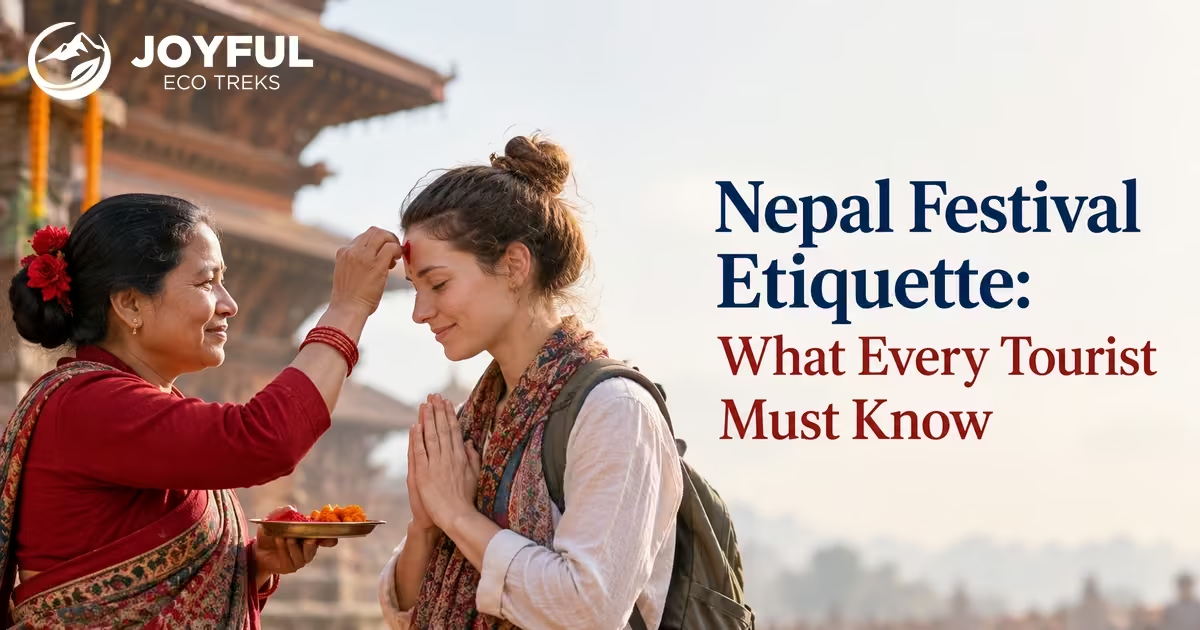
An invitation inside is more intimate than a photo opportunity, and a few concrete moves show you understand that. Leave your shoes at the door before anyone asks. Sit at or below the level of the elder giving tika, never standing over them; most families sit on the floor. Recipients face west, per the Samiti's 2026 guidance, so simply follow the person ahead of you. When your turn comes, bow your head slightly, accept the tika and jamara without wiping either away, and take the dakshina with your right hand or both hands, never the left alone. A soft namaste and a genuine thank-you are enough. Reciting any part of the mantra is not expected of you.
If You're Passing Through a Village
Walk through a hill village on the tenth day and you will see tika ceremonies spilling onto porches and courtyards. Treat them as you would a stranger's family dinner: keep a respectful distance, do not drift into the middle of a blessing in progress, and wait to be invited rather than inviting yourself. If someone calls you over, the home-guest rules above apply. If no one does, a smile and a passing "Dashain ko subhakamana" (best wishes for Dashain) are the whole of your part.
Clothing, and the Photography Question
Lean conservative on clothes: covered shoulders and knees, nothing you would hesitate to wear into a temple. Our guide to religious-site etiquette in Nepal covers dress and behavior norms in more depth. The camera is its own decision, and the rule is simple: ask before, not during. Never photograph a tika being applied without permission, and never raise a phone into the middle of a blessing, which reads as intrusion no matter how gently you do it. Many families are happy to pose afterward with the tika fresh on their foreheads. If the answer is no, put the camera away without negotiating.
Where to See Public Dashain Rituals in Kathmandu
If you are not attached to any household, Kathmandu still gives you ways to observe public Dashain rituals, even if the family tika ceremony is usually private.
Official Dashain Rituals at Hanuman Dhoka's Dashain Kot
A historic center of Nepal's official Dashain observances is Hanuman Dhoka in Durbar Square. Inside the old palace complex sits the Dashain Kot, where state rituals are performed during the festival. Under the monarchy, public tika was given at the royal palace; under the republic, presidential tika ceremonies have taken place at Sheetal Niwas rather than Hanuman Dhoka. These public observances sit alongside the family rites happening behind doors across the city.
Two cautions keep visitors on the right side of the line. The Taleju Bhawani temple in the square traditionally opens to Hindu devotees on Maha Navami, October 20 in 2026, with entry restrictions that visitors should respect. Do not confuse the temple's Maha Navami opening with the military parade at Tudikhel: that gun salute, with the army playing the old Malashree Dhun, belongs to Phulpati on the seventh day, not to Vijaya Dashami. Different day, different ground.
How Nepal's Vijaya Dashami Differs from Indian Dasara
Travelers often arrive assuming Dashain and the Indian festival they have heard of are one event under two names. They share a root, the triumph of good over evil on the tenth lunar day, and then diverge sharply.
Nepal's Vijaya Dashami is, at its core, a Durga festival wrapped around the family: Shakti worship across the nine nights, then the elder-to-younger tika that reaffirms the household's own order. Ravana-effigy burning is not central to this family rite.
North India's Dussehra turns outward and theatrical. Its signature act is the burning of towering effigies of the demon king Ravana and his kin, staging the climax of the Ramayana in a public field before a crowd. Yet Ravan Dahan celebrations also take place in parts of Nepal's Madhesh region.
South India marks the day differently again. Mysore Dasara centers on the goddess Chamundeshwari and a grand procession through the city from the palace, a royal pageant rather than a domestic blessing. Same tenth day, three distinct rituals, three different meanings: a family receiving tika at home, a crowd watching Ravana burn, and a decorated procession leaving a palace gate.
Questions Visitors Ask About the Vijaya Dashami Tika Ceremony
Can Foreign Visitors Receive Tika from a Nepali Family?
Yes. Most Nepali families are glad to include a foreign guest, and receiving tika is welcomed rather than seen as appropriation. The order varies by household, so follow your host's lead when it is your turn. Accept the tika, jamara, and dakshina graciously, and do not wipe the mark off in front of your hosts.
What Time of Day Does the Vijaya Dashami Tika Ceremony Take Place?
For ordinary households, any time through the day. The Nepal Panchanga Nirnayak Bikas Samiti sets an auspicious muhurta each year, 10:26 am on 21 October in 2026, but has clarified that families may receive tika throughout the day. As a home guest, you simply arrive when invited; many families give tika over several hours as relatives come and go.
What Does the Dashain Tika Jamara Placed on Your Head Symbolize?
The dashain tika jamara is the pale barley grass sown on the first day of Dashain and grown nine days in darkness. Tucked behind the ear or into the hair with the tika, it carries the blessings of Durga's nine forms, the Navadurga, gathered through the nine nights of worship. Its yellow pallor comes from being raised without sunlight, a living marker of that incubation.
How Is Nepal's Vijaya Dashami Different from India's Dasara?
Nepal's Vijaya Dashami is a Durga-centered family rite built on the elder-to-younger tika blessing, though some communities in Madhesh also hold Ravan Dahan. North Indian Dussehra burns effigies of Ravana to stage the Ramayana's climax, and South India's Mysore Dasara stages a palace procession honoring Chamundeshwari. Same tenth day, very different observances.
What Should a First-Time Visitor Do If Invited to a Home Tika?
Remove your shoes at the door, dress conservatively, and sit at or below the level of the elder giving tika. Follow the person ahead of you; recipients face west. Accept the tika without wiping it, take the dakshina with your right hand, and offer a simple namaste. Ask before photographing anything, and never mid-blessing.
If witnessing a ceremony like this is the reason you are coming to Nepal, timing is everything. Our month-by-month guide to Himalayan festivals lays out which celebrations fall when across the year, and our notes on the best time to visit Nepal help you time a trip to coincide with the autumn season. For travelers who want the ceremony built into an itinerary rather than left to chance, our Nepal cultural tour is a natural place to start planning.