Tihar in Kathmandu rewards travelers who know exactly where to stand, and at what hour. The rituals run the same across the valley, but the intensity does not. A lane in the old city glows differently from a riverbank at Pashupatinath, and both reach their peak at a different moment from the Newari squares across the river in Patan. Most guides walk you through what the five days mean. Far fewer tell you where to physically put yourself each night; that gap is what this plan closes.
For the ritual logic behind each day, see our Tihar 2026 dates and rituals guide and our five days of Tihar piece. Here the subject is geography and timing.
Tihar 2026 in Kathmandu runs November 7 to 11. Kaag Tihar opens the festival on November 7; Bhai Tika closes it on November 11. Laxmi Puja, the main lights night, falls on November 9. Confirm the exact date against the official panchang when you arrive, since the lunar reckoning can slide by a day.
What Tihar in Kathmandu Looks Like Across Five Nights
The city does not switch on all at once. On the first night, most of the energy is still inside the markets. By Laxmi Puja, the old lanes are shoulder to shoulder. By Bhai Tika, the mood has turned domestic and calm, a family morning rather than a street spectacle. Tihar in Kathmandu is less a single event than five linked nights, each with its own best address.
How the nights build, and which ones to guard
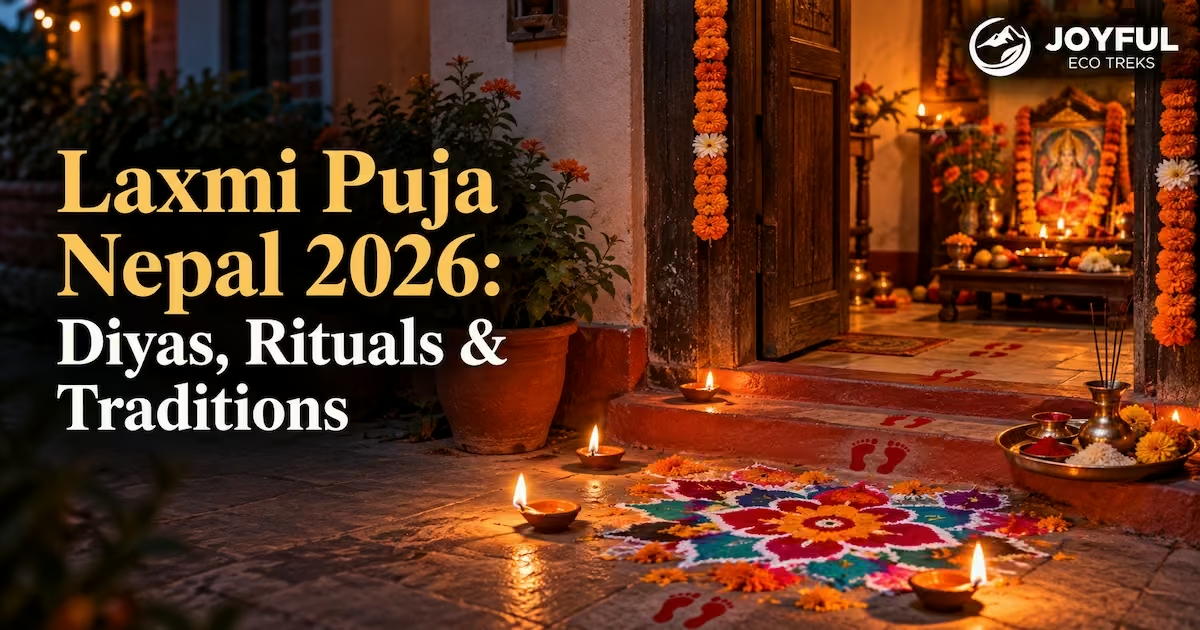
For a traveler with limited evenings, two nights carry the weight. Laxmi Puja on November 9 is the lights peak: every doorway, windowsill, and shopfront carries oil lamps and electric strings, and rangoli patterns cover the thresholds. Mha Puja on November 10 is the quieter cultural high point, and it belongs to Patan. Protect those two evenings. The nights in between still reward a walk, but they are warm-up and wind-down.
Tihar 2026 dates for Kathmandu: November 7 to 11
November 7, Kaag Tihar: crows are honored and the markets fill with last-minute shoppers.
November 8, Kukur Tihar and Laxmi Puja: dogs are garlanded in the morning; the ritual is covered in our dedicated Kukur Tihar guide, and the city lights up for Laxmi Puja after du
November 9, Gai Tihar: cows are honored and some neighborhood celebrations continue after the main Laxmi Puja evening.
November 10, Mha Puja and Nepal Sambat 1147: Newar self-worship in households across the valley, with New Year activity around Patan.
November 11, Bhai Tika: sisters bless brothers in a daytime, household ritual.
Asan Bazaar and Indra Chowk on Laxmi Puja Night
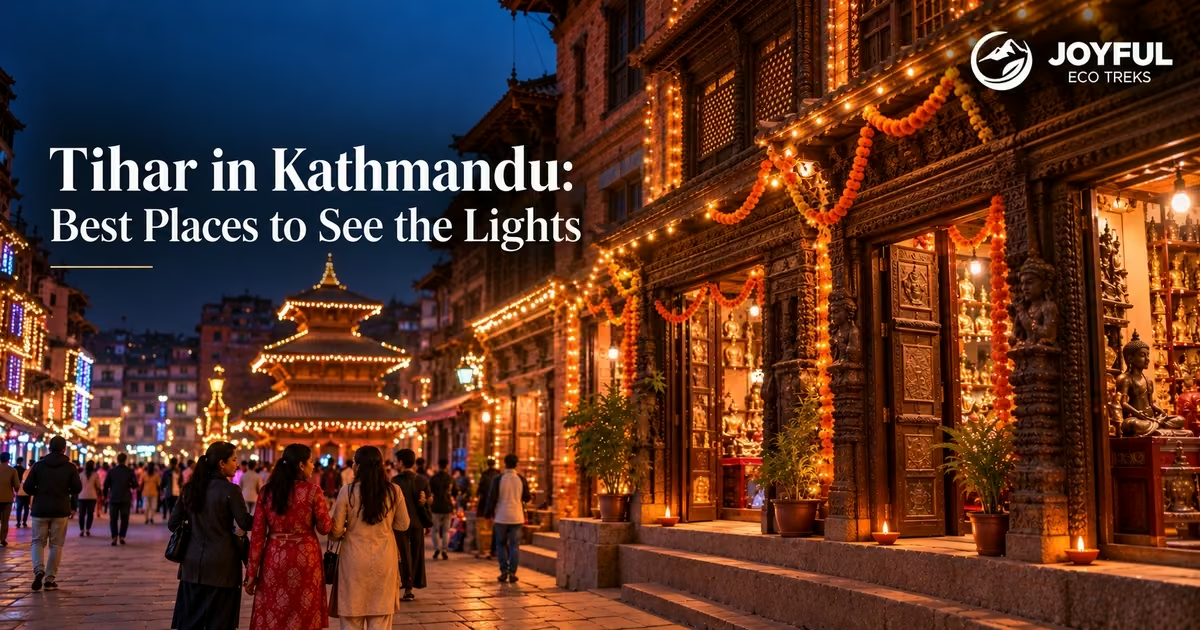
By early evening on Laxmi Puja, the lanes around Asan Bazaar and Indra Chowk are among the liveliest places in the valley to see the lights. The medieval street grid does the work: buildings lean close, the alleys are narrow, and every lamp on every sill throws its glow back off brass, glass, and gold leaf. That geometry funnels light the way a canyon holds sound.
Why the old city's lanes concentrate the glow
No single big display accounts for the effect. The density is cumulative, thousands of small flames packed into a compressed space. Indra Chowk and Asan sit on the old trade spine, so the shops run tight and continuous, and the lamps never thin out between them.
When to arrive, and the rangoli floor art
Aim to arrive around dusk. Rangoli patterns may be visible along the way, and the corridor from Asan down toward New Road can grow crowded as the evening progresses. A useful walking window is roughly 6 to 9pm, although conditions vary. In the days before Laxmi Puja, these same lanes are jammed with people buying garlands, tika powder, and dry fruits, so expect slow going from mid-afternoon onward.
Pashupatinath's Bagmati Aarati: Evening Lamps by the River
This is the spot in Kathmandu where you can watch lamps offered beside a sacred river rather than a street display. Across the Bagmati from the main Pashupatinath Temple, priests perform the evening Aarati with oil lamps and chanting. Unlike the displays on Laxmi Puja night in the old city, this is a regular devotional ceremony. Slower and more solemn than the old-city crush, the ritual is precisely the reason to come.
What the ghats offer that a street cannot
The river gives the ceremony a different setting, and the chanting from the ghats gives the evening a weight the markets lack. If the old city is where Tihar feels like a celebration, Pashupatinath is where it feels like a rite.
When to arrive and where to stand
Arrive at around 5:45pm. The Bagmati Aarati is performed every evening at about 6pm by three priests on the eastern bank, a regular practice since 2006, so arriving a little early gives you time to find a respectful viewing spot. Stand on the eastern bank to watch the lamps and chanting without approaching cremation rituals at Arya Ghat, and avoid photographing mourners.
New Road and Putalisadak: The Merchant Light Corridor
New Road is Kathmandu's commercial spine, and during Tihar the jewellery and electronics shops along it and up Putalisadak compete, informally but visibly, to outshine their neighbours with electric displays, strung facades, and lit signage. This stretch rarely appears in festival guides, and its scale surprises first-time visitors.
How the shopfronts outdo each other
One jeweller's gold-lit frontage pushes the shop next door to match it, and the block grows brighter year on year. Photogenic and unapologetically commercial, this corner of the festival makes no claim to tradition, which is a fair trade once you know what you are getting.
A short walking route through the commercial core
Start at the New Road gate, walk the main stretch toward Bishal Bazaar, then cut up to Putalisadak for the second cluster of displays. Thirty minutes covers it comfortably. Think of it as a bright interlude between the old city and the river, not a destination for the whole evening.
Thamel Across the Middle Nights
Thamel is where most visitors sleep, and it offers the least traditional version of Tihar in Kathmandu. That is not a reason to avoid it, just a reason to calibrate expectations. The tourist quarter lights up and draws in performers, but much of what happens here is pitched at the people watching rather than at the gods.
Day 2 mornings: garlanded street dogs
On the morning of November 8, Thamel's street dogs appear in marigold garlands and a red tika as part of Kukur Tihar. Step out early and you will catch it before the day's foot traffic builds. Our Kukur Tihar guide covers the ritual behind the practice.
What is genuine after dark, and what is staged
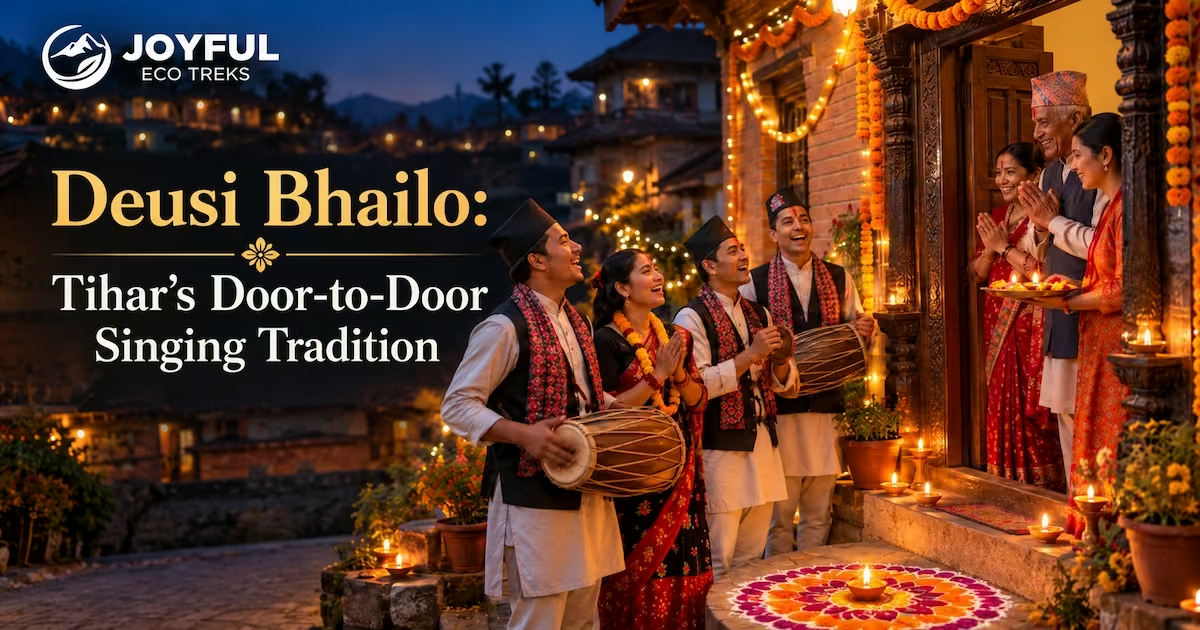
Deusi Bhailo groups do pass through Thamel in the evenings: some are neighbourhood youth doing the real thing, others perform a shortened version for tips and cameras. Walk two or three lanes out into the residential blocks and you will find groups singing for households rather than for an audience. That is the version worth finding.
Patan Durbar Square for Mha Puja on Day Four
On November 10, Patan rings in Nepal Sambat year 1147, and the area around Durbar Square takes on a New Year atmosphere. Mha Puja is a Newar tradition practiced in family homes across the valley, including Patan.
Why Mha Puja is not Laxmi Puja
Mha Puja is the Newar ritual of worshipping the self, performed on the first day of the Nepal Sambat new year. Each family member honors their own body and longevity through an elaborate mandala and offering laid out on the floor. Laxmi Puja two nights earlier honors the goddess of wealth; Mha Puja honors the person. Patan Durbar Square offers a Newar cultural setting that evening, but Mha Puja itself is generally a household ceremony rather than a public ritual in the square.
Getting to Patan through festival traffic
Cross before the squeeze. Taxis can be harder to find in the evening, and traffic on the Bagmati bridges between Kathmandu and Lalitpur may slow on festival nights. Aim to be in Patan by late afternoon; cross before 4pm and spend the early evening around the square while families prepare for the puja at home. If traffic builds, walking from a nearby drop-off point may be easier than sitting in a stalled cab.
Boudha and Chabahil: Following the Deusi Bhailo Singers
Follow the drums. That is the whole trick to finding a Deusi Bhailo procession on foot, and the lanes around Boudhanath and the adjacent Chabahil corridor are worth exploring if you hope to encounter a group. Performances depend on local participation, so you may hear drumming in nearby residential streets after dark.
How to find and follow a group on foot
Try the lanes off the Boudha stupa circle on festival evenings and walk toward singing or drumming if you hear it. Deusi Bhailo groups move house to house; visitors can observe at a respectful distance when welcomed. Our Deusi Bhailo guide covers the tradition itself. On the ground, the etiquette is simple: keep back, do not block the doorway performance, and let the household give before you do.
A quiet Bhai Tika morning at the stupa
Boudha on the morning of November 11 is the antidote to the Laxmi Puja crowds. Bhai Tika is a household ritual, so the streets stay calm. A slow clockwise walk around the stupa is one of the gentlest mornings in the Tihar week. Balgopaleshwar Temple at Rani Pokhari, the historic tank in central Kathmandu, traditionally opens on Bhai Tika for people without siblings; check the 2026 visitor arrangements before going.
Your Five-Night Tihar Plan for Kathmandu, Night by Night
Built around the two nights that matter most and the easiest wins on the others, this schedule gives you a deployable plan for Tihar in Kathmandu in 2026.
Day-by-day, November 7 to 11
Night | Date | Best spot | Arrive by |
|---|---|---|---|
Kaag Tihar | Nov 7 | Asan Bazaar, markets filling | 6pm |
Kukur Tihar / Laxmi Puja | Nov 8 | Thamel morning for street dogs; Asan and Indra Chowk for lights | Early morning; around dusk |
Gai Tihar | Nov 9 | Pashupatinath Bagmati Aarati (optional riverside evening) | Around 5:45pm |
Mha Puja | Nov 10 | Patan Durbar Square | 4 to 5pm |
Bhai Tika | Nov 11 | Boudha stupa or Rani Pokhari | Morning |
Getting around during busy festival evenings
Plan your evenings around festival traffic. Once the lights go up, taxis may be harder to find and fares may vary, while some old-city lanes are better explored on foot. Taxi to the edge of your target neighbourhood by late afternoon, walk the festival on foot, and allow flexibility for the return journey.
For the Patan night, budget extra time for the bridges. For the old-city nights, you will be walking regardless, so a hotel within reach of Asan or Thamel saves the fare and the wait. See our things to do in Kathmandu guide for neighborhood orientation, and our Himalayan festivals month by month calendar for what surrounds the Tihar week.
Ready to build the festival into a full itinerary? Explore our Nepal cultural tours or craft your own Nepal trip around the Tihar week.
FAQs
Which day of Tihar has the best lights in Kathmandu?
Laxmi Puja night, November 8 in 2026, is the clear peak. Every doorway and shopfront in the old city carries oil lamps and rangoli, and Deusi Bhailo groups move through the streets after 7pm. Position yourself in Asan Bazaar or Indra Chowk by 6pm before the lanes fill.
Is Thamel or Patan better for experiencing Tihar as a traveler?
Patan for authenticity, Thamel for convenience. Thamel is an easy base and its lanes do light up, but most of the display there is pitched at tourists. Patan Durbar Square offers a Newar cultural setting on Mha Puja, November 10, while the ritual itself usually takes place inside family homes, making the trip across the river worthwhile.
What time do the lights come on in Kathmandu during Laxmi Puja?
Lamps go up around dusk in early November, with the exact time varying by household. The comfortable window for walking the old-city corridor runs roughly 6 to 9pm, and Deusi Bhailo singing groups may be out after dark.
Can tourists join or follow Deusi Bhailo groups in Kathmandu?
Sometimes, when welcomed by a group or household. Visitors can observe at a respectful distance, but performances are not guaranteed in any neighborhood. You can try the lanes around Boudha and Chabahil on festival evenings. Follow the drumming, keep back from the doorway, and let the household give first.
Are restaurants and shops open in Kathmandu during Tihar?
Most tourist-area restaurants in Thamel stay open through the festival, though some family-run places close for Bhai Tika on November 11. Old-city shops are busiest in the days before Laxmi Puja, and many shutter during the main puja hours, so buy anything you need earlier in the day.