On the fourth day of Tihar, while most of Nepal is still sweeping up marigold petals from Laxmi Puja, Newar families settle onto the floor in front of hand-painted mandalas and worship themselves. Not a god, not an animal, not a sibling. The worshipper. This guide covers Mha Puja Nepal from the inside: the self-worship theology that sets the day apart, the Nepal Sambat new year it begins, and where a traveler can actually witness it.
Why Mha Puja Stands Apart from the Other Four Tihar Days
Tihar's other days all point reverence outward. Day one honors the crow, day two the dog and goddess Laxmi in 2026, day three the cow, and the fifth day sends a sister's blessing across the table to her brother. Mha Puja runs in the opposite direction entirely: the living self is the focus of the rite, while an elder often leads the worship, a direction of reverence that sets it apart within the festival.
"Mha" is the Nepal Bhasa word for the self, or more precisely the body and soul taken together. That single word explains the whole structure. Where Laxmi Puja invites prosperity in from outside, Mha Puja treats the living person as a complete sacred universe already, worth cleansing, lighting, and blessing in its own right. If you have read our five-day breakdown of Tihar, this is the day that breaks the pattern the other four share.
A day the Newar community claims as its own
For the Newar people of the Kathmandu Valley, Swanti names a three-day Newar festival sequence of Laxmi Puja, Mha Puja, and Kija Puja, with Mha Puja at its spiritual center. The ceremony unfolds in Nepal Bhasa, the Newari language, so the prayers, the greetings, and the songs that spill into the streets afterward all carry a linguistic identity separate from the Nepali heard elsewhere during Tihar. This is not a borrowed slot; it is a living tradition whose roots predate the unified festival calendar by centuries.
The Mha Puja Ceremony: Mandala, Offerings, and Sequence
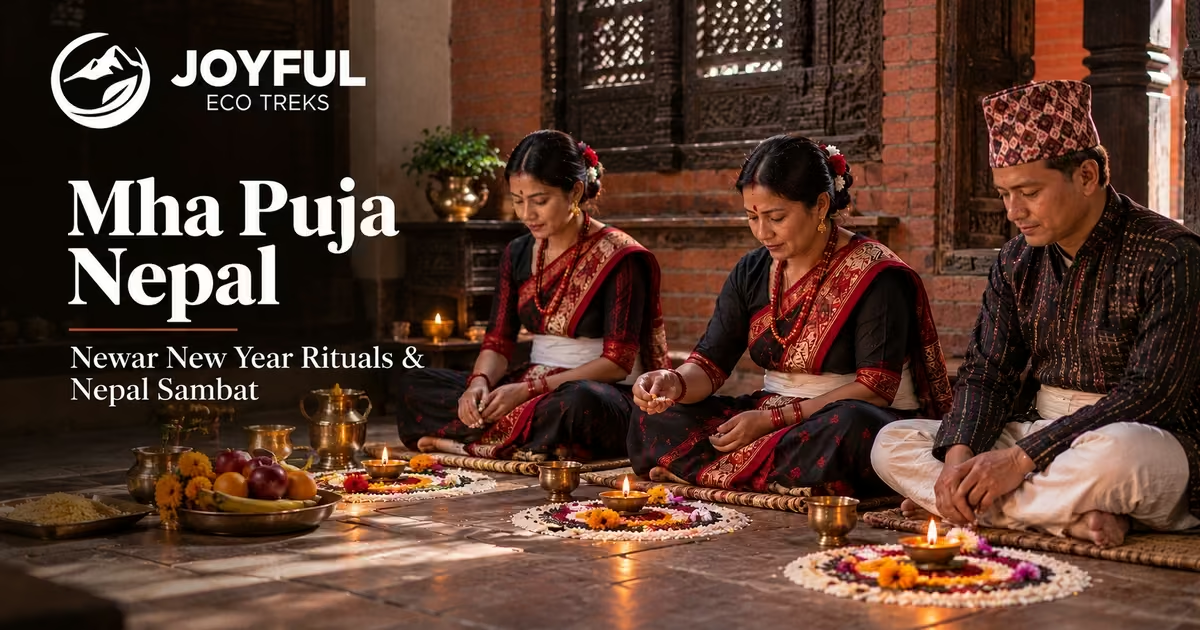
Every participant receives their own mandala drawn on the floor, traditionally with colored powder, oil, and rice flour in concentric rings. Each mandala is a focal point and a map at once: it lies in front of the person and represents the self as a small cosmos. The eldest woman of the household often helps prepare them, leads the worship, and later hands out the blessings.
Traditional offerings and what each one carries
Mha Puja mandalas and the accompanying ritual include a range of offerings, each carrying symbolic meaning. Common examples include:
Oil lamp (diya): presence of the soul being honored, made visible in flame.
Vermilion (sindoor): the auspicious mark of life-force, applied as tika.
Flowers: purity, offered fresh and loose across the mandala.
Uncooked rice: fertility and sustenance, the staple in its raw potential.
Fruits: abundance and the year's harvest.
Beaten rice (chiura): everyday, earth-level nourishment the Newar kitchen runs on.
Curd: cooling and purification, closing the set on a note of calm.
Practice varies by household and lineage, so the proportions, arrangement, and offerings shift. Other traditions may also include lentils, popped paddy, betel nuts, sacred threads, and ceremonial sagun.
From first lamp to the shared feast
The sequence moves in a deliberate order. Once the family gathers and the mandalas are drawn, a flame called the khelu-ita is lit for each person. Moving one by one, each member receives tika, flowers, and the offerings at their own mandala, worshipping themselves while the eldest woman officiates. The rite closes with sagun, a ceremonial plate of auspicious foods, and gifts meant to carry long life into the new year. Then the solemn floor-work gives way to the loudest, warmest meal of the Newar year.
Nepal Sambat 1147: The New Year That Begins on Mha Puja Day
On October 20, 879 CE, during the reign of King Raghavdeva, a new calendar era began in the Kathmandu Valley. That era is Nepal Sambat, and the year beginning on Mha Puja day in 2026 is Nepal Sambat 1147, arriving on November 10, 2026, squarely inside Tihar rather than in spring.
The calendar's origin carries two accounts worth keeping separate. The founding is anchored to Raghavdeva's reign, though the exact circumstances of the inauguration remain historically disputed. The community carries a second, cherished story: the legend of Sankhadhar Sakhwa, a Kathmandu merchant said to have cleared the valley's debts and inaugurated the new era as an act of communal liberation. One is the scholarly record, the other living cultural memory, and Mha Puja honors both at once.
Nepal Sambat ran as the valley's official calendar for roughly 890 years, from 879 CE until Prithvi Narayan Shah set it aside after his conquest of the Kathmandu Valley in 1769. Seeing how it sits beside the two calendars Nepalis use today makes the distinction concrete.
Bikram Sambat | Nepal Sambat | |
|---|---|---|
Era begins | c. 57 BCE | 879 CE |
Year in 2026 | 2083 | 1147 |
Calendar basis | Solar-based in Nepal | Lunisolar |
Primary community | Pan-Nepali, state use | Newar / Nepal Bhasa culture |
Status today | Primary state calendar | National era, in official documents since 2023 |
The gap of more than nine centuries between the two year-numbers is the clearest sign these are genuinely separate reckonings, not two names for one count.
Nepal Sambat's Decades-Long Push for Recognition
Getting a calendar older than the modern state recognized by that state took organized effort across three distinct steps.
The campaign has a founding moment. In 1979, cultural activists formed Nepal Bhasa Manka Khala, and that year the organization staged the first public Nepal Sambat new year celebration, for Nepal Sambat 1100, on October 22, 1979. A ritual that had lived inside Newar homes stepped into the public square for the first time.
Recognition followed slowly. In 2008, the government of Nepal named Nepal Sambat a national era, though no concrete implementation followed for years. The practical step came on November 11, 2023, when the government declared that Nepal Sambat would appear in official government documents alongside Bikram Sambat.
One honest caveat belongs here. Mha Puja is observed primarily as a Newar family tradition, even though November 10, 2026, falls within Nepal's nationwide Tihar public holiday period. The recognition of Nepal Sambat is real, while its practical use in official systems is still developing.
Where to See Mha Puja in Kathmandu, Patan, and Bhaktapur
On Nepal Sambat New Year's morning, while household Mha Puja typically awaits the evening, the old cities turn outward. Processions move through the historic cores of Kathmandu, Patan, and Bhaktapur, led by dhime baja drum troupes, and the streets fill with the Newar new year greeting, Nhudanya Bhintuna. This public celebration is the side of the day any visitor can walk up to and join without ceremony.
In Kathmandu, the lanes around Asan Tole, Indra Chowk, and Maru Tole near Kathmandu Durbar Square are the dense, atmospheric heart of it. In Bhaktapur, the open ground around the Durbar Square area gives the processions room to gather and expand. To combine the festival with broader city exploration, our guide to things to do in Kathmandu maps the same old-city routes.
What counts as open, and what does not
The line a respectful visitor should hold is clear. Public processions and new year celebrations are open to everyone and are the right access point for travelers. A household Mha Puja, by contrast, is a family rite held on the floor of a private home, and attending requires a genuine invitation from a Newar family. Turning up uninvited to a private ceremony is not appropriate. Wait to be asked, and if the invitation comes, treat it as the privilege it is.
Mha Puja in the Tihar 2026 calendar
Mha Puja falls on Tuesday, November 10, 2026, the fourth of Tihar's five days. Here is the full week in order:
Day | Date (2026) | Name | Honors |
|---|---|---|---|
1 | Nov 7 | Kaag Tihar | The crow |
2 | Nov 8 | Kukur Tihar & Laxmi Puja | The dog and goddess Laxmi |
3 | Nov 9 | Gai Tihar | The cow |
4 | Nov 10 | Govardhan Puja, Mha Puja & Nepal Sambat 1147 | Govardhan, the self and Newar new year |
5 | Nov 11 | Bhai Tika / Kija Puja | Brothers and sisters |
For how this week sits within the wider festival year, see our month-by-month Himalayan festival calendar.
Mha Puja and Nepal Sambat: Common Questions
Is Mha Puja only for Newars, or can others participate?
Mha Puja is a Newar ritual, and the household ceremony is a Newar family tradition conducted in Nepal Bhasa. Non-Newar friends invited into a home are included with genuine warmth. Others are welcome at the public new year celebrations and processions. The rite belongs to Newar culture, but its spirit is not closed off to those who approach it with respect.
What exact date does Mha Puja fall on in 2026?
Mha Puja falls on Tuesday, November 10, 2026, the fourth day of Tihar. That same day opens Nepal Sambat 1147.
What does the Mha Puja mandala represent?
Each person sits in front of their own floor mandala, which stands for the self as a small, complete universe. Depending on household tradition, the mandala and its accompanying offerings may include an oil lamp for the soul's presence, vermilion for life-force, flowers for purity, uncooked rice for sustenance, fruits for abundance, beaten rice for everyday nourishment, and curd for cooling purification.
Can foreign visitors attend a household Mha Puja ceremony?
Only by invitation. Household Mha Puja is a private family rite, not a public event. A foreign visitor needs a personal invitation from a Newar family to attend. Without one, the public Nepal Sambat procession in the old city is the appropriate and equally rewarding place to experience the day.
Why does the Newar new year fall inside Tihar?
Nepal Sambat is a separate lunisolar calendar whose year turns in autumn, while Nepal's solar-based Bikram Sambat civil calendar begins its year in spring. The two systems count from different origins, so their new years land in different seasons entirely.
Mha Puja rewards the traveler who treats it as its own subject rather than a footnote to the festival of lights. To plan a visit around the whole celebration, read our complete Tihar 2026 guide and map your days around all five.