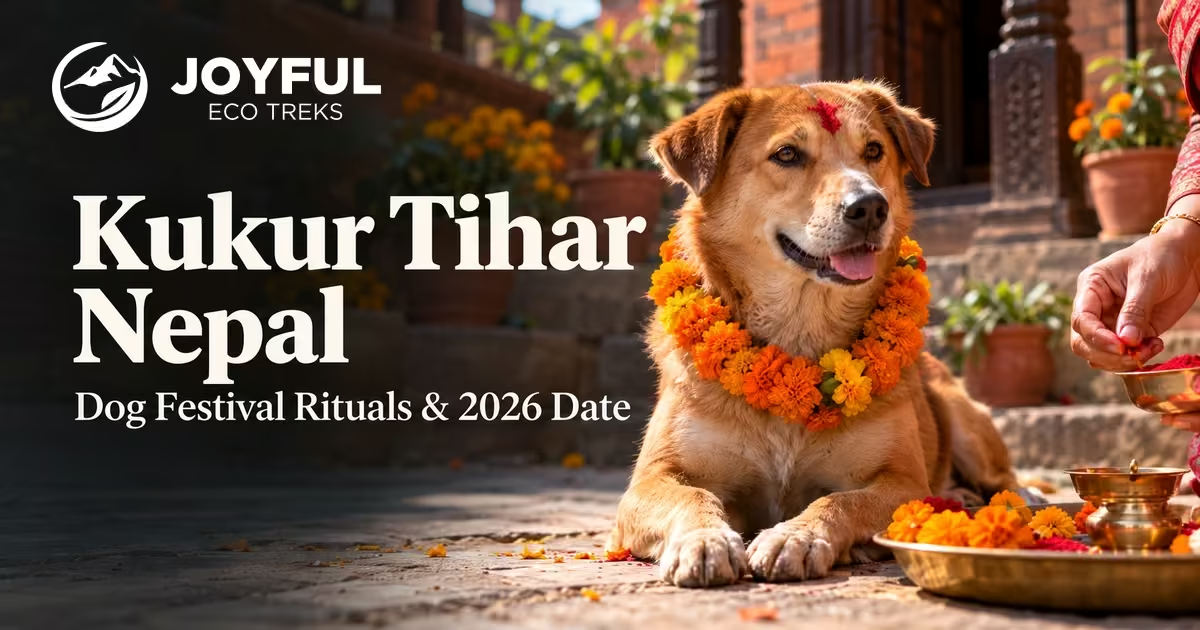
On the morning of November 8, 2026, a street dog that slept under a parked motorbike the night before will wear a marigold garland and a smear of red tika, fed sel roti by hands that may not even know its name. That image travels fast. Search kukur tihar nepal after seeing one of those photographs and you will likely meet the same thin explanations everywhere: garland, tika, "dogs are honored." The real story runs deeper, through two separate scriptural lineages, a Himalayan street-dog culture most guides skip, and a persistent misconception this piece will clear up for good.
Why Nepal Sets Aside a Day to Honor Dogs
Tihar is Nepal's festival of lights, and its second day traditionally honors the dog. The logic is not sentimental. Hindu scripture hands the dog a role in the machinery of death and righteousness, and the ceremony you see on the street is the public settling of that debt. Before the garlands and the viral images, that is what is actually happening.
Where the Dog Day Sits in the Tihar Calendar
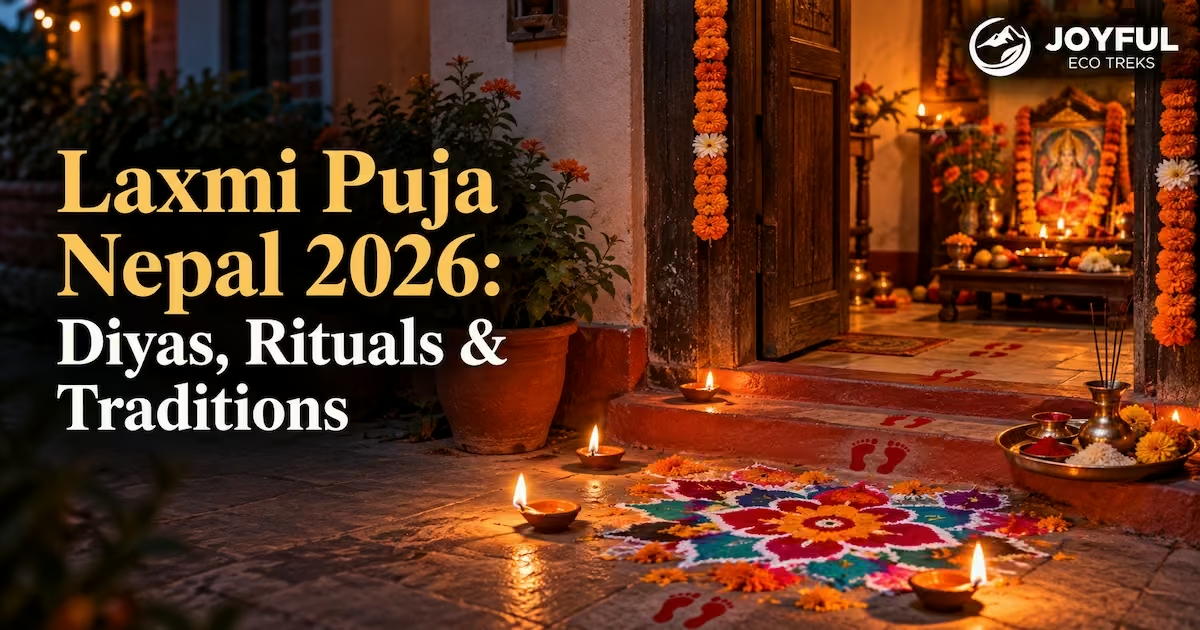
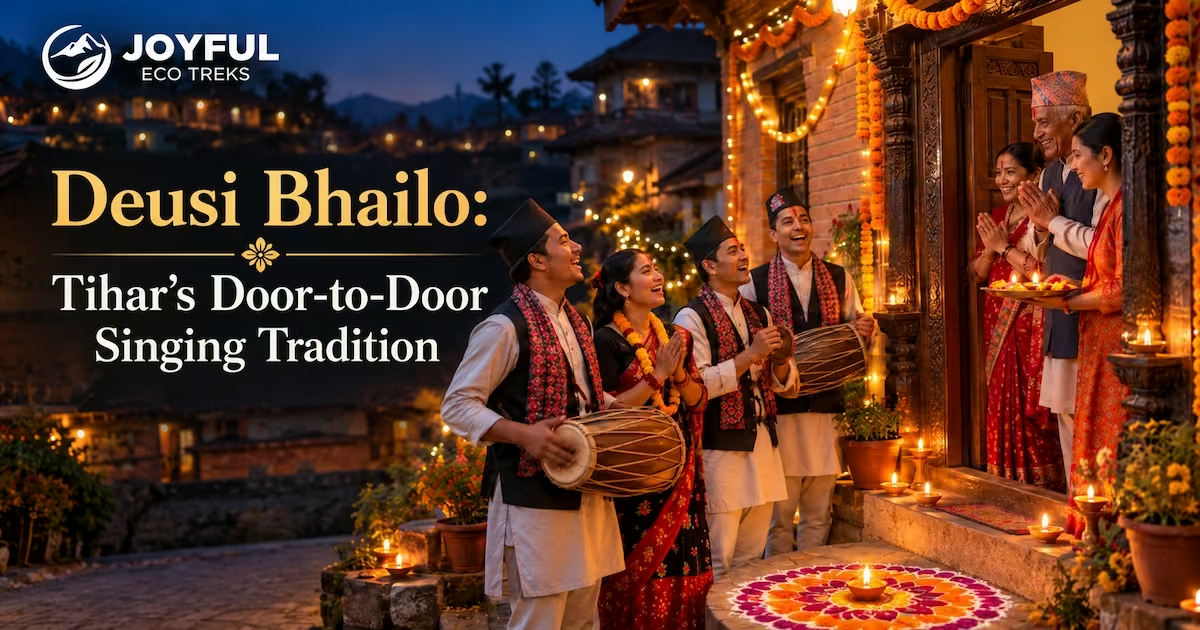
Kukur puja falls on the second of Tihar's five days. The festival opens with the crow, moves to the dog, then to the cow and the goddess Lakshmi, and closes with the sibling bond of Bhai Tika. In 2026, Kukur Tihar and Lakshmi Puja both fall on November 8, while Gai Tihar follows on November 9. Our month-by-month guide to Himalayan festivals sets each day in context. Here we stay on the dog.
The Four Layers Most Guides Skip
Nearly every page on this subject stops at garland and tika. Four things go missing: the full scriptural stack behind canine sacredness, which spans two distinct lineages rather than one; the deliberate inclusion of street dogs alongside pets; neighborhood-level guidance on where a visitor can actually stand and watch; and a straight answer to the "dog eating festival" searches that keep surfacing. Anyone researching kukur tihar nepal in depth deserves all four, and this guide delivers them.
The Mythology That Makes Dogs Sacred in Nepali Hinduism
Two religious associations help explain the dog's standing here, though they come from different traditions. One runs through Yamaraj, god of death. The other runs through Bhairava and the Tantric traditions of the Newar people of the Kathmandu Valley. Grasping both is what separates a real explanation from a caption.
Yamaraj's Gatekeepers: Shyama and Sabala
Yama, the god of death, keeps two dogs who guard the path to his realm and hunt out the dying. The Rigveda calls them sarameyau, the sons of Sarama, a divine hound, and describes them as four-eyed and broad-nosed. Personal names came later: the text gave them colors, not individual names, labeling them shyama (dark) and sabala, also rendered Sharvara (brindled or spotted). Over centuries those color epithets hardened into the names Shyama and Sabala. Rigveda 10.14.10–12 already describes them as Yama's guardians and messengers, rather than assigning that role only in a later text. When a Nepali household feeds a dog on this morning, that is the figure being acknowledged: the animal who meets you at the threshold between worlds.
The Mahabharata's Final Test
The most quoted dog story in Hindu scripture is also the most misattributed. Found in the Mahaprasthanika Parva, the seventeenth book of the Mahabharata, the episode follows Yudhishthira as he walks toward heaven while his brothers and wife fall one by one along the way. A single dog follows him the whole distance. At the gates, Indra offers him entry but not the dog; Yudhishthira refuses to enter without the animal that stayed loyal. The dog then reveals itself as Dharma, the god of righteousness and Yudhishthira's own divine father, exposing the refusal as a test of virtue that Yudhishthira passed. Two details matter and are routinely muddled: the dog is Dharma, not Yama, and the episode sits in Book 17, not the Svargarohana Parva that follows it.
Bhairava's Dog and the Newar Tantric Line
Bhairava, the fierce form of Shiva, rides a dog as his vahana, or divine mount, earning him the epithet Svashva: "he whose vehicle is a dog." Bhairava worship has a significant place in Newar religious life, though shrine traditions vary across the valley. This connection adds another layer to canine reverence in Kathmandu, Patan, and Bhaktapur, alongside the Yamaraj tradition.
Inside Kukur Puja: The Ceremony, Step by Step
The ritual moves through a sequence most pages compress into two items. Some families begin by washing or grooming the dog, although practices vary from household to household. A tika of sindoor mixed with rice grains goes onto the forehead. A marigold garland follows around the neck. Then come the offerings, placed by hand: sel roti, meat, hard-boiled eggs, and milk. The whole observance reads as hospitality shown to an honored guest, because that is precisely the register it is performed in.
Sayapatri Garland and Red Tika
Strung from sayapatri marigolds, the garland announces that the animal is blessed and set apart for the day. Deep orange anchors all of Tihar's visual identity, so draping it on the dog folds the animal into the broader festival language. The tika, a mark of red sindoor pressed with rice grains onto the forehead, extends the same blessing humans receive to the dog. Both are widely recognized parts of the celebration, although individual practices vary.
Why Sel Roti, Meat, and Eggs
Each offering is chosen deliberately. Sel roti, the ring-shaped rice bread fried fresh throughout Tihar, is the festival's defining food, so sharing it with the dog places the animal inside the family's celebration rather than at its margins. Meat and eggs acknowledge what a dog actually eats, a gesture of respect for the animal on its own terms rather than a symbolic token. Milk may also be offered as part of the tradition, though it can upset some dogs' stomachs. Visitors should avoid rich sweets, seasoned foods, and unfamiliar hand-feeding; a small dog-safe treat should only be offered with a caretaker's agreement.
Newari Households vs. Hill Hindu Families
Observance varies across Nepal's communities in instructive ways. In some hill Hindu families, the day centers on the Yamaraj messenger framing: household puja, garland, tika, food. Some Newar families also place Kukur Tihar within wider observances that include Mha Puja, the ritual worship of oneself; Bhairava's association with the dog offers another religious reference. Same garland, same tika, with different layers of religious meaning.
Pets, Guard Dogs, and Street Dogs All Get Honored
The ceremony is not reserved for family pets, and that is the detail that gives the festival its real emotional reach.
Why Strays Are Included, Not Just Pets
A guard dog chained in a courtyard and a stray that patrols a single alley receive the same garland and tika as a pampered house dog. Nothing in the theology distinguishes ownership, because Yama's gatekeepers and Dharma's loyal companion were never about belonging to a person. They were about the dog as a category of being. Kathmandu's community dogs, the thousands of free-roaming animals that belong to a neighborhood rather than a household, are fed and marked by whoever adopts them for the morning.
Kathmandu's Community Dogs on the Day
For an animal that spends the year dodging motorbike traffic, this one morning brings sel roti from strangers' hands. The inclusion runs institutional as well as informal: Nepal Police and the Armed Police Force formally honor their own canine units on Kukur Tihar, validating at a state level what the street does by instinct.
Where to Watch in Kathmandu and the Valley
General advice says "Kathmandu, Patan, Bhaktapur." Useful advice tells you which lanes.
Pashupatinath Precinct Streets
Residential streets around the Pashupatinath temple complex may offer opportunities to observe neighborhood celebrations. Entry to the temple itself is restricted, but the surrounding lanes are open, and some household pujas may be visible from public lanes, depending on local participation.
Patan Old Quarter and Bhaktapur's Taumadhi Square
Patan's dense Newar neighborhoods reward slow walking: Bhairava traditions form part of the area's religious landscape. Around Bhaktapur's Taumadhi Square, the temple architecture provides a striking backdrop if you happen upon a public observance.
Thamel and New Road: Urban Street Scenes for Central Visitors
For visitors based in the tourist district, both Thamel and New Road may offer informal street scenes, including community dogs being honored by residents and shopkeepers. These are convenient central settings for anyone who would rather not navigate residential neighborhoods alone on a first visit.
Kukur Tihar 2026: Date and Morning Timing
Kukur Tihar 2026 falls on November 8, which is Kartik 22, 2083 on the Bikram Sambat calendar. The full Tihar festival runs from November 7 to November 11. In 2026, Lakshmi Puja shares November 8 with Kukur Tihar, and Gai Tihar falls on November 9. For the wider season, our Dashain and Tihar travel guide sets the broader context; the date to hold is the eighth.
The Morning Window and the Afternoon Street Scene
For visitors, roughly 7 to 10 AM is a practical window to look for household pujas involving tika, garlands, and feeding. That window is a planning estimate, not an official schedule; timing varies by household and neighborhood. By afternoon the formal rituals give way to a looser street scene: garlanded community dogs wander the neighborhoods, and the feeding continues informally well into the day.
How the Date Moves Each Year
Kukur Tihar follows lunar tithis within Nepal's Bikram Sambat festival calendar, rather than a fixed Gregorian date, so its timing shifts from year to year. The festival is fixed to Kartik Krishna Chaturdashi, a specific lunar day, which is why it can land in late October one year and early-to-mid November the next. Anyone timing a trip around it should confirm the lunar date rather than assuming a repeat of the previous year's.
How Visitors Can Join Without Getting It Wrong
Foreign visitors may take part respectfully when invited, but should not approach, garland, or hand-feed unfamiliar street dogs. A safer way to join is to observe or help with a familiar dog under its caretaker's supervision. The respect is in the details.
Joyful Eco Treks' Kukur Tihar Field Checklist
Practical specifics, in one place:
What to bring: a marigold garland or a handful of loose flowers, plus a small dog-safe treat only if a caretaker agrees. Buy flowers the morning of; vendors stock up specifically for Tihar.
When to arrive: the 7 to 10 AM window is a reasonable time to look for household pujas; lingering into the afternoon gives you the relaxed community-dog street scenes.
Where to stand: residential streets behind the Pashupatinath precinct, old-quarter lanes in Patan, and the Taumadhi area in Bhaktapur.
How to engage: ask before participating, offer flowers to the caretaker rather than placing them on an unfamiliar dog, and follow the household's lead rather than directing the moment.
What to avoid: approaching or feeding unfamiliar strays,, using flash during tika application, and stepping into private courtyards without a clear invitation.
Photographing Ceremonies: The Etiquette
Lowering the camera buys more access than raising it. Ask before photographing a family's puja, skip the flash entirely during the tika and feeding (it startles the dog and intrudes on the moment), and give the animal room. Visitors may be invited to join a supervised ceremony, but should not approach an unfamiliar dog themselves. The etiquette is not a constraint on the photograph; it is how you earn the better one.
Setting the Record Straight on the "Dog Eating Festival" Claim
Type kukur tihar nepal into a search bar and a disturbing companion query often appears: "dog eating festival nepal." To be unambiguous: Kukur Tihar is a festival that feeds, garlands, and blesses dogs. Eating them has nothing to do with it. The confusion appears to conflate Nepal's dog-worship day with entirely different cultural contexts elsewhere in Asia, and it does a disservice to a tradition built on exactly the opposite impulse. Reverence, not consumption, is the entire point.
Frequently Asked Questions About Kukur Tihar Nepal
What is the exact date of Kukur Tihar in 2026?
Kukur Tihar 2026 falls on November 8, 2026, the second day of the five-day Tihar festival. On the Bikram Sambat calendar that is Kartik 22, 2083, marked as Kartik Krishna Chaturdashi. The full festival runs November 7 through 11. In 2026, Lakshmi Puja takes place on the same date as Kukur Tihar.
Are stray and street dogs included, or only household pets?
Both. Street and community dogs are ceremonially included alongside pets and guard dogs. The scriptural basis for the day treats the dog as a sacred category regardless of ownership, so free-roaming neighborhood animals are garlanded, marked with tika, and fed just as family animals are.
What food is traditionally offered to dogs during Kukur Tihar?
Sel roti (the ring-shaped fried rice bread made throughout Tihar), meat, hard-boiled eggs, and milk. Sel roti shares the family's own festival food with the dog; meat and eggs respect what the animal naturally eats. These are traditional offerings, not a recommendation for visitors to hand-feed unfamiliar dogs; milk and rich foods can cause digestive upset.
Which Kathmandu neighborhoods are best for witnessing it?
The residential streets behind the Pashupatinath precinct, the old-quarter lanes of Patan, and the area around Bhaktapur's Taumadhi Square may offer opportunities to observe local ceremonies, though sightings are not guaranteed. Thamel and New Road are accessible urban areas to explore for visitors who prefer to stay central.
Is it appropriate for foreign visitors to join a ceremony?
Yes, when invited to a supervised ceremony. Do not approach or hand-feed unfamiliar community dogs. Follow the family's lead, and stay out of private courtyards and away from flash photography without clear permission.
Why are dogs sacred in Nepali Hindu tradition specifically?
Two scriptural lineages converge here. Dogs are Yamaraj's gatekeepers Shyama and Sabala, a status reinforced by the Mahabharata's account of Yudhishthira, who refused heaven without his dog (later revealed as Dharma). A second, Nepal-specific lineage runs through Bhairava, whose divine mount is a dog, anchoring canine reverence in Newar Tantric tradition across the Kathmandu Valley.
Is Kukur Tihar connected to the "dog eating festival Nepal" searches online?
No. That search reflects a misconception. Kukur Tihar celebrates, feeds, and garlands dogs; the day has no connection to eating them. The phrase appears to confuse Nepal's dog-worship tradition with unrelated practices elsewhere.
Planning to be in Nepal for the Tihar season? Browse Joyful Eco Treks' Nepal cultural tours to build a festival-timed itinerary around Kukur Tihar and the wider Tihar calendar, and check the best time to travel before you lock your dates.