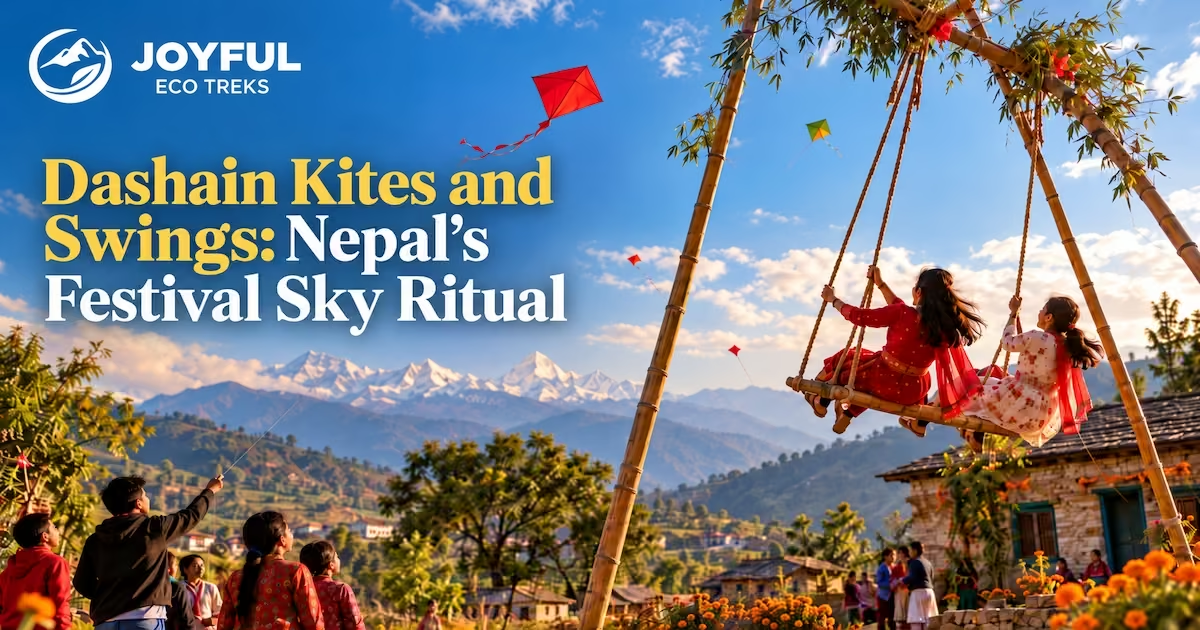
By four o'clock on an October afternoon, the sky over Kathmandu fills with small paper diamonds. In the courtyards below, a bamboo frame taller than the houses creaks under a swinging child. These two sky-directed practices carry separate histories, separate participants, and separate reasons for belonging to this fortnight and no other. Read correctly, Dashain kites and swings form a seasonal argument about wind, bamboo, and the body, and knowing that argument turns a pretty rooftop scene into something you can actually follow.
What Dashain kites and swings share with the October sky
Both activities are answers to the same weather. The monsoon pulls out of Nepal in late September and early October, the clouds thin, and steady westerly winds settle over the valleys. That single shift in the air does two things at once: it gives a paper kite reliable lift, and it dries the bamboo groves enough that a fresh pole can be cut, hauled, and raised. Dashain sits in the middle of that window, so the question of why the sky fills with kites and swings in this fortnight is, at bottom, a question about wind and bamboo.
Why kites and swings are closely tied to Dashain
Tihar arrives a few weeks later, but kite flying is not confined to Dashain. Indra Jatra falls earlier, when the monsoon may not yet have fully cleared. Dashain sits at the heart of the traditional kite-flying season. The Kathmandu Post notes that the valley's kite season officially runs from Nag Panchami in August through Haribodhini Ekadashi in November, with Dashain at its centre. Kites are not a Dashain invention. The festival simply occupies the best flying weather of the year, and the culture pinned its biggest celebration to the clearest skies.
The linge ping and its traditional symbolism
Linge ping is the Nepali name for the tall bamboo swing. "Ping" is just the word for swing. Some accounts connect "linge" with the Sanskrit linga, Shiva's symbol of creative energy, because four bamboo poles lashed together at the top give the swing a tapering form. That interpretation is a traditional association rather than a firmly established origin of its name. Beyond the symbolism, the bamboo frame has become a familiar part of Dashain's communal celebrations.
Why Nepalis fly kites during Dashain
The winds arrive around the festival
The physical reason is the ritual reason. Post-monsoon breezes can help a Lokta-paper kite climb and hold as the skies clear around the festival. In 2026, kite flying gathers pace around Ghatasthapana on 11 October, and in Kathmandu late afternoon can be a lively time to watch when the weather is clear. Kite duels may grow especially lively during the Dashain holidays, including Fulpati and Maha Ashtami on 17 and 18 October, when families have more time to gather.
Durga's victory, Indra's rain, and older beliefs about the body
Dashain commemorates Durga's defeat of the buffalo demon Mahishasura, and the clear October sky is the festival's own visual metaphor for that victory: darkness and the monsoon's heavy clouds have both been overcome. Flying a kite into that clarity carries the narrative forward in a physical act. Alongside the goddess narrative runs a separate thread directed at Indra, god of rain. A kite carries a message asking him to stop: the harvest is in, the fields no longer need water. Other folk strands treat the kite as a line of contact with ancestors or a guide for departed souls. Running beneath all of these is an older, health-minded reading passed down in conversation more than in print. After months of damp monsoon illness, people climb to the rooftops for sun and dry air, and the act of flying gets tied to shaking off the sickness of the wet season. Treat that last strand as oral tradition rather than documented doctrine, but it fits the season cleanly.
How a linge ping is built and raised
Green bamboo, jute rope, and a plank called the kaapro
A traditional linge ping is four bamboo poles set at the corners of a square and tied near the top, with a height that depends on the poles used. A jute rope drops from the frame, and a wooden plank seat called the kaapro hangs at the bottom. The bamboo is often cut fresh for the festival. Raising one takes a cluster of neighbours working together, which is part of why the finished swing feels communal rather than private.
One note to head off confusion: the tall rope swing is the linge ping, while the wooden structure that turns like a small Ferris wheel is the rote ping, another traditional swing seen during Dashain and Tihar.
The swing is more than a festival prop. In communities that still raise a linge ping, neighbours work together to build it and gather to take turns during the holidays. That shared work helps explain why the finished swing can feel like a neighbourhood institution rather than simply a religious object or a festival attraction.
The days when the swing is busiest
Use is not spread evenly across the fifteen days. The linge ping can draw large crowds during the main Dashain holidays, including Fulpati and Maha Ashtami, which in 2026 fall on 17 and 18 October. Families, children, and neighbours take turns, with customs varying from place to place. An experienced rider standing on the kaapro can drive the swing high enough that the crowd below stops talking to watch. The frame often goes up around Dashain; some communities keep it until Tihar, while others dismantle it earlier.
Inside a Dashain kite duel: manjha and the cutting line
How glass-coated manjha turns paper into a blade
A changa, the Nepali kite, is a light construction of Lokta paper on bamboo spars. What makes the fight possible is the string. Manjha is cotton thread coated in an abrasive, and the traditional Kathmandu Valley recipe, documented by the Kathmandu Post, is specific: snail slime, rice or sago starch, and glass ground from burnt-out electric bulbs, boiled together and smeared along the line, which dries to a cutting edge. The spool that holds it is the lattyain. A toy becomes a blade the moment that coating goes on, and that is the whole point of the duel.
The valley's kite culture extends beyond Dashain itself. At Swayambhu, a separate Buddhist sky-ritual once saw kites shaped as the Five Transcendent Buddhas flown during Kojarta Purnima, the full moon associated with the hilltop complex. That tradition has largely faded, but it positions Dashain kite flying inside a broader sky-ritual culture that long predates any single festival.
Reading a fight from the ground
The winning move is counterintuitive. Touch your opponent's line, then reel out your own at speed; friction from the paying line does the cutting. When a kite goes free, the shout goes up: "Changa Chait!" Children pour across the rooftops in pursuit. The chase has its own name, changa lutne (kite looting), and a parallel name for the string itself, dhago lutne (string looting), which signals how seriously competitors track the cut line as well as the freed kite. Catching a drifting kite is a small triumph of the afternoon. Spot a sudden surge of movement over the roofs and a rising cheer, and a line has just been cut, with the looting already on.
Where to watch kites and ride the swings in Nepal
Dashain kites and swings reward different travel choices, and the difference is worth planning around.
Kathmandu rooftops, Tundikhel, and Asan
For kites, Tundikhel, the long open ground in the city centre, offers wide views of the sky, though visitors should check access and local rules before flying there. A safe rooftop in the old city can work too, provided you have permission to use it. The lanes of Asan fill with kite and spool sellers through the festival; on a clear afternoon, the air may already be busy.
Valley rim villages where the linge ping survives
Here the three settings diverge, and the split tells you where to go. In the Kathmandu city core, the traditional linge ping has almost vanished: no open square remains to raise one, and urban life has thinned the custom to almost nothing. On the valley rim, it survives in recognisable form. Villages such as Bungamati, Khokana, Sankhu, and Changunarayan, along with the hills above Kirtipur, are places to ask locally about festival swings; availability varies from year to year. Out in the Terai and the mid-hill towns, swings still appear in open squares, but the tradition is visibly fading there, squeezed by the same pull of phones and packed schedules reported from towns like Bhairahawa. The practical takeaway: for kites, stay in Kathmandu; for a linge ping in something close to its old form, take a half-day out to a rim village rather than hunting for one downtown.
What travelers can join and what to watch from afar
Kite flying is the easy one to join. Buy a changa and a lattyain in Asan, then choose a safe, permitted place to fly, away from power lines, roads, and airport approaches. In October 2026, aviation authorities also warned against flying kites near Tribhuvan International Airport or along aircraft flight paths. A local will usually demonstrate the wrist flick that keeps it up. The swing is more open than it looks, too. A linge ping is often a communal structure, and visitors may be welcome to take a turn, provided they ask the people supervising it, follow the local queue, check that it is safe to use, and accept a gentle push rather than commandeer the seat.
What you watch rather than touch is the manjha. Glass-coated line is a genuine hazard at street level, where a drifting cut string can catch a passing neck or hand, and on rooftops, where crossing lines sweep the open air. Nepali parents warn their children about it for good reason. Keep an eye upward when you are on a roof, and do not grab at a falling string to join a changa lutne chase unless you know what the line is coated with.
For the full 2026 dates, tika timing, and the day-by-day ritual breakdown, our Dashain festival guide is the natural next read for planning the fortnight. For the wider seasonal calendar, see Nepal's festivals month by month, and for the capital itself, things to do in Kathmandu.
Questions travelers ask about Dashain kites and swings
Why do Nepalis fly kites during Dashain and not during other festivals like Tihar?
Because Dashain often falls during clear post-monsoon weather. The breezes that lift a kite can be favorable during the festival, but the valley's traditional kite season runs from August to November with Dashain at its centre. The festival did not create kite flying; it became especially associated with the autumn skies.
What is a linge ping and what makes it different from an ordinary swing?
A linge ping is a tall swing built from four bamboo poles lashed at the top, with a jute rope and a wooden kaapro seat. What sets it apart is that it is seasonal and communal: often erected for Dashain, with a shape that some people associate with a Shiva linga.
Is kite cutting a competitive skill or a ceremonial act during Dashain?
It is competitive, not ceremonial. The goal is to sever a rival's line using glass-coated manjha, by touching their string and reeling out fast so the friction cuts. A severed kite drifts free and sets off a rooftop chase called changa lutne. Skill decides who wins, not ritual.
Can foreign visitors ride a linge ping swing during the festival?
Often yes, if the people looking after the swing welcome visitors. Wait behind the local families and children, ask before taking a turn, and follow the customs of that particular community. Check that the swing appears well maintained, and accept a gentle push rather than demand a hard one.
What is manjha string and why do parents warn children about it?
Manjha is cotton kite string coated in a paste of starch and powdered glass so it can cut other lines. The same edge that cuts kites can cut skin. Stray and falling lines at street level catch necks and hands, and lines crossing overhead are a hazard on rooftops, which is why parents keep children clear of loose string through the season.