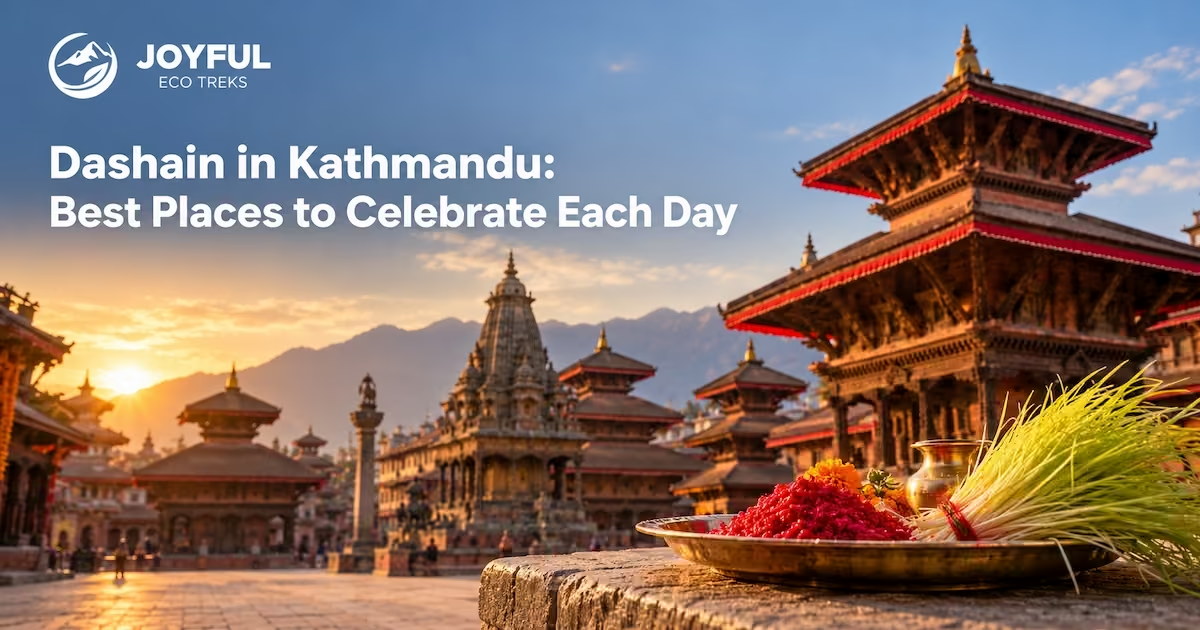
On Fulpati afternoon, ceremonial rifle and cannon salutes crack across Tundikhel while, days later, devotees queue for Maha Navami worship at Taleju Bhawani in Hanuman Dhoka. Dashain in Kathmandu scatters across squares, mela grounds, and temple courtyards, each peaking at a different hour. The traveler who books a room in Thamel and waits for the festival to arrive usually misses the parts worth flying in for.
This guide skips ritual meanings and the full fifteen-day calendar, which our Dashain festival dates and rituals guide already covers, and answers the harder question: where do you stand, and when. The payoff is a day-by-day location matrix further down, built for the five days that actually matter.
Why Dashain in Kathmandu Rewards a Place-by-Place Plan
Look up on any clear afternoon in the week before Vijaya Dashami and the festival is written across the sky: kites tilt and duel over the rooftops, cut loose when the dry late-October wind is right. At street level, the old tell was bamboo, the tall swing frames once lashed together at crossroads. Both signals point to the same truth. The celebration lives outdoors, in public, at specific coordinates, and it moves through the week.
Proximity is not a plan. Being in the city during Dashain is not the same as seeing it. By Vijaya Dashami, the Old City can feel abandoned, shutters down and residents gone to family homes across the country, while, on Maha Navami the day before, devotees queue early at Taleju Bhawani. Timing and location do the work here, not luck. The rest of this guide is the coordinates.
Tundikhel: Fulpati Gun Salute and Nearby Festival Events
Tundikhel does two completely different Dashain jobs, and most visitors arrive knowing about neither. The long parade ground in the city's centre, bordered by Ratna Park to the north and Sahid Gate to the south, is where the state stages Fulpati, while nearby Bhrikuti Mandap hosts separately scheduled festive exhibitions and fairs.
The Fulpati procession and the Army's feu de joie
On Fulpati, the seventh day (17 October in 2026), the sacred floral bundle travels from Gorkha to Kathmandu. In 2026, the bundle was dispatched from Gorkha Durbar by vehicle and brought via Dhading to Jamal in central Kathmandu; from there, officials, security personnel, and traditional musicians accompanied it in a ceremonial procession to the Dashain Ghar at Hanuman Dhoka. Jamal is the position almost nobody writes about. Stand there when the procession assembles and you can watch the final ceremonial leg. The Nepal Army also staged a feu de joie with ceremonial rifle and cannon fire at Tundikhel in the afternoon in 2026. The bundle reached Hanuman Dhoka in the afternoon in 2026, so Durbar Square rewards a second visit rather than an all-day wait.
The Bhrikuti Mandap mela: check the event schedule
The Bhrikuti Mandap and Ratna Park side is a different Tundikhel entirely. During the festive season, the grounds may host shopping exhibitions and temporary fairs, but the stalls and attractions depend on the organizer. In 2026, a documented Dashain shopping expo ran from 8 to 12 October, before the main ritual days, so do not assume a fair is running after tika. Check the announced dates and hours before going.
Pashupatinath on Maha Navami, October 20
The ninth day, Maha Navami (20 October in 2026, not the 19th that one widely shared page still lists), brings intensive worship to the valley’s goddess temples, while Pashupatinath offers a different kind of riverside visit, not a verified viewpoint for Maha Navami sacrifices. If you budget only one temple morning specifically for Dashain rituals, spend it at Taleju Bhawani in Hanuman Dhoka, which opens for public worship on Maha Navami.
What you can see from the eastern bank
The eastern bank of the Bagmati is the answer. The Nepal Tourism Board is explicit that non-Hindu visitors are restricted to the terraces on the river's eastern side and cannot enter the main temple or Guhyeshwari. Those same terraces happen to be the best vantage in the complex, looking straight across the cremation ghats and the temple roofs. From that one spot you are meant to stand, you get the ghats, the sadhus, the funeral smoke, and the morning crowds.
Fees, etiquette, and why 8 a.m. matters
Foreign non-Hindu visitors pay NPR 1,000 under the Nepal Tourism Board’s published entry-fee schedule, which covers permitted visitor areas but not the inner sanctum; confirm the current rate before you go. Arriving before 8 a.m. can make the visit quieter, but no published schedule guarantees Maha Navami-specific rituals or crowd conditions on these terraces. An early entry gives you time to observe respectfully without treating the cremation ghats as a festival spectacle. Keep your distance from the ghats and ask before photographing anyone mid-ritual.
Basantapur, Asan, and the Honest Story of the Old City Swings
Most Dashain guides send you to Basantapur, Asan, and Indrachowk to find the linge ping, the tall bamboo swings that rival the kites as a symbol of the festival. Go looking in 2026 and you will mostly find congested crossroads and no swings. Nepal Traveller reported in October 2026 what residents already knew: the linge ping have largely disappeared from Kathmandu's urban core, squeezed out by a plain lack of space to plant the poles. The tradition is alive, just not here. For a genuine swing, head to Bhaktapur, Kirtipur, Lalitpur, or Changunarayan, where the lanes still open out enough to raise one. The Nepal Tourism Board has also taken to installing swings at a handful of tourist sites during the festival, which is pleasant but not the same thing.
That is no reason to skip the Old City. The run of lanes between Asan and Indrachowk is the densest festival-market walk in the capital, thick with marigold garlands, jamara sellers, and crowds stocking up before the shutters come down. There is also a reason to come back the day after Vijaya Dashami: Asan's own Newar tika day, Chalan, sends a palanquin of the goddess Annapurna Ajima on a route through Thahity, Jyatha, Balkumari, and Bhotahity, a procession almost no English-language guide mentions.
Patan Durbar Square: Courtyard Puja and Quiet Hitis
Patan rewards the traveler who wants Dashain at conversational volume. While Kathmandu's Durbar Square draws the crowds and the cameras, Patan keeps a slower rhythm. In the early morning, courtyard shrines and the sunken stone hitis around Mangal Bazaar fill with households bringing puja, and you can stand in a bahal watching one family's ritual without becoming a spectacle yourself. The residential blocks south of the square stay residential. Come between roughly 7 and 9 a.m., then let the rising heat and the thinning crowd move you on. For photography without a scrum, Patan is the valley's best option during Dashain week.
Bhaktapur: The Valley's Most Intact Dashain Atmosphere
For sheer festival atmosphere, Bhaktapur is the single best choice in the valley, and a day there reframes what Dashain can look and feel like. Central Kathmandu has traded much of its festival texture for traffic and concrete. Bhaktapur, with brick lanes largely closed to cars and its Newar civic life still intact, holds what the capital has gradually lost.
Taumadhi Square and the Khame Jatra buffalo procession
The streets around Navadurga Dya Chhen and the route toward Brahmayani are the stage. The single most distinctive public spectacle in the valley on Maha Navami is Bhaktapur’s Khame Jatra, a procession in which a buffalo symbolizing the demon Mahishasura is led through the eastern neighborhoods toward Brahmayani; the later sacrificial rite is not open to ordinary spectators. In a separate Maha Ashtami-night tradition, 25 buffaloes are sacrificed at Bhaktapur’s Taleju temple. Nothing in central Kathmandu on the same day matches it for observable drama.
Batti Dina Jane: the ten-night lamp ritual
The quieter draw runs every evening. From Ghatasthapana through Vijaya Dashami, girls in Bhaktapur light oil lamps at the temples at dusk, a ritual called Batti Dina Jane that turns the squares into fields of small flames across the full ten-day stretch. It asks nothing of you but to be there near nightfall. One overnight in Bhaktapur buys you both the daytime jatra and the evening lamps, and on a tight schedule that combination is worth the trade-off.
Where to Be on Each Key Day: A Kathmandu Timing Matrix
The matrix below is Joyful Eco Treks' own planning tool, built from public festival schedules and the ground realities above. For the full calendar logic behind these dates, see our Dashain festival dates and rituals guide.
Key day (2026) | Best single location | Primary event to witness | Peak time window |
|---|---|---|---|
Fulpati, Oct 17 | Jamal to Hanuman Dhoka, via Narayanhiti Museum area and Tundikhel | State procession and ceremonial rifle and cannon salutes | Afternoon Tundikhel ceremony; Fulpati received at Hanuman Dhoka in the afternoon |
Maha Ashtami, Oct 18 | Mul Chowk at Hanuman Dhoka (access restricted) | Kalratri worship and traditional offerings | Night of Maha Ashtami; public viewing not guaranteed |
Maha Navami, Oct 20 | Hanuman Dhoka Taleju Temple, then Bhaktapur | Annual Taleju opening; Khame Jatra buffalo procession | Taleju from early morning; Khame procession from afternoon; confirm locally |
Vijaya Dashami, Oct 21 | Wherever your hosts are; Thamel to eat | Auspicious tika time at 10:26 a.m.; blessings throughout the day | Midday tika; Old City empties by afternoon |
Days 11 to 14 | Bhrikuti Mandap, only if an event is announced | Scheduled exhibitions or fairs, if any | Check organizer schedule; no fixed post-tika fair |
On Maha Ashtami night, 54 buffaloes and 54 goats are sacrificed during Kalratri worship at Mul Chowk in Hanuman Dhoka, which is why the matrix notes that visitors should not assume public access. The one judgment call baked into Navami: the morning belongs to Taleju at Hanuman Dhoka and the afternoon to Bhaktapur, and doing both well means an early start with a car already waiting. When that is not possible, pick one.
Three Day Trips Beyond the Valley During Dashain
Travelers already in the valley for the key days have three worthwhile escapes, each a different trade.
Gorkha Durbar: where the royal Dashain began
Gorkha Durbar is the source. The hilltop palace sits roughly 169 kilometres northwest of the capital, approximately four hours by road in good conditions, though the journey can take longer when traffic builds around the festival days. The site is where the Shah dynasty’s Dashain tradition began and where the Fulpati bundle starts its relay toward Kathmandu. To catch the Fulpati departure procession at Gorkha Durbar, plan to arrive by the morning of 17 October, which means leaving Kathmandu early. Go for the origin story, not for convenience.
Bandipur: a hilltop celebration without the crowds
Bandipur is the gentle option. A car-free bazaar town perched on a ridge near 1,000 metres on the old road toward Pokhara, it offers a family-scale Dashain: swings raised at the edge of town, households at tika, and a fraction of the capital's crowd density. It works best as a stop if you are already heading west, half a day of calm between the valley and the lakes rather than a there-and-back from Kathmandu.
The Madhesh Terai: a quieter, different Dashain
The Madhesh Terai runs on a different current. Dashain in the southern plains is observed but comparatively subdued; the region saves its real intensity for Tihar and, especially, Chhath a few weeks later. Go south during Dashain for the quieter, more agrarian texture of the holiday, not for a peak, and set expectations to a different festival rhythm than the valley's.
Getting Around Kathmandu When Half the City Has Gone Home
Spending Dashain in Kathmandu means accepting that the city partly empties. The public holiday window runs 17 to 23 October in 2026: government offices, banks, schools, and most local shops close for three to five days, while hotels, tourist restaurants in Thamel, Jhamsikhel, and Lazimpat, petrol stations, and temples stay open. Plan around that split.
Two practical warnings. First, draw cash before the holiday starts. ATMs in tourist areas routinely run dry during Dashain, and bank branches are shut, so the machine that worked on the 16th may be empty by the 20th. Second, the roads behave strangely. Outbound intercity buses in the days before Dashami fill with residents leaving the city, and seats vanish fast, while inside the valley the thinned traffic suddenly makes walking the Old City a pleasure instead of a contest. Taxis grow scarce and more expensive on Vijaya Dashami itself, so for that day, stay within walking distance of whatever you want to see.
The timing above gets you to the right square at the right hour. To line up the rest of your October, including the ritual meaning behind each of these days and the exact 2026 calendar, read our full Dashain festival dates and rituals guide, then weigh it against the best time to visit Nepal if you are still choosing your window.
Questions About Experiencing Dashain in Kathmandu
Is Bhaktapur or central Kathmandu better for experiencing the Dashain mela atmosphere?
Bhaktapur for atmosphere, central Kathmandu for the state Fulpati ceremony. The two experiences do different work. For a fair or shopping expo, check whether Bhrikuti Mandap has a confirmed event on your dates. For intact festival ambience, Bhaktapur wins decisively, with car-free brick lanes, the Khame Jatra buffalo procession on Maha Navami, and nightly lamp lighting the capital no longer matches.
Can tourists visit Pashupatinath on Maha Navami, and what is the etiquette?
Yes, non-Hindu visitors can observe the temple from the eastern-bank terraces of the Bagmati, but the inner temple remains off limits. The Nepal Tourism Board lists a foreign-visitor ticket of NPR 1,000. An early visit may be quieter; keep your distance from the cremation ghats and follow photography restrictions. Do not assume that Maha Navami animal sacrifices can be viewed from the terraces. Treat it as witnessing, not sightseeing.
Which neighborhoods in Kathmandu still raise bamboo swings (linge ping) during Dashain?
Very few inside the city core. The linge ping have largely vanished from Basantapur, Asan, and Indrachowk for lack of space, as Nepal Traveller documented in 2026. For a real swing, go to Bhaktapur, Kirtipur, Lalitpur, or Changunarayan, or look for the swings the Nepal Tourism Board installs at a few tourist sites during the festival.
Are shops and restaurants in Thamel open or closed on Vijaya Dashami?
Tourist restaurants, bars, and guesthouses in Thamel stay largely open on Vijaya Dashami and through the holiday window, since they serve visitors rather than families observing tika. Local shops, banks, and government offices across the rest of the city close for three to five days. Thamel and Jhamsikhel are the safe bets for a meal on the 21st.
Is a day trip to Gorkha Durbar during Dashain worth it from Kathmandu?
Worth it for travelers who care about the festival’s royal origin and have a full day to give. Gorkha Durbar is where the Fulpati bundle begins its journey, but the drive takes approximately four hours each way under good conditions and can run longer around the festival. Witnessing the morning procession on 17 October means an early departure from Kathmandu. On a tight itinerary, the valley itself holds more than enough for the key days.