By mid-afternoon on the third day of the festival, the steps at Kamalpokhari can already be crowded, and families who arrive later may end up watching from the back. Chhath in Kathmandu is not an event you can drift into late. The riverbanks are small, the crowds are large, and the two ceremonies visitors plan around run on the sun's timetable, not a flexible one. This guide covers which ghat to choose, when you need to be standing on it, and how to reach the water on a day when traffic and parking restrictions can complicate the last stretch.
What the Ghats Look Like During Chhath in Kathmandu
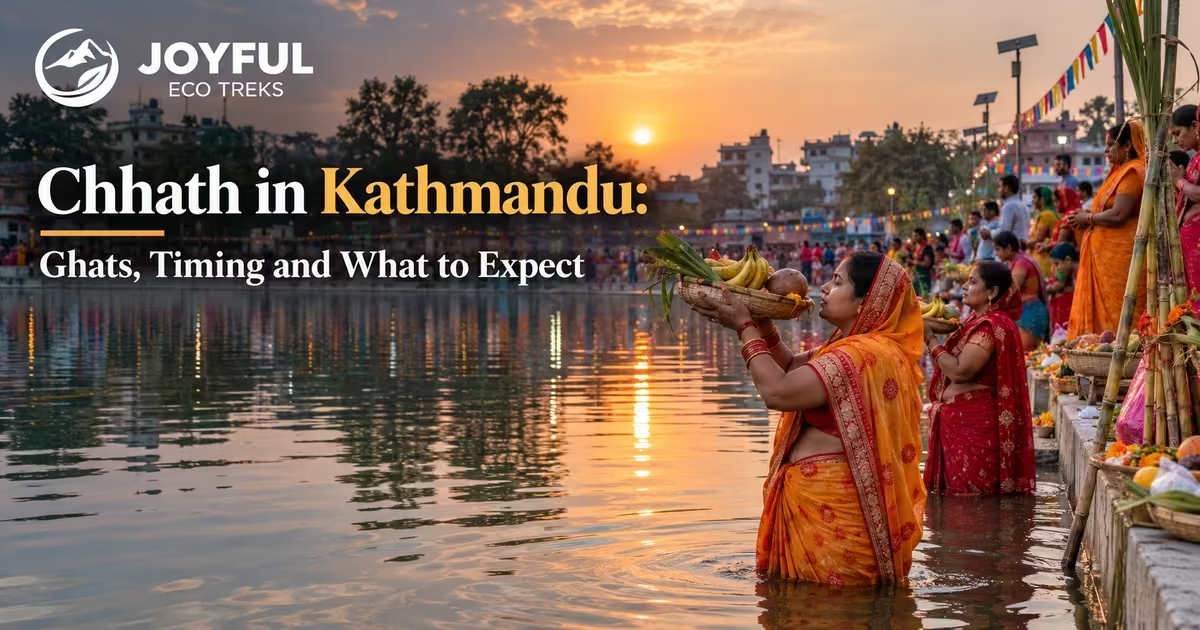
Kathmandu has several rivers and tributaries, including the Bagmati and the Bishnumati, yet for four days in the month of Kartik their banks and several pond edges become one of the city's largest religious gatherings. Local organiser Satish Jha estimated that around 800,000 people attended Kathmandu's Chhath celebrations annually before the pandemic. The festival arrived in the capital with its people. The first organised communal Chhath puja here was held in 1987 at Thapathali Ghat by families with Mithila roots, and decades of migration from the Terai, Nepal's southern plains, grew it into the dense riverside crowd you see now.
Chhath is primarily a Madhesi and Maithili observance. Since 2007, when it gained official holiday recognition, non-Madhesi residents of the valley have joined in too, but the rhythm and the prayers still belong to communities with Terai roots. You are a guest at something that is at once a public spectacle and a private, multi-generation family vow. The full ritual sequence and its meaning sit in our complete Chhath Festival Nepal guide; this piece stays on the practical side.
The Four Days of Chhath and When Each Ceremony Happens
Planning around Chhath in Kathmandu comes down to two decisions: which ghat, and what time. This year the festival runs from November 13 to 16, 2026. The main public sunset and sunrise offerings at the ghats take place on the last two days.
Nahay Khay and Kharna: before the main ghat ceremonies
The first two days, Nahay Khay on November 13 and Kharna on November 14, focus on ritual bathing and preparations at home. Devotees bathe, cook ritually pure food, and begin the fast. The main public sunset and sunrise offerings come later, so save your energy, and your early alarm, for days three and four.
Sandhya Arghya on day three: the sunset arrival window
Day three carries the first offering you can watch. On November 15, 2026, the Sandhya Arghya, the offering made standing in the water, falls at the 5:12 PM sunset for Kathmandu, per Drik Panchang. Families often gather well before sunset to prepare offerings and find space by the water. Treat 3:00 to 3:30 PM as your target to be standing at the ghat. By four, the best vantage points at busy central sites may already be taken.
Bihania Arghya on day four: the predawn walk to the water
The final offering, the Usha Arghya or Bihania Arghya, is made at sunrise on November 16, timed at 6:25 AM for Kathmandu in 2026. Arrive by 4:30 AM. That sounds extreme for a 6:25 sunrise, but devotees begin gathering before first light, the diyas are lit, and the atmosphere in the dark is the reason to come. Show up at six and you may be watching from behind the crowd with the sky already pale.
Which Kathmandu Ghats KMC Sets Up, and How to Reach Each
In 2025, Kathmandu Metropolitan City helped prepare major Chhath ghats with cleaning, lighting and security, and restricted parking around designated worship areas. That list shifts from year to year, which matters more than most guides admit. KMC's 2025 municipal report named nine main sites: Kamalpokhari, Gaurighat, Boksidaha, Bagmati Dobhan in Ward 32, Tankeshwor, the Balkhu Kumari Club area, Kuleshwor Volleyball Ground, Ramghat, and Balaju 22 Dhara. As of late October 2026, the final 2026 arrangements were still awaiting confirmation. Check KMC's latest announcements before you commit to a ghat.
Below are five sites for visitors to consider, with general directions from Ratnapark, the city's central transit hub. Boksidaha, Tankeshwor, Ramghat, and Balaju 22 Dhara also appeared in KMC's 2025 report but are omitted from this table.
Ghat | Where it is | From Ratnapark | Getting there |
|---|---|---|---|
Kamalpokhari | Central city | Walkable | On foot from New Road or Sundhara |
Gaurighat | Near Guhyeshwari | About 4 km east | Microbus or tempo toward Pashupati |
Kuleshwor Volleyball Ground | West | About 4 km | Microbus toward Kalimati or Kuleshwor |
Bagmati Dobhan (Ward 32) | Koteshwor area | Via Tinkune | Sajha Route 5 toward Tinkune; check the ghat entrance |
Balkhu Kumari Club area | Southwest | Via Kalimati | Bus or microbus toward Balkhu; walk to Kumari Club area |
Kamalpokhari: the central ghat that fills first
For anyone who has never worked a festival-day crowd in Kathmandu, Kamalpokhari is a convenient first choice. Central, walkable from New Road and Sundhara, it was set up in 2025 for roughly 500 families with free worship-space reservations, according to the Kamalpokhari Chhath Puja Society. It is also a popular site that can become crowded. When KMC did not allow Chhath worship at nearby Ranipokhari in 2024, over 500 worshippers from Asan and Indrachowk had to seek other sites, including Kamalpokhari. Arrive early or accept the back row.
Gaurighat, Kuleshwor and the mid-valley sites
Gaurighat, beside Guhyeshwari on the Pashupatinath corridor about four kilometres east, is another major organised site. In 2025, it was prepared for 615 families, up from 564 the year before, with eight to ten CCTV cameras and a budget near two million rupees, according to the Gaurighat Chhath Puja Committee. Organisers reported turning some families away in 2025, so it is not a quiet alternative, just a well-run one. Other places to consider include Kuleshwor Volleyball Ground to the west and Bagmati Dobhan near Koteshwor, along with Tankeshwor and Boksidaha. Check each site's arrangements before assuming it will be less crowded.
Why older guides still name Teku, Sundarighat and Ranipokhari
Several travel pages still send visitors to Teku, Sundarighat or Ranipokhari. None of those appeared on KMC's 2025 list by name, and Ranipokhari was closed to Chhath worshippers in 2024. KMC's 2025 report places Bagmati Dobhan in Ward 32, around Koteshwor, while some coverage called it Tinkune Dobhan. That is not a confirmed Teku-area ghat. A site outside the municipal list may have different lighting, access or crowd arrangements. Confirm against the year's KMC announcement rather than an undated blog.
Getting to the Ghats When Half the City Is Already Moving
Microbus and tempo routes from Ratnapark
Many public routes pass through Ratnapark. For Balkhu in the southwest, Sajha Yatayat Route 5 passes through Ratnapark, Kalimati and Solteemode on its Thankot-to-airport service. Check the remaining journey to the Balkhu Kumari Club area, since the bus does not stop at the ghat itself. For other inner-city and confluence sites, look for transport toward Tripureshwor, Kalimati or Koteshwor, depending on your chosen ghat. Kathmandu reshuffles its bus routes often, so check Sajha Yatayat's published timetable for current frequency and journey time before you depend on it.
Traffic restrictions and the pedestrian stream
On Sandhya Arghya afternoon, expect slow traffic near busy ghats and possible parking restrictions or diversions. Check local traffic-police notices before setting out. Ride as close as traffic allows, get out, and join the pedestrian stream, which by mid-afternoon flows toward every major ghat the way water finds a drain. Walking the last stretch is faster than sitting in a taxi that cannot move. For the predawn Bihania Arghya, the traffic is thin, but transport is sparse at 4 AM, so a pre-booked taxi or a bed within walking distance of your chosen ghat beats hoping for a ride.
What to Bring, Wear, and Leave Behind
Dressing for the predawn cold
The sunrise offering is the cold one. A Kathmandu November morning at four or five o'clock sits around eight to twelve degrees Celsius, and you will be standing still on stone beside a river, not moving to keep warm. Layers, a warm top, and closed shoes you can slip off near the water make the difference between staying for the whole offering and leaving early. The daytime Sandhya Arghya is mild by comparison, though the temperature drops fast once the sun is down.
Photography and the one move that gets you asked back
Dress modestly, and ask before photographing anyone at close range; most families are gracious about it. The single behaviour that gets a visitor waved back is standing on the ghat steps devotees use to walk down into the water. Those steps are the one path between the family on the bank and the person standing waist-deep making the offering. Block them and you are inside the ritual, not beside it. Keep off the steps and the water's edge during the Arghya itself, shoot from the side or behind, and you can watch without disrupting the ceremony.
How Kathmandu's Chhath Compares to the Madhesh
Visitors who have seen Chhath in Janakpur or Birgunj will find Kathmandu compressed. The Terai celebrations spread along wide riverbanks and open floodplains, with room for families to set up metres apart. Kathmandu's urban banks and ponds often leave less open space for spectators, and popular ghats can feel tightly packed. The experience is more concentrated and more urban: lights reflected off a small pond, foot traffic routed by volunteers, families packed close along a short stretch of bank. That density is exactly why arrival time, not just ghat choice, decides whether Chhath in Kathmandu is something you watch comfortably or something you glimpse over shoulders.
Chhath at the Ghats: Questions Visitors Ask Before They Go
Which Kathmandu ghat is easiest to reach by public transport?
Many public routes pass through Ratnapark, but the closest stop depends on the ghat. Staying centrally? Kamalpokhari needs no bus at all, since it is walkable from New Road and Sundhara. For Balkhu, confirm where to get off and how far you will need to walk. Check current bus service and timetables with Sajha Yatayat before the day, as routes change.
What time does the Sandhya Arghya sunset ceremony start at Teku Ghat?
The sunset offering falls at the 5:12 PM sunset on November 15, 2026. At busy ghats, arriving by around 3:30 PM gives you time to find a place to watch. One caveat on Teku: it did not appear on KMC's 2025 official ghat list, so do not assume it will be set up this year. For a major site used in previous years, consider Kamalpokhari or Gaurighat and confirm its 2026 arrangements before visiting.
How early should visitors arrive for the predawn Bihania Arghya?
Arriving by 4:30 AM is a sensible plan. The sunrise itself is timed to 6:25 AM in 2026, but devotees begin gathering before dawn, and busy ghats can fill early. Getting there around half past four improves your chances of a clear vantage point and the fuller atmosphere.
Are non-Hindu visitors welcome to observe at Kathmandu's Chhath ghats?
Yes. Visitors of any faith are welcome to watch respectfully. Dress modestly, stay off the ghat steps devotees use to enter the water, and ask before taking close-up photographs. Observe from the side rather than wading into the ritual space and you will be a welcome guest.
Is the Chhath celebration in Kathmandu as large as in the Terai?
Janakpur and Birgunj hold major celebrations along their riverbanks and ponds, while Kathmandu's urban ghats can feel more compact. The crowd may feel especially dense at popular Kathmandu sites, though reliable city-by-city attendance comparisons are limited. You get a tighter, more urban version of the same festival rather than the open-floodplain scale of the Terai.
Are there food or drink facilities at the ghats during Chhath?
Visitor facilities vary by ghat. At Gaurighat in 2025, organisers arranged tents, blankets and firewood for devotees, but food stalls and other visitor services are not guaranteed at every site. Eat before you go, carry your own water, and remember that the families around you are fasting, so keep any eating and drinking discreet and away from the water's edge.
Pick your ghat the night before, check the latest KMC notice, and build your afternoon or your alarm around the arrival windows above. For the ritual context and meaning behind what you will see at the ghats, read the complete Chhath Festival Nepal guide.