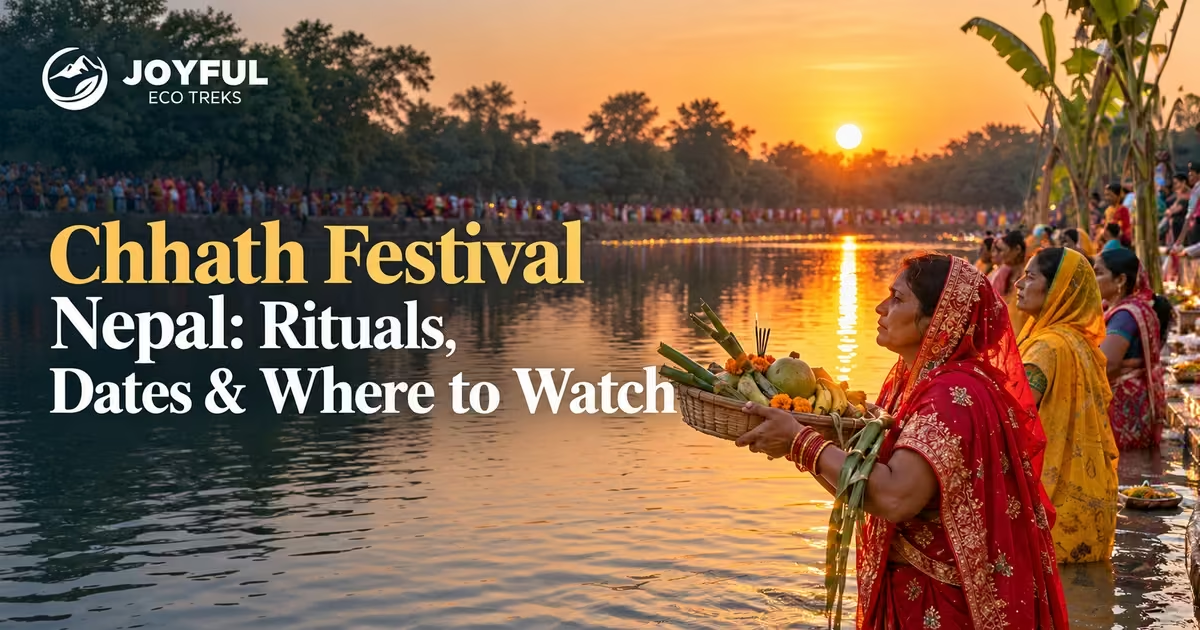
At sunset on the third day, the surface of Dhanush Sagar in Janakpur disappears under standing bodies: thousands of women waist-deep in cold water, baskets of fruit lifted toward a sun that is almost gone. No priest leads them. No temple roof stands between them and the sky. Across Nepal's southern plains each autumn, the Chhath festival arrives as a major celebration deeply rooted in the Madhesh and wider Mithila region, and most travelers who already know Dashain and Tihar file it away as a footnote. It deserves better. Worship centered on Surya and Chhathi Maiya, a fast that forbids even water, a four-day arc that resolves at the water's edge rather than inside a shrine: Chhath runs on a logic entirely its own.
This guide maps that arc. It covers the theology behind what you are watching, the 2026 dates and the lunar rule that sets them, the named ghats in Janakpur and Kathmandu, and a timing sheet that tells you when to arrive so you actually see the arghya.
Why Chhath Stands Apart from Every Other Nepal Festival
Group Nepal's festivals by who performs the central ritual, and Chhath lands outside every familiar category. Dashain belongs to families gathered under an elder's tika. Tihar moves through the house, from crows to dogs to siblings. Chhath centers on the parvaitin, the fasting devotee, traditionally a woman, although men also observe the rituals. That focus reorders much of what a hill-festival visitor expects.
Chhath has deep roots in the shared traditions of Nepal's Madhesh and the neighboring Indian regions of Bihar, Jharkhand, and eastern Uttar Pradesh. That lineage is audible: the Chhath Geet carried across the ghats in Janakpur is sung in Maithili, Magadhi, and Bhojpuri, among other regional languages. Chhath's cultural heartland in Nepal lies in the Terai, particularly the Mithila region.
Surya and Chhathi Maiya: worship without a temple
The two deities are Surya, the sun, and Chhathi Maiya, associated with the goddess Shashthi and, in some traditions, described as Surya's sister, invoked for the health and protection of children. Their worship gives Chhath a different emphasis from Dashain and Tihar. The name Chhath itself derives from Shashthi, the sixth day, since the festival's defining ritual falls on the sixth day of the waxing moon. What matters most for a traveler is the direction of worship. The central offering goes directly to the sun across open water, generally without requiring a priest as intermediary. Unlike many temple- and household-centered observances, Chhath is anchored to the horizon.
The 36-hour nirjala fast as the offering itself
Nirjala means without water. Not a fast from food that still permits sips through the day, but complete abstention from water for roughly 36 hours, beginning after the evening prasad of Kharna on day two and ending only at Usha Arghya on the fourth morning. The strictness of this vow makes the Chhath fast especially demanding. Here it is not, and that is the point. The devotee's bodily austerity, the tapas, becomes the offering itself. The offerings of water, fruit, and sweets accompany that endurance. Stand at a ghat near the end of the fast, and the emotional weight is unmistakable; now you know its source.
The Four-Day Ritual Sequence: What Happens, Where, and Why
Four days, four named rituals, one unbroken fast running through the back half. Travelers who can only attend part of the festival should target days three and four, which hold both ghat gatherings.
Nahay Khay and Kharna: the two days that build the fast
Day one is Nahay Khay, literally bathe and eat. The devotee bathes, then prepares a single pure meal. In Janakpur, the festival also reflects the city's Mithila heritage: some devotees visit Janaki Temple and bathe at sacred ponds. The city's associations with Sita and the Ramayana add a local layer to the solar ritual.
Day two is Kharna, also called Lohanda. The devotee fasts through daylight, then breaks it after dusk with kheer and roti. For the sunset and sunrise offerings, families also prepare thekua, the dense sweet of wheat flour and jaggery, alongside fresh fruit, sugarcane, banana, and coconut, arranged in bamboo baskets known as daura or sup. Once that evening prasad is eaten, the nirjala fast begins and does not break for a day and a half.
Sandhya Arghya: the sunset offering on day three
Day three is the one most visitors remember. In late afternoon, the parvaitin carries the laden baskets to the ghat, wades in, and offers arghya, water and the fruit offering, to the setting sun. Chhath honors the setting sun before the rising one, which surprises most first-time observers. For visitors used to sunrise-centered worship, this one opens by thanking the sun as it leaves.
Usha Arghya: sunrise and breaking the fast
Before first light on day four, the devotees return to the same water and wait, facing east. As the sun clears the horizon, they offer the morning arghya. Only then is the prasad distributed and the fast broken, closing the roughly 36-hour nirjala window that opened on Kharna night. The crowd thins through the morning, baskets are shared, and the festival ends not with a procession but with people walking home wet, hungry, and finished.
Chhath Puja Nepal Dates in 2026 and How the Lunar Calendar Sets Them
Kartik Shukla Shashthi: the anchor that moves each year
Chhath is fixed to Kartik Shukla Shashthi, the sixth day of the waxing moon in the Nepali month of Kartik. Sandhya Arghya always falls on Shashthi; the rest of the sequence counts outward from it. Because the lunar and Gregorian calendars drift against each other, the Western date shifts every year. In 2025, Sandhya Arghya fell in late October; in 2026 it moves into the middle of November. Any guide that treats Chhath as a fixed late-October event is working from an old calendar.
2026 Chhath dates in Bikram Sambat and Gregorian
The 2026 schedule is Nahay Khay on November 13 (Kartik 27), Kharna on November 14 (Kartik 28), Sandhya Arghya on November 15 (Kartik 29), and Usha Arghya on November 16 (Kartik 30), 2083 BS. The Hamro Patro calendar and Nepali Patro both identify November 15 as Kartik 29 and the main Chhath festival day. Treat November 15 to 16 as your planning target and confirm local ghat timings and arrangements closer to the time. For broader seasonal planning, our guide to the best time to visit Nepal sets Chhath in the wider autumn calendar.
Janakpur: Nepal's Chhath Capital
Janakpur is where Chhath in Nepal reaches full scale. The ponds draw a vast plains pilgrimage across the main arghya days, making Janakpur one of the country's most prominent Chhath destinations. What is not in doubt is the density: the ponds fill shoulder to shoulder, and the surrounding lanes become one slow river of people in red and yellow.
Dhanush Sagar and Ganga Sagar: the two sacred ponds
Janakpur holds many of its Chhath celebrations at sacred ponds, alongside the riverbank gatherings familiar in the wider Mithila region. Dhanush Sagar and Ganga Sagar are among the main sites for the sunset and sunrise arghya, alongside ponds such as Argaja Sagar and Dasharath Talau. Local preparations can vary, so confirm the active ghats on arrival. The enclosed-pond setting concentrates the crowd and the sound in a way that feels different from an open river.
Getting to Janakpur for Chhath: flights, buses, and when to book
Janakpur has its own airport with short flights from Kathmandu, and long-distance buses run from the capital and the border towns. The flight saves time; the bus is the budget option and a significant haul. The real constraint is lodging. Accommodation in Janakpur can be in high demand during festival week, especially near the ponds. Lock a room before anything else.
Chhath Beyond Janakpur: Kathmandu and the Terai Belt
The Chhath festival Nepal celebrates is not confined to Janakpur.
Where Kathmandu observes: Kamalpokhari and the Bagmati ghats
Kathmandu holds its own Chhath, smaller and far more accessible. Well-documented sites include Kamalpokhari and the Guhyeshwari–Gaurighat stretch of the Bagmati, with celebrations also held at Thapathali, Tankeshwor, Balkhu, Kuleshwar, and other designated ghats. Check the Kathmandu Metropolitan City's latest festival arrangements before choosing a site, as locations and access may change each year. Crowds vary by ghat and can be substantial during the arghya. For a visitor already in the capital, a confirmed site offers a clear first encounter with the ritual, and pairs naturally with the rest of things to do in Kathmandu.
Birgunj, Biratnagar, and the border towns
Chhath runs the length of the Terai. Birgunj and Biratnagar, the large plains cities near the Indian border, observe it with the same intensity as Janakpur if not the same pilgrim draw, and countless smaller towns light their ghats the same two evenings. Traveling the southern belt during the festival window, you will not have to search for it.
Attending Chhath in Nepal as a Traveler: Timing, Crowds, and Conduct
The Chhath Traveler's Timing Sheet
Arrival timing matters if you want to witness the arghya. Below is a planning sheet for each site. The arrival buffers are suggested estimates rather than official event times; confirm exact arghya times and access locally.
Factor | Janakpur | Kathmandu (Kamal Pokhari) |
|---|---|---|
Ghat type | Enclosed sacred ponds (Dhanush Sagar, Ganga Sagar) | Urban pond and river ghats |
Crowd scale | Very large plains pilgrimage | Can be busy; varies by ghat |
Arrive before Sandhya Arghya (day 3 sunset) | 90+ minutes (estimate) | about 60 minutes (estimate) |
Arrive before Usha Arghya (day 4 sunrise) | 90+ minutes, in the dark (estimate) | about 60 minutes (estimate) |
Accommodation lead time (festival week) | Book early; availability varies | Book ahead; availability varies |
Lodging approach | Check current guesthouse rates | Check current hotel rates |
At Janakpur, the sheer volume means good vantage points along the ponds are gone well before the sun moves, and the pre-dawn Usha Arghya requires finding your spot in the dark, so budget 90 minutes or more at both. At Kamalpokhari, aiming to arrive an hour early is a planning buffer, not a guarantee of a viewing spot. Compare current lodging and transport costs before choosing between a Kathmandu visit and a Janakpur trip, since fares and room rates can change during festival week.
Photography and the moments to lower the camera
Foreign visitors are generally welcome at the ghats as observers. Keep a clear distance from the devotees in the water; the ghat edge is a working ritual space. Cut flash entirely during the arghya itself, when devotees are mid-offering, and read the room before pointing a lens at anyone's face. During the actual offering, watch first and photograph second. Our guide to religious site etiquette in Nepal covers the wider conventions.
FAQs
What exact dates does Chhath puja fall on in Nepal in 2026?
Chhath runs from November 13 to 16, 2026 (Kartik 27 to 30, 2083 BS), with Sandhya Arghya on November 15 (Kartik 29) and Usha Arghya on November 16 (Kartik 30). Confirm the local timing of the offerings before visiting.
Can foreign tourists attend Chhath ghat rituals in Janakpur, and are there things they must not do?
Yes, foreign visitors are generally welcome as observers at the ghats. Keep a respectful distance from devotees standing in the water, avoid flash during the arghya offerings, and do not step into the ritual space at the pond's edge. Watch before you photograph.
Why do Chhath devotees stand in river water at sunset and sunrise rather than pray at a temple?
Chhath worships Surya, the sun, directly as a cosmic force, with the main offering made in open water, generally without a priest acting as intermediary. The devotee offers arghya from open water straight to the sun on the horizon, which is one of the features that distinguishes Chhath from many temple-centered observances.
How is the Chhath festival in Nepal different from how it is celebrated in Bihar, India?
Janakpur's celebration is closely associated with sacred ponds such as Dhanush Sagar and Ganga Sagar, while many large gatherings in Bihar take place on riverbanks. Both regions share Mithila traditions, Chhath songs, and the sunset and sunrise offerings. Janakpur's association with Janaki Temple adds a distinctive local setting, but temple worship is not a required first step for every devotee.
Which locations in Kathmandu hold Chhath celebrations, and how do they compare in scale to Janakpur?
Kathmandu's documented Chhath locations include Kamalpokhari, Guhyeshwari–Gaurighat along the Bagmati, Thapathali, and other designated ghats. Janakpur is a major pilgrimage destination, but crowds can also be large in Kathmandu; confirm the year's venue arrangements before traveling.
Chhath rewards travelers who plan around it rather than stumble into it. If the southern plains are on your route this November, build a Terai circuit that pairs Janakpur's ghats with Lumbini and Chitwan, and you will see a major festival rooted in Nepal's Mithila heritage.