On most Kanchenjunga circuit itineraries, the gompas get a single line: visit the monastery at Ghunsa on your acclimatization day. That sentence flattens centuries of lineage, a prayer hall reported in 2021 to rely on wooden supports, and ceremonies whose dates need local confirmation. These are living religious institutions, fragile in places, and they repay a trekker who plans around them instead of past them. This guide names documented gompas on and around the circuit routes, separates what is documented from what is only oral tradition, and ends with a structured reference table no itinerary page currently carries.
How Tibetan Buddhism Reached the Kanchenjunga Valleys
The Buddhism you meet in these valleys arrived on foot, over the passes. Understanding how it got here explains why the gompas sit where they do and whose lineage they carry.
Migration Routes Through the High Passes Into the Tamor
Tibetan settlers, and later communities related to the Sherpa, crossed the high cols at the head of the Tamor basin, following the same trade corridors that carried salt, wool, and butter down from the plateau. They settled the upper valleys at Walung, Olangchung Gola, and Ghunsa, bringing their prayer halls with them. One distinction worth holding: the people of Ghunsa, the Gunsawa, are not Sherpa. They speak Ghunsake, a variant of the Walungge tongue within the Central Tibetan language family. The lineage a village gompa inherits follows its actual settlers, not a generic Himalayan template.
Why Nyingma Practice Took Hold
Nyingma, the oldest of the Tibetan Buddhist schools, took root for structural reasons as much as doctrinal ones. Its transmission leans on oral teaching and terma, treasure texts revealed across generations, and on a tantric ritual calendar kept by households and a village lama rather than a large resident monastic college. In settlements of a few dozen families, cut off by snow for months at a stretch, a tradition that can live in a lineage-holder's memory and a single prayer hall travels better than one requiring a campus of monks to survive. Both Nyingma and Kagyu are practiced at the higher settlements, Ghunsa included, but Nyingma is the thread running through most of the named sites.
Tashi Chhyoling Gompa at Ghunsa, the Circuit's Living Center
Ghunsa village sits at 3,475 m, and Tashi Chhyoling Gompa stands just above it at approximately 3,500 m in a January 2021 report. Reported figures vary across sources, so treat any single elevation as approximate, but no single elevation should be treated as definitive. Many circuit trekkers plan to visit this gompa, usually on the acclimatization day the standard itinerary builds in at Ghunsa.
Founding Lineage and What the Hall Preserves
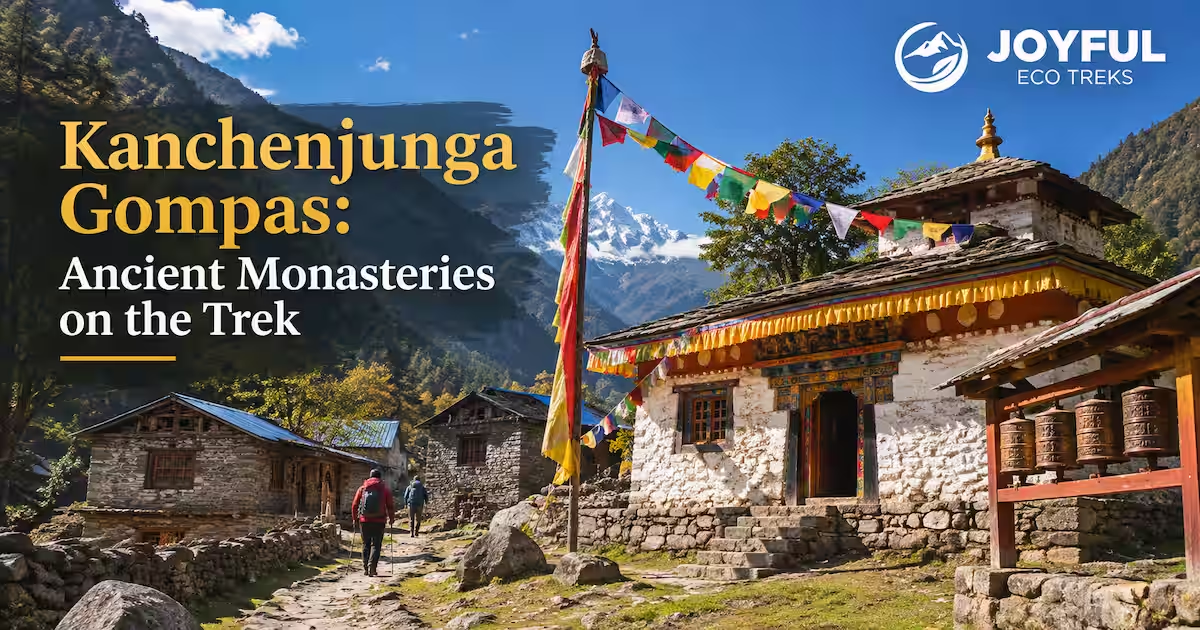
Local tradition calls Tashi Chhyoling very old, a thousand years by some accounts, but no founding record, named lineage, or primary document backs that figure. Treat it as oral history, not a dated fact. What is verifiable is more sobering: a January 2021 report described wooden supports and warned of collapse without conservation work; its present condition needs fresh confirmation. Picture it less as a sealed museum and more as a working parish hall that has outlived its maintenance budget. Inside are the furnishings of a Nyingma hall, thangkas on the walls, a central shrine, and rows of butter lamps, but nothing here is behind glass, and its current condition and visitor access should be checked before entering.
Monk Residency: What Ground Reports Show
Itinerary pages and ground reports diverge on this point. Several trek listings describe Tashi Chhyoling as an active spiritual center; at least one first-hand account from the village reports that it no longer has permanently resident monks and opens mainly when lamas are summoned for ceremonies. Until an operator confirms otherwise on the ground, work from the honest version: confirm whether the hall is open before visiting, rather than expecting monks in daily attendance.
Dumje, the Ceremony to Verify Before Planning Around
Dumje is documented in Nepal's Khumbu region, but a specific annual Dumje schedule at Tashi Chhyoling in Ghunsa has not been verified. The detailed ritual sequence and UNESCO attribution should not be applied to this gompa without local evidence. Ask your guide or monastery caretakers which ceremonies, if any, coincide with your trip. The catch for trekkers is the timing: June and July are monsoon season, bringing leeches, cloud cover, and landslide risk. If a ceremony happens in monsoon, good trail conditions may not coincide with it.
Tholung Gompa: A Location Trekkers Must Not Confuse
Among the Kanchenjunga gompa names found in travel writing, Tholung needs special care: its documented location is in Sikkim, India, not on Nepal’s standard Kanchenjunga Circuit.
The Claimed Climb Above Ghunsa
No reliable source checked for this guide confirms a separate Tholung Gompa at 3,900 to 4,000 m or a three to four hour climb above Ghunsa. The Government of Sikkim identifies Tholung Monastery in Upper Dzongu, India. One warning for anyone researching it online: do not treat that documented Sikkim monastery as evidence for a Nepal site or add an unverified side trip to your itinerary.
What the Location Evidence Tells You
The location distinction itself is instructive. Himalayan monasteries can share similar names, while their actual trails, histories, and rituals belong to different valleys. A place described as a difficult climb is not automatically a verified circuit stop. Before adding a Tholung detour from Ghunsa, ask your operator for a locally confirmed site name and route.
Smaller Kanchenjunga Gompas on the North and South Routes
Beyond Ghunsa, a handful of smaller gompas fill out the north circuit, while the south circuit is genuinely thinner on documented sites.
Phale, Deki Chholing, and the Northern Sites
Phale village has monastery sites linked to Tibetan refugee history, though the founding dates and religious schools of individual halls still need local verification. On a separate or extended route, Diki Chhyoling Gompa at Olangchung Gola, the old Walung trading settlement near the Tibet border, is described by Nepal Tourism Board as around 400 years old, with its precise age and school not independently established here. It is outside the standard Kanchenjunga Circuit, reached on routes such as Nango La or Lumba Sumba and is tied to the Walungpa trading community whose Tibet links predate the closure of the trade routes. Ramdang Monastery sits higher still, in the glacier terrain between Kambachen and Lhonak; its school affiliation is not confirmed in any source available for this guide.
On the question of Lelep and the lower Tamor valley: the same honest gap that applies to the south circuit applies here. No public source names a specific active gompa at Lelep or in the immediately surrounding lower Tamor villages. If your route passes through Lelep, ask your operator or a local guide directly rather than trusting information this guide cannot verify.
Yamphudin and the South Circuit
The sources checked did not verify a named, regularly accessible gompa at Yamphudin or along the standard south Kanchenjunga circuit. The best documented gompa stops in this guide lie toward the northern, upper-Tamor routes. Routing via the south and wanting a named site to visit? Ask your operator directly rather than trusting a page that invents one.
Reading a Gompa's Status Before You Arrive
Gompas fall into three practical states. Active means regular use and maintenance. Seasonal means used only for festivals or when a lama travels through, which describes more of these sites than the itineraries admit. Ruins means a structure you can see but not enter or use. Knowing which you are walking toward saves the disappointment of a locked door at the top of a long climb.
Kanchenjunga Gompas: Named-Site Reference Table
The table below is Joyful Eco Treks' own compilation, drawn from public records where they exist and from our guides' ground knowledge where they do not. No competitor itinerary on the current search results offers this in structured form. Where sources disagree or go silent, the entry says so.
Gompa | Location / Elevation | School | Status | Trekker Access |
|---|---|---|---|---|
Tashi Chhyoling | Ghunsa, approx. 3,500 m (2021 report) | Confirm locally | Concerns reported in 2021; current status unconfirmed | Confirm access and route permits |
Tholung | Upper Dzongu, Sikkim, India | Not assessed | Outside Nepal route | Not a Kanchenjunga Circuit stop |
Phale | Phale village | Unverified | Confirm locally | Confirm access and route permits |
Diki Chhyoling | Olangchung Gola (extended route) | Unverified | Historic; about 400 years (NTB) | Confirm access and route permits |
Ramdang | Kambachen–Lhonak section | Unconfirmed | Present status unconfirmed | Confirm access and route permits |
Visiting Kanchenjunga Gompas Without Getting It Wrong
These are working religious sites, not visitor attractions, and a few customs are non-negotiable.
Thresholds, Circumambulation, and Cameras
Shoes come off at the threshold, every time, at every active hall. Walk clockwise around any stupa or chorten, keeping the monument on your right. The direction follows the course of the sun; walking it anticlockwise reads as a deliberate affront, not an innocent mistake. For cameras, ask before photographing interiors or people, assume flash is unwelcome near old thangkas, and accept that some halls forbid interior photography outright. At Tashi Chhyoling in particular, given the structural concerns reported in 2021, do not lean on or brace yourself against the structure.
Permits: KCAP, RAP and TIMS in 2026
KCAP and RAP govern conservation-area and restricted-area entry, while NTB also lists Kanchenjunga routes under its TIMS guidance. The Kanchenjunga Conservation Area Permit (KCAP) costs NPR 2,000 per foreign visitor per entry; confirm the current KCAP fee before travel, as rates are subject to revision. The Restricted Area Permit (RAP) costs USD 20 per person per week for the first four weeks and USD 25 per week beyond that, and a licensed guide from a registered agency is mandatory, and your registered agency should confirm the TIMS requirement for the exact route rather than assuming RAP replaces it. The territorial split matters: KCAP covers general conservation area entry, while RAP covers officially designated restricted wards of Taplejung. Your registered agency should check which intended stops fall inside the restricted wards. These permits are not themselves monastery-entry tickets; a small donation left at the hall is customary.
Fitting Gompa Visits Into Your Kanchenjunga Itinerary
The gompa stops worth most of your attention depend on where you were already planning to spend time.
Time Budgets and Where They Fit
A standard itinerary runs five to seven days from the Taplejung trailhead to Ghunsa. The Tashi Chhyoling visit may fit into the Ghunsa acclimatization day if access is confirmed, which is part of why it is the one gompa nearly everyone sees. Olangchung Gola is the larger route decision. It requires a separate or extended itinerary, so ask your operator to plan it instead of adding an unverified Tholung climb above Ghunsa.
Which Months Put Monks in the Halls
A specific Dumje window at Tashi Chhyoling has not been verified; June and July are also monsoon months. The main trekking seasons, October to November and April to May, usually bring more favorable trails, but neither open halls nor resident monks are guaranteed. The trade-off between trek conditions and active ceremony is real; confirm local ceremony dates before you book.
Common Questions About Kanchenjunga Gompa Visits
Are the Monks at Tashi Chhyoling in Ghunsa Resident Year-Round?
Year-round monk residency is unconfirmed. Some ground accounts suggest lamas visit for particular ceremonies, but current arrangements require local confirmation. Ask your guide whether the hall is open rather than expecting monks present every day.
Which School, Nyingma or Kagyu, Governs the Kanchenjunga Gompas?
Nyingma is an important Tibetan Buddhist school in the region, but the affiliation of each named gompa is not consistently verified. Ask local caretakers about the particular monastery rather than assuming all sites follow one lineage.
Can Non-Buddhists Attend Religious Ceremonies at Ghunsa?
Visitor access depends on the ceremony and the wishes of the community; a Dumje programme at Ghunsa is not verified here. Keep a polite distance from the ritual space, follow your guide's cues, and ask before photographing people or the proceedings.
Should You Add a Tholung Side Trip to a North-Circuit Itinerary?
Do not budget an extra day for the claimed Tholung climb above Ghunsa without first confirming that the Nepal site and route exist. The verified Tholung Monastery is in Sikkim, not on the standard Kanchenjunga Circuit.
See our Kanchenjunga circuit trek itinerary to build gompa stops into your acclimatization schedule rather than hoping they fit on the day.