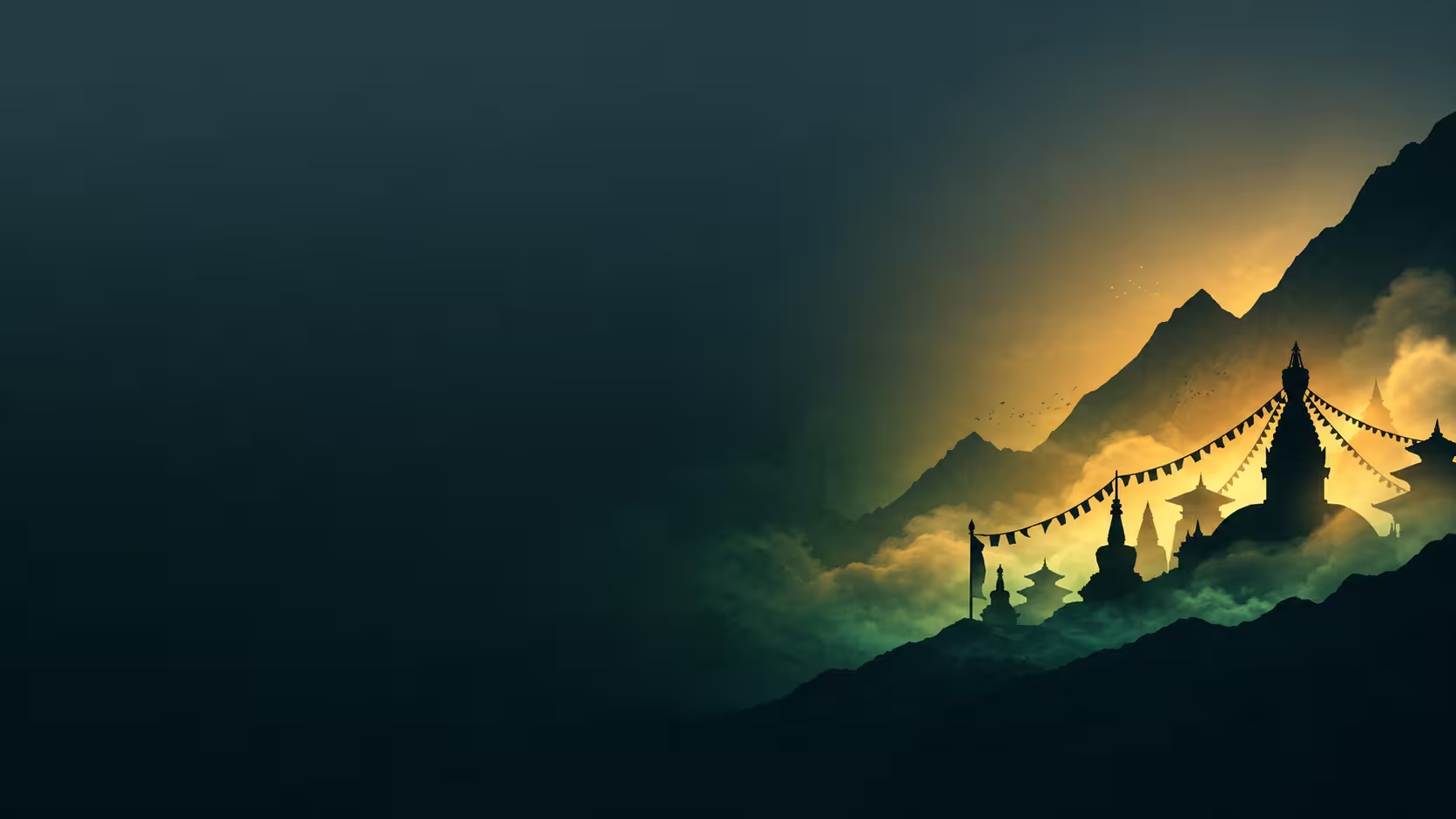
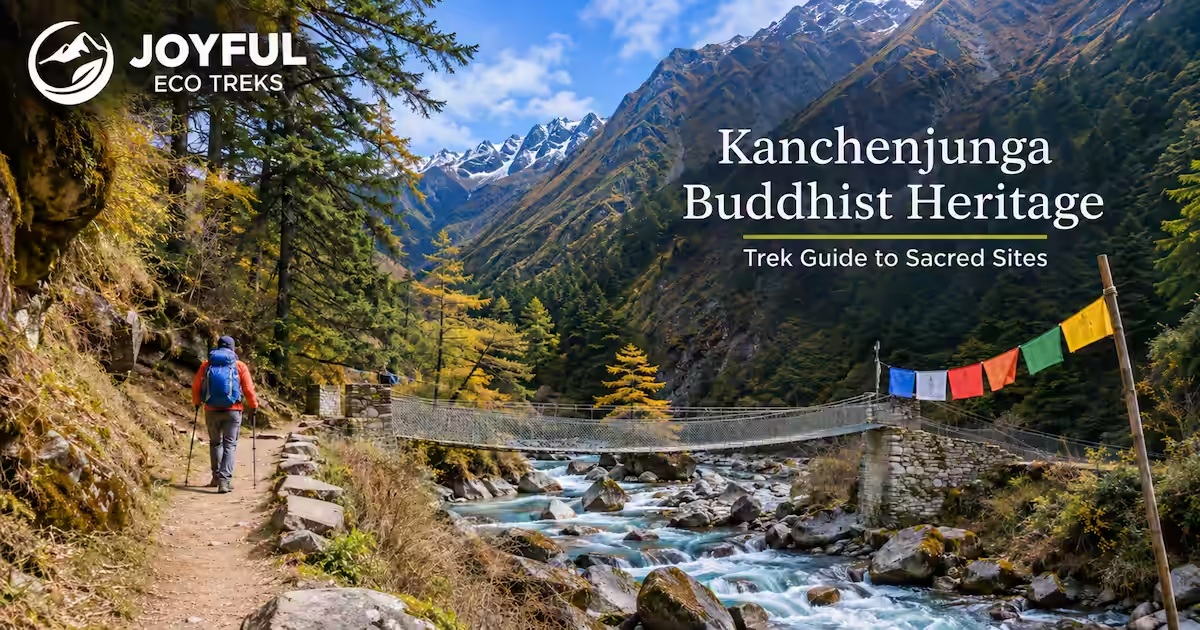
Three communities give Kanchenjunga three names, and each one tells you something the permit office never will. To the Limbu of the lower valleys it is Sewalungma, "the mountain that we offer greeting to." To Tibetan speakers it is Kang-chen-mdzod-lnga, the Five Treasures of Snow. Ranging across its slopes is a guardian being called Dzo-nga. Reading Kanchenjunga Buddhist heritage well starts right here: the peak you are circling is treated not as a summit to be bagged but as a living presence, addressed and kept on good terms by the people through whose territory you walk. What follows is a map of that cultural ground, so you reach Ghunsa understanding the religion around you and not only the thinning air.
Why Kanchenjunga Is a Sacred Landscape, Not Just a Summit
Most mountains carry one sacred story. Kanchenjunga carries two distinct ideas that trekking pages routinely collapse into a vague note about a "holy peak." Keep them separate and the whole landscape reads differently.
Dzo-nga and the Mountain as a Living Deity
The Tibetan place name and the resident deity are not the same thing. Kang-chen-mdzod-lnga is descriptive: it refers to five treasures associated with the mountain, though traditional accounts differ on what those treasures contain. Dzo-nga is a being, a guardian. The deity's name is similarly associated with the five-treasured mountain, although explanations of its exact etymology vary. Some sources describe Dzo-nga as a rakshasa figure patrolling the heights.
That distinction between address and tenant has a practical edge on the trail. A mountain that hosts a protective deity requires negotiation, not conquest. On the first successful ascent in 1955, Joe Brown and George Band stopped just short of the summit in respect for its sacred status; that does not establish a rule followed by every later expedition. Scaled down, the same logic runs through how porters nod toward the peak and how a teahouse owner talks about weather as something the mountain decides rather than something a forecast reports.
Beyul Demojong: Kanchenjunga as a Hidden Sacred Valley
In 1962, a Tibetan lama named Tulshuk Lingpa led around 300 followers toward the snowfields of Kanchenjunga. They had given away their possessions. Their aim was not a pass or a viewpoint but a doorway: they believed they could physically enter Beyul Demoshong, a hidden valley fabled to lie within the mountain. An avalanche killed Lingpa and companions who had gone ahead; published accounts differ on the number of people who died.
That event is the clearest evidence of how literally this landscape is held. In Nyingma Buddhist tradition, a beyul is a valley blessed by Padmasambhava as a refuge, its location recorded on scrolls hidden under rocks and inside stupas, to be revealed when the age demands it. A beyul is a place where the physical and spiritual worlds are thought to overlap, so pilgrims leave offerings to the lords of the land. The Kanchenjunga landscape is associated with this hidden-land tradition, the spelling running as both Demoshong and Demojong across sources. The consequence for a trekker is simple and large: the glaciers, the ridgelines, the rivers you ford are all considered ritually active ground. You are walking inside the shrine, not past it.
Two Religious Traditions Along the Kanchenjunga Trek
The organizing fact of this wider trekking region comes down to communities and geography, not altitude alone. Gaining height, you encounter different religious traditions across the valleys, but the transition is gradual rather than a clear boundary under your boots.
Low down, through the cardamom terraces out of Taplejung at roughly 1,800 metres, you encounter Limbu communities. Climb toward Phale and Ghunsa, around 3,000 to 3,400 metres, and Tibetan Buddhist influences become more visible in some settlements as fields give way to higher pastures. Same wider trekking region, different religious histories overlapping across communities rather than neatly stacked by elevation.
Limbu Yumaism in the Taplejung Valleys
Competitor guides file the Limbu under "animism," which tells you only what the tradition lacks. Yumaism is a structured indigenous theology with its own canon and pantheon. Its scripture is the Mundhum, an oral corpus whose name carries the sense of "great strength," recited by shamans and governing ritual and social conduct alike. Its supreme divine figure is often described as Tagera Ningwaphuma, also known in some traditions as Yuma Mang or Yuma Sammang. Ancestor veneration and worship can take place at household shrines, sacred natural places, and constructed Mangkhim or Mangheem worship spaces; the latter are not limited to river bends, caves, or ridges.
The relationship with Buddhism is syncretic, not sealed off. Over centuries of contact with Tibetan and Nepali Buddhist neighbours, Limbu practice absorbed and sat alongside Buddhist elements without surrendering its own structure. Call it animism and you miss the point; what you are looking at is a coherent tradition that coexists with the Vajrayana world uphill without dissolving into it.
Tibetan Orthodox Practice at Ghunsa
Ghunsa sits at approximately 3,400 metres and is an important Tibetan-influenced Buddhist settlement on the north circuit. Its religious landscape includes Vajrayana traditions and the historic Tashi Chhyoling monastery in Ghunsa, but published sources do not establish daily ceremonies there or at Phale and Lhonak. Orthodox mountain Buddhism of the kind recognizable from Solukhumbu, but accessed here through a more remote and far less documented corridor, one where visitor numbers are generally lower than on Nepal's best-known trekking routes.
Long-standing residents have described Tashi Chhyoling as over 1,000 years old and the first monastery built in the district, although its founding date has not been independently verified. A 2021 report found it held up by wooden poles and at risk of collapse without conservation work. Treat that as a snapshot that may have changed; ask locally and tread lightly if you are given access to the interior.
What Buddhist Heritage Looks Like at Each Trek Stage
The route notes below are editorial analysis, built from public trekking-route and monastery-location data rather than from any single on-the-ground survey. The northern approach runs through Phale and Ghunsa to Kambachen, Lhonak, and Pangpema; the southern approach goes through Yamphudin, Tortong, Tseram, and Ramche toward Oktang, with high passes connecting them on a full circuit. These notes are meant to tell you what to watch for and when without presenting both approaches as one continuous path.
Lower Valleys and the Tortong Approach: Limbu Territory and Ancestor Rites
The first days read as farmland, not as pilgrimage, and that is itself the lesson. Limbu sacred places do not always announce themselves with Buddhist monuments. Expressed through natural landmarks, built shrines, and ancestor rites that cluster around the harvest, this sacred space can be easy to walk straight past. A trekker moving through in late autumn may miss the most important religious site in a village because it looks like an ordinary grove or a river stone. Ask your guide what a given spot is before you sit on it.
Ghunsa and Above: Mani Walls, Chortens, and Gompa Culture
From Phale northward, the physical vocabulary of Tibetan Buddhism appears all at once: mani walls carved with the six-syllable mantra, whitewashed chortens at village edges, prayer flags strung across the trail, prayer wheels set into monastery walls. This is the stretch where Kanchenjunga Buddhist heritage becomes visible rather than inferred. Ghunsa is the hub, with Tashi Chhyoling among its historic religious landmarks; prayer schedules at Phale and farther toward Lhonak should be confirmed rather than assumed. By the time you reach Pangpema under the north face, the human markers thin out and the beyul logic takes over: the mountain itself becomes the monument.
The Junction Villages Where Traditions Meet
In the middle villages, a Limbu household and a Bhote household may be neighbours; intermarriage blurs the lines, and a single family event can draw on both a shaman's Mundhum recitation and a lama's text. No clean seam exists here. Expect overlap, and expect people who move between both frames without finding anything odd in it.
Festivals and Ceremonies Trekkers Can Witness
Chasok Tangnam in the Lower Valleys
Chasok Tangnam is the Limbu harvest and ancestor festival, and its ritual content is where this article parts company with every page that merely lists the name. Often observed around the Mangsir full moon, in November to December, it may overlap with visits to Limbu communities in the lower valleys, but not with every trekking itinerary. Its core is an offering of newly harvested crops to household deities and ancestors before families consume them; the precise rituals and places of worship vary by community. Some celebrations may include Mundhum recitations, traditional dances, and shared food, but these details vary from place to place. Witnessing this is witnessing a working theology, not a performance staged for visitors.
Losar at Ghunsa on the North Circuit
Losar, Tibetan New Year, is the counterpart festival at Ghunsa, and here honesty serves the reader better than confidence. No reliable public account describes exactly how Ghunsa keeps Losar, when it falls relative to the trekking season, or whether outsiders are welcomed into the observance. Losar generally lands in late winter, outside the busiest trekking months, so a trekker hoping to see it should treat attendance as something to confirm in the village rather than something to build an itinerary around. What holds regardless of timing: Tashi Chhyoling is a historic religious site whose present use and visiting arrangements should be confirmed locally, and respectful presence counts more than catching a single date.
What the Kanchenjunga Conservation Area Protects
The 1997 Mandate and the 2016 UNESCO Context
Start with the Nepal side, because that is the ground you are actually on. Established in 1997, the Kanchenjunga Conservation Area covers 2,035 square kilometres of Taplejung District. An IUCN Category VI protected area, it is managed through community-led conservation arrangements, with government oversight, balancing protection with sustainable resource use by people living inside it. Culture is part of what it holds, not an afterthought to the wildlife.
The UNESCO designation that general reading often attaches to Kanchenjunga belongs to the other side of the frontier. In 2016, Khangchendzonga National Park in Sikkim, India was inscribed on the World Heritage List under mixed natural and cultural criteria, India's first mixed-heritage site. That inscription applies to the Sikkim side only. Nepal's side is not included. Read both facts together and you see two countries writing separate legal responses to one transboundary sacred mountain: a UNESCO mixed site to the east, a conservation area to the west, each protecting a stretch of the same beyul.
What Protection Means for Access to Sacred Sites
Protected status shapes your paperwork and your conduct. The Kanchenjunga Restricted Area Permit costs USD 20 per person per week for the first four weeks and USD 25 per week thereafter. Following a March 2026 policy change, individual foreign trekkers can be issued restricted-area permits provided they travel with a licensed guide through a registered trekking agency; the change does not allow independent, unguided trekking. The separate Kanchenjunga Conservation Area entry fee is listed by Nepal Tourism Board as NPR 2,000 per foreign visitor; confirm the current fee before travel. None of these permits buys you a right to enter a monastery or a Mangkhim site at will. Access to sacred places remains the community's gift, not the fee's entitlement.
How to Engage Respectfully With Living Buddhist Heritage
Three rules travel the length of the route, and they hold whether the site is a Tibetan chorten or a Limbu grove.
Clockwise Movement at Mani Walls and Chortens
Pass every mani wall, chorten, and prayer wheel with the structure on your right, moving clockwise. Circumambulation is the physical grammar of merit in this tradition, and locals read your direction of travel as a signal of whether you understand where you are. Going the wrong way around a mani wall is the trail equivalent of walking into someone's shrine with your shoes on. Spin prayer wheels clockwise too, and do not climb on chortens for a photograph.
Photography at Monasteries and Ceremonies
Exteriors and landscapes are generally fine. Monastery interiors, murals, and anyone mid-ceremony are not, unless you have asked and been told yes. During a rite such as Chasok Tangnam or a monastery prayer, a raised camera turns a participant into a subject, and the Kanchenjunga Buddhist heritage you came to understand becomes a backdrop instead. Ask first, accept a no without negotiating, and put the camera down when a lama or shaman is officiating.
When to Trek for the Richest Buddhist Heritage Experience
Timing decides whether you meet architecture or ceremony. The main Kanchenjunga trekking windows are March to May and September to November; Chasok Tangnam around the Mangsir full moon can overlap late-autumn visits to lower-valley communities, but December brings colder, potentially difficult high-pass conditions. Starting low around the locally confirmed festival date may offer a chance of walking through Limbu villages while harvest rites are underway, a different experience from reading a plaque. The north circuit's Losar sits in late winter and is harder to plan around, so if living ceremony is the goal, weight your dates toward the lower-valley festival. Either way, moving slowly through the altitude transition rewards you more than racing to base camp does, because the culture changes faster than the scenery.
Five Trekker Questions About Kanchenjunga Buddhist Heritage Answered
Is Kanchenjunga sacred in Tibetan Buddhism, and why does it matter?
In Tibetan Buddhist tradition, the mountain is associated with five treasures and with a guardian deity, Dzo-nga, while the surrounding landscape figures in the beyul tradition of hidden sacred valleys blessed by Padmasambhava. In practice this means the whole landscape, not just the monasteries, is treated as consecrated ground, which helps explain why the 1955 first-ascent team stopped just short of the summit and why respectful conduct is expected everywhere, not only inside gompas.
How does Limbu practice differ from Tibetan Buddhism here?
Two distinct traditions, often encountered across different communities and elevations. The Limbu of the lower valleys follow Yumaism, an indigenous theology with its own oral scripture (the Mundhum) and divine figures including Tagera Ningwaphuma, also known in some traditions as Yuma Mang, with worship at sacred natural places, in households, and in built Mangkhim spaces. Tibetan-influenced Buddhist communities around Ghunsa practise forms of Vajrayana Buddhism, with monasteries, mani walls, and chortens among its physical markers. Yumaism is syncretic with Buddhism, not a version of it.
Can trekkers attend ceremonies at Ghunsa monastery?
Possibly, with local permission. Tashi Chhyoling is a historic monastery, but published research describes it as only occasionally used; visiting arrangements and ceremonies must be confirmed in Ghunsa. Attendance at an actual rite, including Losar, depends entirely on the community; no public source confirms a fixed open-door policy, so ask in the village rather than assuming access. Remove your shoes where indicated, keep silent, and do not photograph the interior or the monks without explicit consent.
Does the UNESCO Mixed Heritage listing cover the Nepal side?
No. The 2016 UNESCO Mixed Heritage inscription applies to Khangchendzonga National Park in Sikkim, India, not to Nepal. Nepal's side of the mountain is protected by the Kanchenjunga Conservation Area, established in 1997 and covering 2,035 square kilometres. Two separate legal frameworks, one transboundary sacred landscape.
How does this heritage compare to Everest or Annapurna?
The difference is density and layering rather than grandeur. Along the Everest and Annapurna trails, Buddhist sites are well documented and routinely explained; the religious corridor is long-established and shaped by decades of heavy visitor traffic. Kanchenjunga offers something less curated in structure but richer in texture: a genuine mid-route transition from an indigenous Limbu tradition that most guides cannot name to orthodox Tibetan practice at Ghunsa, across a mountain held as a living beyul. Less interpretation, more intact in-use culture. That rewards a trekker willing to arrive informed.
To put faces to the buildings along the way, read the companion guide to the ancient gompas on the Kanchenjunga route for site-by-site detail on the monasteries you will pass through.