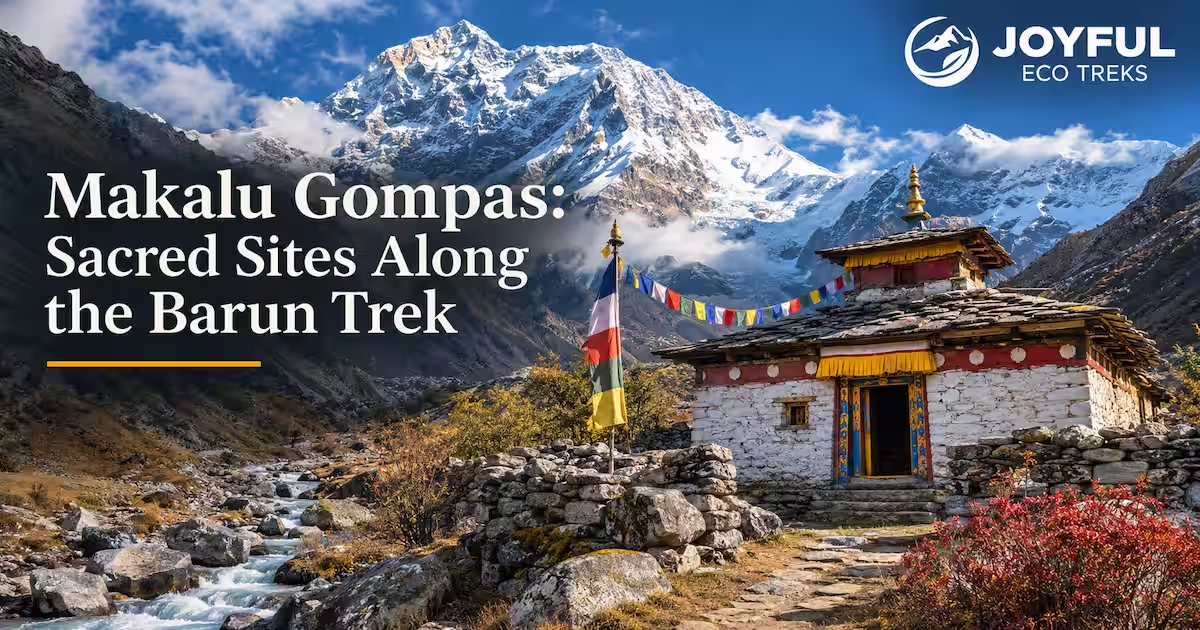
Walk the Makalu Base Camp route from Num and you pass Buddhist sacred objects for days before anyone explains them. A mani wall here, a whitewashed chorten on a pass there, a locked prayer hall in a Sherpa village. The Makalu gompas and the shrines strung along the Barun Valley are the least-documented Buddhist sites on any major Nepal trek, and that is not an accident of neglect. This guide maps them by trail position, names the tradition behind each, and tells you what you will actually find when you arrive.
Why Makalu's Gompas Stay Off the Record
Three agency itineraries will name "Tashigaon Gompa" in a single line, then move straight to the altitude profile. None tells you its tradition, whether a monk is inside, or how it relates to the shrine you passed an hour earlier. The reason is footfall. The Makalu-Barun region draws a fraction of the traffic that floods Everest or Annapurna, so the thick layer of blog coverage that normally forms around a popular trail never accumulated here.
The access rules thin the crowd further. Since 31 March 2023, trekkers on the Makalu Base Camp route have been required under the Nepal Tourism Board's published rules to travel with a licensed guide and an agency-issued TIMS card. Fewer independent walkers mean fewer people photographing a side-valley shrine and writing it up afterwards.
So here is what the following sections map: reported gompas, temples, mani walls, and chortens on the standard route, with its altitude, its trail day from Num, and an honest indication of whether religious activity or visitor access has been confirmed.
The Barun Valley Is a Beyul, and That Frames Every Site
One idea has to come first, because without it the sites look random. In the Nyingma school of Tibetan Buddhism, the oldest of the four Tibetan schools and the lineage traced to Guru Padmasambhava in the 8th century, certain Himalayan valleys are beyul: hidden lands that Padmasambhava is said to have consecrated as refuges for times of crisis. The Barun is one of them. Its beyul name is Khembalung, counted alongside Rolwaling, Rongshar, and Nubri in the classic cluster of Himalayan hidden valleys.
That status is the theological map under the physical one. A beyul is not scattered with sacred objects at random; the mani walls, chortens, and prayer-flag lines read as a consecrated landscape, markers on ground already understood as holy. For a culturally curious trekker, the beyul is the reason behind every object the trail throws at you, not just a label for it.
The Sherpa communities of the Barun follow this same Nyingma tradition, and one feature of it shapes what you will see. Nyingma allows spiritual authority to rest with married householder lamas, not only with celibate monastics. A hamlet too small to support a monastery can still run a working prayer hall led by a layman. That is precisely why some Makalu gompas have no resident monk and are nonetheless plainly in use.
One caution on the beyul story. The most sacred Khembalung cave sits at roughly 2,210m in a separate drainage, near the Arun and Choyang confluence, well off the standard Barun trekking line. The beyul concept blankets the whole region, but the famous pilgrimage caves are not waypoints on the Makalu Base Camp walk. Do not plan your days expecting to reach them.
Gompas on the Lower Makalu Approach: Num to Tashigaon
Num, the usual trailhead at 1,497m in Sankhuwasabha District, gives you a steep drop to the river and an equally steep climb to Seduwa. Seduwa sits at around 1,500m and is where your permits get checked. Search snippets describe a small village gompa here, but no reliable source confirms its size or whether anyone tends it, so treat Seduwa as a gateway rather than a confirmed gompa stop.
Tashigaon is the real anchor of the lower route. At roughly 2,070 to 2,100m and about two walking days from Num via Seduwa on the standard route, it is the last permanent settlement before the trail climbs past the treeline. A small gompa is reported near Ropesa on the approach to Tashigaon, but the building's current access arrangements and resident religious life have not been independently confirmed. Budget time here if you want to ask your guide about visiting a local prayer room, but do not assume it will be open.
Between the villages, the trail keeps its own quiet liturgy. Mani walls, long low stone banks carved with the om mani padme hum mantra, sit at the path's centre so that walkers split around them. Keep them on your right. Passing a mani wall or chorten clockwise is the single most-watched piece of etiquette on the trail, and your guide will steer you without comment the first time you drift to the wrong side.
Mapping Every Makalu Gompa and Shrine by Trail Day
The Makalu gompas and sacred sites sort into three honest categories. First, reported village gompas whose religious use and visitor access may vary, including a small gompa on the approach to Tashigaon. Second, structures associated with upper-valley communities, whose use and access may change with the season. Third, fixed markers, the mani walls, chortens, and prayer-flag poles that need no human presence at all to do their work.
Hold that taxonomy next to the altitudes and the picture turns practical:
Site | Altitude | Trail day from Num | Type | What to expect |
|---|---|---|---|---|
Seduwa gompa | ~1,500m | Day 1–2 | Reported site | Existence and access unverified |
Ropesa/Tashigaon-area gompa | ~2,070–2,100m | Day 2 from Num | Reported small gompa | Location and access: ask locally |
Khongma La sacred markers | ~3,873m | Above Tashigaon | Reported trail markers | Exact structures unverified |
Ghungru La sacred markers | ~4,055m | Upper route | Reported trail marker | Specific chorten unverified |
Shipton La sacred markers | ~4,220m | Upper route | Reported trail marker | Exact structures unverified |
Yangle Kharka gompa | ~3,634m | Around Day 5 from Num | Documented gompa site | Older gompa lost in 2017 flood; check access |
Shiva Dhara caves | ~4,310m | Side trip from Yangle Kharka | Hindu-Buddhist pilgrimage | Seasonal pilgrimage, not a gompa |
Two rows in that table deserve a flag. Yangle Kharka has a documented gompa history: an older building was destroyed by the April 2017 flood, while a newer gompa built in 2014 reportedly survived. Its current condition, religious use and visitor access should be checked locally. Shiva Dhara, the most-written-about sacred site above Yangle Kharka, with its caves and waterfall, is a Hindu-Buddhist pilgrimage site rather than a Nyingma gompa; Shrawan (roughly mid-July to mid-August) is a traditional pilgrimage period, which lands squarely inside the monsoon when most trekkers stay away.
Above Yangle Kharka, be honest with yourself about what remains. Available documentation reviewed for this guide does not establish a named, active gompa farther up the standard Barun route. The sacred presence at that elevation is the beyul landscape itself, plus informal shrines and cairns, not monastic architecture. If you are climbing toward base camp hoping for one more monastery, ask a local guide rather than counting on one.
What an Active Makalu Gompa Actually Holds
If you are invited inside a local gompa, the Nyingma vocabulary may become tangible. Thangkas, the painted scroll images of deities and lineage figures, can hang on the walls. Butter lamps may burn before a shrine. Murals, ritual drums and texts are also found in Himalayan Buddhist prayer halls, though these features have not been verified for a particular hall at Tashigaon. Village prayer halls can be modest working spaces, not tourist cathedrals.
The building only tells half the story, because a gompa comes fully alive on its festival days. Losar, the Sherpa and Tibetan New Year, runs as a 15-day observance falling somewhere between late January and mid-March on the lunar calendar. In some Sherpa communities, ceremonies can include chanting and Cham masked dances, but these have not been verified at Tashigaon. Dumji, associated with Guru Padmasambhava in Sherpa communities, may include days of ritual and masked dance where it is observed. Ask your guide about the local calendar before planning a trek around a ceremony.
How to Visit Makalu Monasteries Without Causing Offence
Circumambulate clockwise. Every mani wall, every chorten, and the gompa building itself is walked around with the structure on your right. This one habit covers most of the etiquette you need, and it applies even to the solitary chorten on a windswept pass where no one is watching.
At a gompa threshold, remove your boots and your hat, lower your voice, and wait. Do not stride into a prayer hall as though it were a viewpoint. If a lama or caretaker is present, catch their eye and ask before entering, then ask again before photographing anything inside: many halls allow outside shots but not images of the shrine or the texts. A small cash donation left discreetly near the altar, rather than handed over with ceremony, is the customary thank-you and goes toward lamps and upkeep. If no one is there, as will often be the case at these Makalu Barun monasteries, look, pay your quiet respect, and leave everything as you found it.
Permits, Timing, and Finding the Sites Without Getting Lost
Get the permit name right before you pay for anything. The current requirement is the Makalu Barun National Park Entry Permit, NPR 3,000 for foreign nationals and NPR 1,500 for SAARC nationals per Nepal Tourism Board current rates, plus an agency-issued TIMS card at NPR 2,000 for non-SAARC trekkers or NPR 1,000 for SAARC trekkers. There is no separate "MCAP permit" despite the acronym circulating on booking pages: MCAP refers to the Makalu-Barun Conservation Project launched in 1988, which predated the national park's designation in 1992. The park now protects roughly 2,330 km², a 1,500 km² core wrapped in an 830 km² buffer. Carry both documents for inspection at checkpoints; the DNPWC brochure describes the park permit as valid for a single entry, not as having unlimited validity. Fees do get revised, and additional local or restricted-area permits may apply depending on the precise route, so confirm the current set with your agency before departure.
Timing decides whether you meet anyone. Pre-monsoon (roughly March to May) and post-monsoon (late September to November) are the trekking windows, and they bracket the harsh winter when upper-valley families and their seasonal structures clear out. For ceremonial life rather than empty halls, ask a local guide which ceremonies are actually observed; Losar dates alone do not guarantee access to a gompa or festival at Tashigaon. The upper Barun's seasonal sites are a summer-grazing phenomenon, awkwardly out of phase with the clearest trekking weather.
The 2023 guide mandate turns out to be the quiet asset here. A licensed local guide (reckon on USD 25 to 40 a day) is not just a bureaucratic box to tick; they know which side valley holds a herders' shrine, whether a local caretaker or lama is available this week, and how to ask for entry in the right register. For the off-trail and seasonal sites, that knowledge is the whole difference between walking past a place and being let into it.
One correction worth carrying with you: if you have read about "Thubten Choling Gompa" in Barun Valley travel content, set it aside. That large Nyingma monastery sits near Junbesi in Solu-Khumbu, well away from the standard Makalu Base Camp route, and it is sometimes confused with sites on this trek. You will not pass it on this route.
Treat the Makalu gompas as what they are: a thin, honest scatter of living and dormant sacred sites across a consecrated valley, with reported gompas around the Tashigaon approach and increasingly elemental as you climb. Once you know which tier you are standing in front of, the Barun Valley Buddhist temples stop looking random and start reading as a map.
Planning the Makalu Base Camp trek itself? Our complete Makalu-Barun trekking guide covers permit logistics, route options, and what to pack for the approach.
FAQs
Are the gompas in the Makalu region open to trekking visitors?
Not always. A small gompa is reported near Ropesa on the approach to Tashigaon, but its visitor access and religious activity are not confirmed; mani walls and chortens along the trail can generally be viewed respectfully from outside. Remove your boots at a prayer-hall threshold, ask before entering or photographing, and walk every structure clockwise.
Do you need a local guide to find the smaller gompas and shrines in the Barun Valley?
For practical purposes, yes. Under Nepal Tourism Board's published rules, a licensed guide has been required for the Makalu Base Camp route since 31 March 2023, and that same guide is what makes the off-trail and seasonal shrines findable at all. Many upper-valley sites are unmarked on maps, and local knowledge is the only reliable way to reach them.
What Buddhist tradition do the Sherpa monasteries in the Makalu area follow?
The Nyingma school of Tibetan Buddhism, the oldest of Tibet's four schools, traditionally associated with Guru Padmasambhava's teachings in the 8th century. Nyingma has a strong influence in Sherpa Buddhism, though the lineage of every prayer hall along this route has not been verified, and it permits both celibate monks and married householder lamas to lead rituals.
Can trekkers stay overnight at any gompa on the Makalu route?
Do not plan on it. Gompas on this route should not be treated as regular trekking accommodation, and no overnight arrangements have been verified for these sites. You sleep in teahouses or on camping arrangements organised through your agency, then visit a gompa during the day before moving on to your booked accommodation.
When are monks most likely to be in residence at Makalu region monasteries?
There is no verified schedule of resident monks or ceremonies at the reported gompa near Tashigaon. Losar can be an important period for Sherpa Buddhist communities, but chanting, masked dances or access at this particular site should not be assumed; ask a local guide or caretaker before planning a visit.