
Scenic Annapurna Base Camp Trek
Annapurna, Gandaki Province, Nepal
Group size
1–16 trekkers (Private & Small Group)
Overview
Most trekkers reach Annapurna Base Camp through a direct sanctuary approach. The 12-day Annapurna Base Camp trek takes a different path, starting through the classic Ghandruk village route and giving trekkers a deeper look at the landscapes, culture, and trails that make this region special.
The itinerary climbs steadily through Chhomrong, Dovan, Deurali, and Machhapuchhre Base Camp before reaching Annapurna Base Camp (4,130m / 13,550 ft). The journey back down includes a relaxing stop at Jhinu Hot Springs, giving the 12-day itinerary a comfortable finish after reaching ABC.
Trip Info
- Trek Starts at
- Syauli Bazar
- Trek Ends at
- Jhinu Danda
- Destination
- Annapurna, Gandaki Province, Nepal
- Trekking Distance
- Approx. 80 to 95 km / 50 to 59 miles, depending on road conditions and side hikes
- Activity
- Trekking, Hiking
- Difficulty
- Moderate to Strenuous
- Best Season
- Spring (Mar to May), Autumn (Sep to Nov)
- Maximum Altitude
- Annapurna Base Camp (4,130m / 13,550 ft)
- Daily Walking Hours
- 4 to 7 hours
- Trek Permits
- Annapurna Conservation Area Permit (ACAP), TIMS (Trekkers' Information Management System)
- Accommodation
- Hotel in Kathmandu and Pokhara + Teahouses during the trek
- Meals
- Breakfast, Lunch, and Dinner during the trek
- Guide & Porters
- Government-licensed guide, 1 porter per 2 trekkers

Why the 12-Day Annapurna Base Camp Trek?
Shorter itineraries often push trekkers quickly through the sanctuary approach, which can make the climb feel rushed and increase altitude fatigue. This 12-day Annapurna Base Camp Trek gives you a steadier pace by starting through Ghandruk, where you can enjoy stone paths, local houses, Gurung culture, and mountain views.
The route then continues through Chhomrong, Bamboo, Dovan, Deurali, and Machhapuchhre Base Camp before reaching Annapurna Base Camp at 4,130m / 13,550ft. On the return, you descend through Bamboo and stop at Jhinu Danda, where the natural hot springs give your legs a relaxing break before the drive back to Pokhara.
Trek Highlights
- Scenic hike from Syauli Bazar to Ghandruk, a classic Gurung village with wide views of Annapurna South and Machhapuchhre.
- Cultural walk through Ghandruk with traditional houses, stone-paved lanes, mountain views, and local village life.
- Trek through Chhomrong, the last major village before entering the deeper Annapurna Sanctuary route.
- Peaceful trail through rhododendron and bamboo forests along the Modi Khola valley.
- Close-up views of Machhapuchhre from Machhapuchhre Base Camp before continuing toward ABC.
- Reach Annapurna Base Camp (4,130m / 13,550 ft), surrounded by Annapurna I, Annapurna South, Hiunchuli, Machhapuchhre, and nearby Himalayan peaks.
- Relaxing return through Bamboo and Jhinu before driving back to Pokhara.
Tour Plan
Day 01Arrive in Kathmandu
As soon as you land at Tribhuvan International Airport, our representative team meets you at the arrival terminal. They assist with your bags and drive you straight to the hotel via a private vehicle. After checking in, take some well-deserved time to freshen up, rest, and shake off your international flight.
In the evening, head out to the Thamel area for a short walk. Our team also runs a quick trip briefing and gear check to make sure everything is ready before the drive to Pokhara the next morning.
- Trip duration: 25 to 30 minutes taxi ride from the airport to your hotel
Note: Do not miss the trek briefing and gear check with the guide.
Day 02Drive from Kathmandu to Pokhara (822m / 2,696ft) | 6 to 7 hrs
After a hot breakfast, you leave Kathmandu and drive west toward Pokhara along the Prithvi Highway. The road follows the Trishuli and Marsyangdi river valleys through terraced hills and small towns, with short stops along the way for tea and stretching.
By late afternoon, you arrive in Pokhara and check into a hotel. The evening is free for rest, a walk along the Lakeside strip, sunset views over Phewa Lake, and final preparation before the first trekking day.
- Drive duration: 6 to 7 hours
- Drive distance: 200 km / 124 miles
- Maximum altitude: 1,350m / 4,429ft
- Elevation loss: -528m / -1,732ft
Note: The drive can take longer due to traffic, roadwork, or weather, so keep water and light essentials in your day bag.
Day 03Drive from Pokhara to Syauli Bazar (1,220m / 4,003ft); Trek to Ghandruk (1,940m / 6,365ft) | 5 to 7 hrs
The day starts early from Pokhara with a drive through rolling hills and rural valley settlements to Syauli Bazar. This is where the vehicle transfer ends, and the walking journey officially begins.
From Syauli Bazar, the path climbs through forest sections, stone steps, and small settlements before reaching Ghandruk. This Gurung village sits at 1,940 meters (6,365 feet), with wide views of Annapurna South, Hiunchuli, and Machhapuchhre on a clear day.
- Drive duration: 1.5 to 2 hours
- Drive distance: Approx. 45 km / 28 miles
- Trek duration: 4 to 5 hours
- Trek distance: Approx. 8 km / 5 miles
- Maximum altitude: 1,940m / 6,365ft
- Elevation gain: +1,118m / +3,668ft
Day 04Trek from Ghandruk to Chhomrong (2,170m / 7,119ft) | 4 to 5 hrs
After breakfast in Ghandruk, you leave the village and start walking toward Chhomrong. This day’s route offers a classic Himalayan ridge walk, weaving through quiet forest paths, small farming patches, and mountain cuts.
The walk has both uphill and downhill parts, so your pace stays steady throughout the day. After reaching Chhomrong, you settle into a local teahouse and rest before continuing deeper into the Annapurna Base Camp route the next morning.
- Trek duration: 4 to 5 hours
- Trek distance: Approx. 6 km / 3.7 miles
- Maximum altitude: 2,170m / 7,119ft
- Elevation gain: +230m / +755ft
Note: Permits are checked at Chhomrong. Keep your ACAP permit and TIMS ready.
Day 05Trek from Chhomrong to Dovan (2,600m / 8,530ft) | 5 to 6 hrs
From Chhomrong, the trail drops steeply on stone steps to the Chhomrong Khola river. After crossing the bridge, you climb toward Sinuwa, a small teahouse settlement with open valley views and a quieter mountain setting.
From Sinuwa, the route enters thick bamboo and rhododendron forest along the Modi Khola valley. The path passes through Bamboo, a peaceful riverside stop, before continuing to Dovan, where the cool forest, shaded trail, and sound of the river make the walk feel calm and refreshing.
- Trek duration: 5 to 6 hours
- Trek distance: Approx. 6 km / 3.7 miles
- Maximum altitude: 2,600m / 8,530ft
- Elevation gain: +430m / +1,411ft
Note: Trail sections are damp and slippery. Watch your footing on the stone steps and river crossings.
Day 06Trek from Dovan to Deurali (3,200m / 10,499ft) | 5 to 6 hrs
You leave Dovan and follow the Modi Khola valley through a dense bamboo and rhododendron forest. As you move higher, the route becomes quieter and cooler, with shaded paths, small streams, and narrow forest sections along the way.
On the way, you reach Himalaya, a small teahouse stop where you take a short rest before continuing toward Deurali. From there, the trail moves into a more rugged mountain setting with rocky paths, steep cliffs, and colder air before reaching Deurali.
- Trek duration: 5 to 6 hours
- Trek distance: Approx. 8 km / 5 miles
- Maximum altitude: 3,200m / 10,499ft
- Elevation gain: +600m / +1,969ft
Note: Permits are checked at Chhomrong. Keep your ACAP permit and TIMS ready.
Day 07Trek from Deurali to Annapurna Base Camp (4,130m / 13,550ft) | 5 to 6 hrs
Today is the main day of the trek. Leaving Deurali, you enter the higher and more open part of the Annapurna Sanctuary. The route follows the Modi Khola valley through rocky ground, colder air, and glacier-fed streams as you move closer to Machhapuchhre Base Camp.
You first reach Machhapuchhre Base Camp, a scenic stop below the Fishtail peak. From MBC, the final section to Annapurna Base Camp feels wide and dramatic, with Annapurna South, Hiunchuli, Machhapuchhre, Gangapurna, and nearby peaks rising around the valley.
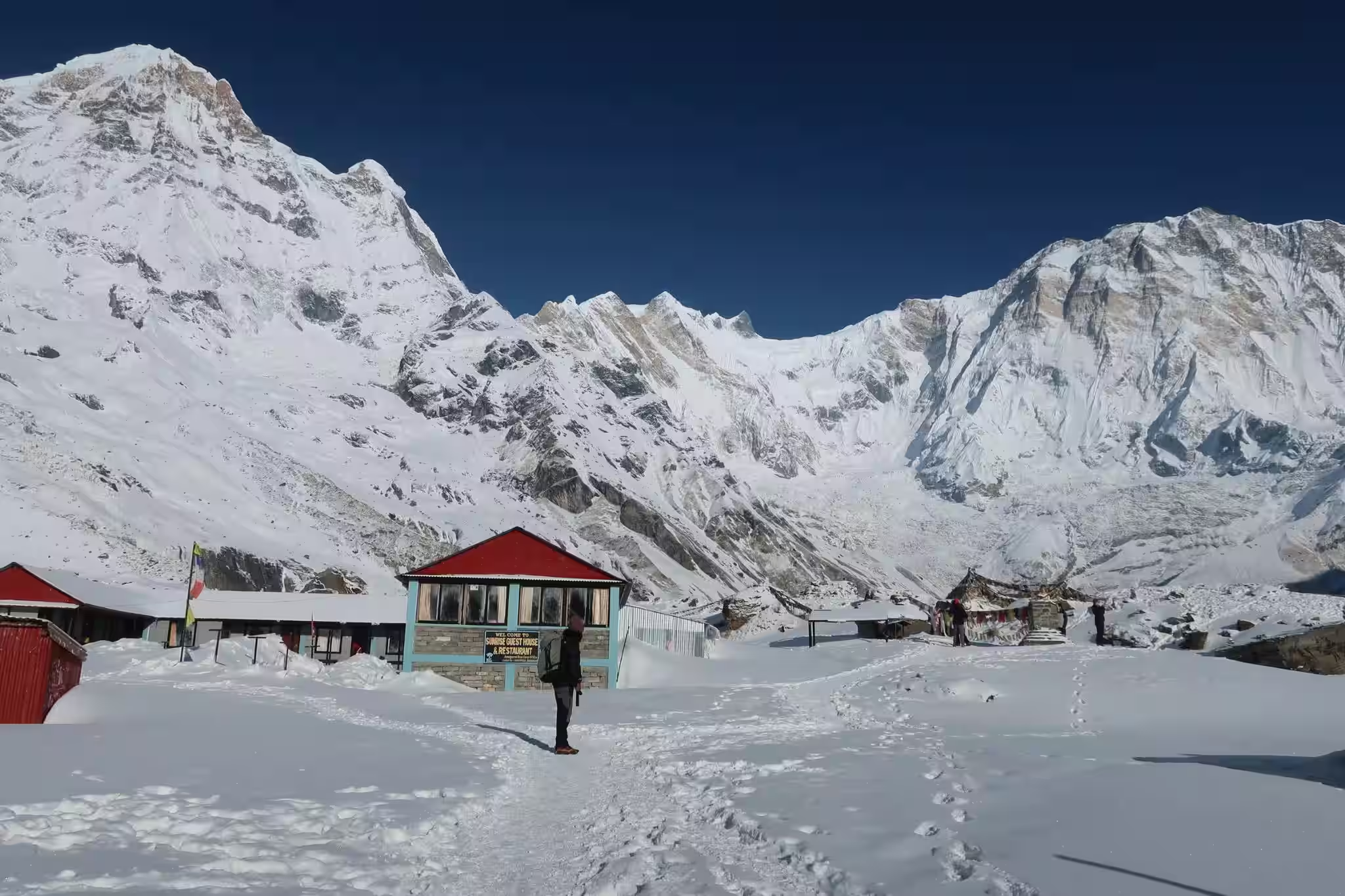
At Annapurna Base Camp, you reach the highest point of the trek at 4,130m / 13,550ft. The base camp sits inside a natural mountain bowl, surrounded by a full circle of Himalayan peaks, making this the most rewarding day of the journey.
- Trek duration: 5 to 6 hours
- Trek distance: 8 to 10 km / 5 to 6.2 miles
- Maximum altitude: 4,130m / 13,550ft
- Net Elevation gain: +930m / +3,050ft
Note: Walk slowly after Deurali, drink enough water, and keep your warm layers ready for the cold evening at base camp.
Day 08Trek from Annapurna Base Camp to Bamboo (2,345m / 7,694ft) | 7 to 8 hrs
You start early from ABC to catch the morning mountain views before heading down. The route drops back through MBC and continues toward Deurali, retracing the open sanctuary section before the valley narrows again.
As you drop quickly in altitude, the landscape changes within a few hours. Trees return, the air grows warmer, and the steep alpine terrain turns into shaded forest paths. You pass familiar stops and continue through bamboo sections until you reach Bamboo, a quiet riverside settlement.
- Trek duration: 7 to 8 hours
- Trek distance: 14 to 15 km / 8.6 to 9.3 miles
- Maximum altitude: 4,130m / 13,550ft
- Net Elevation loss: -1,785m / -5,856ft
Note: Use trekking poles during the descent, as the long downhill walk puts pressure on your knees.
Day 09Trek from Bamboo to Jhinu Danda (1,700m / 5,577ft) | 5 to 6 hrs
After a long descent from Annapurna Base Camp to Bamboo, the journey continues toward Jhinu Danda. The route leaves the quiet forest around Bamboo and moves through familiar sections of the Annapurna Base Camp route, with stone steps, village paths, and shaded forest along the way.
This day feels gentler than the long descent from ABC, with warmer air, greener hillsides, and more signs of village life along the route. By the time you reach Jhinu Danda, the natural hot springs beside the Modi Khola river are only a short walk away. Here, you can also enjoy warm water and give your tired legs a relaxing break after several days of trekking.
- Trek duration: 5 to 6 hours
- Trek distance: 11 to 12 km / 6.8 to 7.4 miles
- Maximum altitude: 2,345m / 7,694ft
- Elevation loss: -645m / -2,116ft
Note: Carry sandals and a small towel for the hot springs at Jhinu Danda.
Day 10Drive from Jhinu Danda to Pokhara (822m / 2,696ft) | 3 to 4 hrs
After breakfast at Jhinu, your journey continues by road toward Pokhara. The drive leaves the Annapurna foothills and follows rural roads through river valleys, terraced hillsides, small villages, and green landscapes.
As you get closer to Pokhara, the trekking route slowly gives way to rural roads, terraced fields, and lower hillside villages. After reaching the city, you check into your hotel and take the rest of the day to rest, walk around Phewa Lake, or enjoy a relaxed evening in Lakeside after completing the Annapurna Base Camp route.
- Drive duration: 3 to 4 hours
- Drive distance: Around 40 km / 25 miles
- Maximum altitude: 1,700m / 5,577ft
- Elevation loss: -878m / -2,881ft
Note: Road conditions affect the drive time, especially during or after rainfall.
Day 11Drive from Pokhara to Kathmandu (1,395m / 4,577ft) | 6 to 8 hrs
You leave Pokhara after breakfast and drive back to Kathmandu. After several days in the Annapurna foothills, the return journey gives you time to rest, look back on the trek, and enjoy the changing scenery along the highway.
After reaching Kathmandu, you check into your hotel and relax after the long drive. In the evening, our team hosts a farewell dinner to celebrate the completion of your 12-day Annapurna Base Camp Trek before your final departure the next day.
- Drive duration: 6 to 8 hours
- Drive distance: Around 200 km / 124 miles
- Maximum altitude: 1,395m / 4,577ft
- Elevation gain: +573m / +1,880ft
Note: Keep your important documents, valuables, water, and light snacks in your day bag during the drive.
Day 12Final Departure from Kathmandu
Your final morning in Kathmandu is kept easy and flexible. Depending on your flight schedule, you can rest at the hotel, pack your bags, or take a short walk around Thamel for last-minute shopping.
Our team will pick you up from your hotel and transfer you to Tribhuvan International Airport by private vehicle. With the airport drop-off, your Annapurna Base Camp Trek officially comes to an end.
- Drive duration: 25 to 30 minutes
Note: Reach the airport at least 3 hours before your international flight.
What’s Included & Excluded
Cost Includes
- Airport pickup and drop-off service
- Kathmandu hotel (3-star) for 2 nights
- Pokhara hotel accommodation as per the package
- Kathmandu to Pokhara and return trip by private vehicle as per the package
- All standard meals during the trek: breakfast, lunch, and dinner
- Government-licensed English-speaking trekking guide
- Tea house accommodation during the trekking days
- Annapurna Conservation Area Permit (ACAP)
- Trekkers Information Management System (TIMS) Card
- Basic first aid kit
- Trip completion certificate
- Farewell dinner on the last night in Kathmandu
- Duffel/kit bag, trekking map, sun hat, and neck gaiter
Cost Excludes
- International flights to/from Nepal
- Nepal visa fees
- Travel insurance with emergency evacuation coverage
- Personal trekking gears and equipment
- Drinks, boiled/bottled water, and extra teahouse costs
- Wi-Fi, charging, hot showers, laundry, and other personal services
- Any extra nights in Kathmandu, Pokhara, or on the trail
- Extra costs caused by weather, road delays, landslides, illness, or personal schedule changes
- Costs for rescue or evacuation
- Any service not mentioned in the Cost Includes section
Packing List for Annapurna Base Camp Trek
The Annapurna Base Camp Trek takes you from warm lower villages to colder areas near Machhapuchhre Base Camp and Annapurna Base Camp. Pack light, but carry the right layers and essentials for changing weather, long walking days, and basic teahouse stays.
Luggage & Porter Guidelines6 items
- Duffel bag or large rucksack, 60L to 70L
- Daypack, 25L to 35L
- Rain cover for daypack
- Waterproof liner or dry bag
- Extra luggage storage in Kathmandu
- Porter weight limit: around 24 kg in total
Clothing8 items
- Moisture-wicking trekking T-shirts, 3 to 4 pairs
- Thermal tops and bottoms, 2 pairs
- Fleece jacket or warm pullover
- Long-sleeve trekking shirts, 2 pairs
- Trekking pants, 2 pairs
- Down jacket with hood
- Waterproof and windproof jacket and pants
- Comfortable innerwear, 4 to 6 pairs
Head, Hands & Face7 items
- Sun hat or cap
- Warm beanie or woolen hat
- Neck gaiter or buff
- Face mask or light scarf for dusty road sections
- Lightweight inner gloves
- Warm windproof or waterproof gloves
- UV-protection sunglasses
Medical Kit10 items
- Personal medicines
- Diamox (to prevent and treat altitude sickness), only after doctor’s advice
- Pain relief tablets
- Anti-diarrheal medicine
- Rehydration salts or electrolyte tablets
- Blister pads or moleskin
- Band-aids and medical tape
- Antiseptic wipes
- Muscle rub or anti-inflammatory cream
- Tweezers
Snacks & Money8 items
- Energy bars
- Nuts or chocolate
- Electrolyte powder
- Cash in Nepali rupees
- Passport copy
- Travel insurance copy
- Emergency contact details
- Zip-lock bags or dry bags for small items
General Trekking Gear8 items
- Four-season sleeping bag, rated to around -10°C to -15°C
- Sleeping bag liner, optional
- Trekking poles
- Water bottles or hydration bladder, at least 2L capacity
- Dry bags or zip-lock bags
- Water purification tablets, drops, or a filter
- Trekking map, if provided by our team
- Small lock for a duffel bag
Footwear & Socks5 items
- Broken-in waterproof hiking boots
- Camp shoes, sneakers, sandals, or Crocs
- Trekking socks, 4 to 5 pairs
- Warm wool socks for sleeping
- Gaiters, optional for snow or muddy trails
Electronics6 items
- Headlamp with extra batteries or a charging cable
- Power bank, 20,000mAh or higher
- Travel adapter
- Phone and charging cable
- Camera, optional
- Extra memory card, optional
Toiletries & Personal Care10 items
- Sunscreen, SPF 50+
- Lip balm with SPF
- Wet wipes
- Quick-dry towel
- Hand sanitizer
- Toilet paper, 2 rolls
- Toothbrush and toothpaste
- Soap or body wash
- Moisturizer
- Small shampoo bottle or sachets
Route Map & Seasonal Conditions
October: Ideal / Peak Season
The best month of the year: warm sunny days, crystal-clear views of the Annapurna Sanctuary, and cold but manageable nights.
| Route stop | Elevation | Day | Night |
|---|---|---|---|
| Kathmandu | Elevation1,400 m | Day20–28°C | Night12–16°C |
| Pokhara | Elevation822 m | Day22–28°C | Night15–18°C |
| Ghandruk | Elevation1,940 m | Day16–20°C | Night5–9°C |
| Chhomrong | Elevation2,170 m | Day15–19°C | Night4–8°C |
| Dovan | Elevation2,600 m | Day10–15°C | Night2–6°C |
| Deurali | Elevation3,200 m | Day8–14°C | Night0–4°C |
| Machhapuchhre Base Camp | Elevation3,700 m | Day5–10°C | Night-3–1°C |
| Annapurna Base Camp | Elevation4,130 m | Day4–9°C | Night-8–-5°C |
| Bamboo | Elevation2,345 m | Day10–15°C | Night2–6°C |
| Jhinu Danda | Elevation1,700 m | Day17–23°C | Night8–12°C |
Temperatures are broad seasonal estimates, not forecasts. Actual conditions vary with wind, cloud, snowfall, and local weather.
Good to Know Before You Go
Seasons & weather
The best time for the Annapurna Base Camp Trek is during spring and autumn. Spring, from March to May, brings mild daytime weather, blooming rhododendron forests, and comfortable walking conditions on the lower trails. Autumn, from September to November, comes after the monsoon, so the skies are often clearer, the trails are drier, and the views of mountains and nearby peaks are usually at their best.
Winter is also possible for trekkers who are ready for cold weather, but the upper sections near Deurali, MBC, and ABC have snow or icy trails. Monsoon is usually the least suitable time because heavy rain makes stone steps slippery, forest trails muddy, and road travel less reliable.
Teahouses & meals
Accommodation on the Annapurna Base Camp Trek is comfortable in Kathmandu and Pokhara, while it is more basic during the trekking days. You stay in a local teahouse/guesthouse along the trail. Rooms usually contain basic single/sharing beds, blankets, and shared toilets.
Meals are simple but filling. Common food options include dal bhat, noodles, fried rice, soup, potatoes, pasta, eggs, tea, coffee, and seasonal local dishes. However, food choices become more limited in higher stops like Deurali, Machhapuchhre Base Camp, and Annapurna Base Camp.
Carry light snacks such as energy bars, nuts, chocolate, or electrolyte powder. They are useful on longer sections, especially between Deurali and ABC and on the descent toward Bamboo.
Fitness & altitude
The Annapurna Base Camp Trek is moderate to strenuous. You do not need proper climbing skills. But you need good fitness, steady legs, and the ability to walk for several hours on uphill trails, downhill stone steps, and high mountain terrain.
The highest point is Annapurna Base Camp at 4,130m or 13,550ft. Cold weather, tired legs, and thinner air can make the upper section more demanding. Walking at a controlled pace, drinking enough water, and following your guide’s advice help make the trek safer and more comfortable.
This trek is a good match for prepared first-time trekkers and regular hikers who want a classic Himalayan trail with villages, forests, hot springs, and close mountain views.
Ready to Walk into the Annapurna Sanctuary?
Tell us your travel dates, group size, and trekking experience. Our local team will help you shape a comfortable 12-day Annapurna Base Camp Trek with clear support for permits, transport, pacing, meals, and teahouse stays.
Scenic Annapurna Base Camp Trek
Frequently Asked Questions
Practical answers about the Ghandruk route to ABC, difficulty, and planning.
Is the Annapurna Base Camp Trek difficult?
Yes, the Annapurna Base Camp Trek is moderately difficult because it includes stone stairs, uphill climbs, downhill trails, forest paths, and high-altitude walking. You do not need climbing skills, but you should be ready to walk for several hours a day with steady energy. Regular walking, stair climbing, and light cardio before the trip help you enjoy the trek with less strain.
Is ABC a beginner-friendly trek?
Yes, ABC is beginner-friendly for fit first-time trekkers who prepare well before the trip. The trail is not technical, but the repeated climbs, long descents, and changing altitude make it physically demanding. A guided trek is a better choice for beginners because the guide helps with pacing, route planning, and daily trail support.
Is the ABC Trek risky?
No, the ABC Trek is not highly risky when you trek in the right season, follow a safe pace, and travel with a licensed guide. The main challenges are altitude, cold weather, slippery stone steps, and sudden weather changes near higher sections. Travel insurance with emergency evacuation coverage is still important because mountain conditions are not always predictable.
Can you do the ABC Trek in 5 days?
Yes, you can do the ABC Trek in 5 days from Pokhara, but it is a fast-paced option. It suits experienced trekkers with good fitness because the route includes longer walking days and quicker altitude gain. So, the plan should be made carefully. Contact our trekking team or send us an inquiry with your travel dates, group size, and trekking experience. We will help create a custom Annapurna Base Camp Trek itinerary that fits your schedule.
Is Annapurna Base Camp worth it?
Yes, Annapurna Base Camp is worth it if you want close Himalayan views, changing landscapes, and a classic trekking experience. The route takes you through Gurung villages, forest trails, river valleys, and the Annapurna Sanctuary before reaching a base camp surrounded by a dramatic mountain setting.
Can you see Everest from Annapurna Base Camp?
No, Mount Everest is not visible from Annapurna Base Camp. Everest lies in eastern Nepal, while Annapurna Base Camp is in west-central Nepal. Instead, ABC gives you close views of Annapurna I, Annapurna South, Hiunchuli, Gangapurna, and Machhapuchhre. These mountains surround the base camp and create the dramatic scenery that makes the trek famous.
Which is easier, ABC or EBC?
ABC is generally easier than EBC because it reaches a lower altitude and usually takes fewer trekking days. Annapurna Base Camp stands at 4,130m / 13,550ft, while Everest Base Camp stands at 5,364m / 17,598ft. Even so, ABC still requires good fitness because the route includes steep climbs, long stone stair sections, and several hours of walking each day.
How many stairs are there on the ABC Trek?
There is no fixed official stair count on the ABC Trek. However, the route has many long stone stair sections, especially around Ghandruk, Chhomrong, Sinuwa, Bamboo, and Jhinu Danda. These sections can feel tough on your knees during both climbs and descents.
How should you prepare for the Annapurna Base Camp Trek?
Prepare for the Annapurna Base Camp Trek by building stamina with regular walking, uphill hikes, stair climbing, and light strength training. You should also break in your trekking boots before the trip to avoid blisters and foot pain. Since the trail has repeated climbs and descents, strong legs and steady pacing matter more than walking fast.